Why I Don’t Give a Sh*t About the White House Egg Roll

Apparently, it is a long-standing yearly tradition for the sitting President of the United States to invite thousands of American children and their families to celebrate Easter with an “egg roll” on the White House lawns. I suspect the reason I didn’t know about this tradition until this year is because I am Canadian, most of my friends are Canadian, and it really doesn’t matter to us or to the global community at large HOW the current POTUS chooses to celebrate Easter. (As long as they aren’t, you know, dropping bombs and missiles on Middle Eastern countries with no clear sense of foreign policy or military strategy or baiting North Korea on Twitter or doing some other highly crazy thing that would spell disaster for us all).

But this year, I do know about the White House egg roll, and the reason I know about the White House egg roll is because progressive/left-leaning media articles shared by progressive/left-leaning friends on my social media feeds have gleefully devoted many words to describing the Trump White House’s failure to adequately prepare for the event. More than one outlet has quoted Melinda Bates (former egg roll planner for Bill Clinton’s administration) and her comments in the New York Times: “[The egg roll is] the single most high-profile event that takes place at the White House each year, and the White House and the first lady are judged on how well they put it on” (emphasis mine), or otherwise made a point of mentioning that the annual egg roll is a reflection on the current First Lady, and through her, on her husband’s administration.

Mmkay.

Now, there are plenty of very VERY good reasons to have a problem with the Trump administration, and, perhaps contrary to an earlier blog post of mine, there are also lots of reasons to specifically have a problem with First Lady Melania (her plagiarism of Michelle Obama’s speech at the Republican National Convention, her hypocritical support for her husband’s anti-immigrant and anti-woman policies, and her refusal to move into the White House [at a cost of millions of dollars to U.S. taxpayers, who must now pay extra to secure the Trump’s New York City penthouse], for example).

But there’s Real News, Fake News, and then there’s distracting bullshit that really shouldn’t be news at all, ESPECIALLY among so-called “progressive” media and critical media consumers. Apparently, we are having so much fun mocking the Trumps for their every misstep that we’re willing to reinforce what I had hoped was now merely an antiquated sexist notion—the idea that the success of a man’s enterprise depends on, and is reflected in, his wife’s ability to play hostess. Did we all end up in some 1960s edition of Ladies’ Home Journal without realizing it? Is it truly important that the spouse of a nation’s leader host a good Easter party? And is it really newsworthy if they don’t?

The Trumps are a family without shame, and whether their first egg roll was a disastrous f*ck up or the successful, more “traditional” affair their PR people say it was probably doesn’t really matter to them, and really shouldn’t matter to us. The best the rest of the world can hope for is to make it through the next four years without being blown to smithereens. In the meantime, there are plenty of good ways to voice our displeasure about the current state of U.S. politics without gossiping about Melania Trump’s failure to fulfill outdated stereotypes about a woman’s role in the political machine or devoting an entire New York Times article to her dress. (Okay, it was in NYT’s Style section, but still).

My newsfeeds, national public broadcasts, and issues of Maclean’s are constantly saturated with stories about Donald Trump—his policies, his people, his bloody Tweets. Whether we like it or not, President Trump is one of the most powerful people in the world right now, and what he does (or doesn’t do) is important.

But let’s not be petty, and let’s not stoop. Let’s not distract ourselves from our legitimate concerns about Trump and his family (and their various conflicts of interest, etc.) by pushing old-fashioned gender norms about party planning. In any other situation, we would be ashamed to measure a woman by such a yardstick simply because she’s somebody’s wife. If we aren’t ashamed, we should be, by both the sexism and the sheer frivolousness of this kind of criticism. In the past days, eggs have been rolling, and missiles have been flying—which do we think is more important?
An Easter Reminder: Bunnies Are Pets, Not Presents

Easter is nearly upon us. For devout Christians, Easter is the celebration of the death and subsequent resurrection of Jesus Christ. For the rest of us who observe this holiday, Easter is a time for decorating/hiding/finding eggs, eating pastel-coloured candy, and toasting the arrival of spring.

Easter is also a time when some folks need reminders that rabbits are living creatures with unique needs. Unless you are committed to their long-term care, rabbits are NOT an appropriate “Easter present” for your children, and they are most certainly NOT disposable. Before bringing a bunny into your home, you need to determine whether you and your family are cut out for the unique responsibilities of rabbit ownership (unless you are planning to eat the rabbit, which is a whole different story, I guess).

A lot of people erroneously make one or more assumptions about owning a rabbit:

  • That rabbits are happy to hang out in a small cage 24/7
  • That the responsibilities involved in owning and feeding a rabbit are similar to those of owning a cat
  • That because rabbits look so fluffy and snuggly and cute, that they will be snuggly and cuddly with humans
  • That because rabbits can be seen “happily” hopping around in the wild, if it doesn’t work out, it’s fine to just dump your bunny in the park or by the side of the road (it is NOT fine—rabbits live only 1-2 years in the wild, as opposed to 7-10 years in a good home. Dumping your house rabbit into the wilderness condemns them to die of starvation, exposure, or by being mauled to death by coyotes or dogs. Not a very nice thing to do to a living creature just so you could have a cute Easter moment).

As a happy long-term bunny owner myself, I thought it might be prudent to share some information about these most special of household pets, to let prospective rabbit families know what they’re getting into:

Rabbits aren’t very happy in cages.

Rabbits have (comparatively) very large, very muscular hind legs. They are capable of running very fast over distance to escape predators, and also capable of leaping into the air and doing 180-degree turns when they’re happy (these leaping activities are sometimes called “binkying”, though we always called it “the electric bunny dance”) . Is an animal with this kind of locomotive power really meant to spend the entirety of its days enclosed in a tiny hutch? Heck no! Rabbits are smart and clean animals who can be litter-trained and are most content living a free-range lifestyle in your home. That said…

Rabbits can be very destructive.

Rabbits love to chew things. In fact, because rabbits’ teeth continue to grow throughout their lifetime, rabbits need to chew in order to grind them down. Rabbits also have a lot of energy. If not provided with ample chewing opportunities and other recreational activities, rabbits will find ways to entertain themselves, usually at the expense of your home (our rabbit, for example, has eaten a small hole in our drywall). All electrical cords MUST be covered up, and items like books and wicker baskets will generally not survive at floor level. Our rabbit absolutely loves to tear strips from cardboard boxes and paper (and eat them), so we keep a few boxes and lids with scrap paper around the apartment, and haven’t had a problem with him gnawing on things he shouldn’t in a long while.

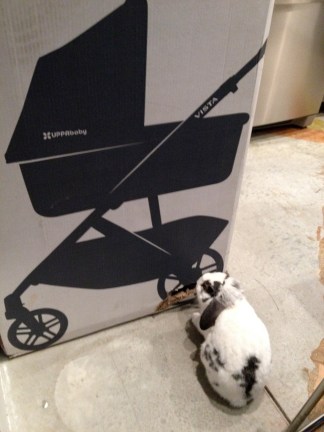
Our bunny helping us unpack the new stroller.

Also helping me sort through the tissue paper after my baby shower.

Rabbits are social (but only to a point).

While every rabbit is different, parents and children are often disappointed to discover that rabbits are generally not very cuddly pets (compared to a dog or a cat). While they do very well in bonded pairs, and enjoy spending time near their owners (on their own terms), rabbits don’t necessarily engage in interactive play, and they do NOT tend to like being picked up. While it’s true that some rabbits are in fact very cuddly (mine isn’t), attempts to force a rabbit to cuddle if they’re not interested will most likely result in ear-piercing shrieks, getting bludgeoned with those aforementioned strong back feet, and having your rabbit hide from you until they can trust you not to pull that shit again.

Rabbits can also have a heart attack and die if handled too roughly or if they become too frightened, so families with kids who don’t understand the concept of “gentle”, or who are easily bored with a pet that doesn’t seem to “do” anything should probably not get a bunny.

Basically, when it comes to your bunny’s sociability, are rabbits awesome and loving in their own ways? Absolutely! Are they going to put up with your bullshit? Heck no.

Rabbits need special care.

  1. Food

Though rabbits can be litter trained, they aren’t just cats with longer ears and shorter tails. For starters, their diet involves a lot more than just a dish of water and a bowl of pet food on the floor each morning. A truly healthy diet for a house rabbit requires unlimited timothy hay (NOT alfalfa), fresh water (changed daily!), and fresh (not rotten) greens (it’s important to check online first before giving vegetables to your bunny since not all veggies are good for them; some, like carrots, are only okay in small amounts, and some are more or less poison). Our rabbit also has some timothy hay pellets each morning (he loves them so much that when he gets them he makes a “mooing” sound) but these need to be limited to keep his digestive system top notch. Failure to properly attend to your rabbit’s diet (or allowing them to manipulate you with their cuteness into giving them sweet things that are bad for them) can result in diarrhea or gastrointestinal stasis, both of which can be very painful and very fatal for bunnies.

  1. Grooming

Did you know that bunnies shed their fur several times a year? Their fur is very soft, and very fine, and will pretty much get EVERYWHERE. We try to brush our bunny when we notice he’s having a shed, but we still find little white clouds of fur in every nook and cranny of our home. Diligent sweeping/vacuuming is required.

Also, did you know that just like our nails, rabbits’ nails will just keep growing and growing? This isn’t as big an issue in the wild where rabbits can grind their nails down by digging (and only have a fraction of the lifespan of a house rabbit anyways), but house rabbits need their nails trimmed every few weeks. Since bunnies tend to hate being picked up, this can be a Process for all involved.

  1. The Vet

Not all veterinarians are trained and experienced in rabbit care. The physiology of a rabbit is VERY different from a cat or a dog (for example, they cannot vomit so it’s really important their gut stays healthy), and a run-of-the-mill cat & dog vet will probably do your bunny more harm than good. If you’re going to own a rabbit, you’re going to need to find a veterinarian that specializes in rabbit care (we really like the vets at Arbutus West Animal Clinic in Vancouver). Obviously the hope is that your rabbit will be mostly healthy, but having a good vet to deal with any emergencies or infections that may arise is critical. It’s also important that you have your rabbit spayed/neutered—rabbits have evolved to be VERY fertile. Even if your rabbit lives solo, with so much cellular reproduction going on in their gonads, house bunnies are very susceptible to cancers of the reproductive organs. In fact, “fixing” your bunny can double their lifespan (and also prevent them from getting super territorial and peeing on all your stuff).

Find the bunny! (Note that we don’t keep any books on bottom shelves).

The uniqueness of rabbit-care aside, our bunny has actually been a rather easy-going pet (much easier in a lot of ways than a dog, and his litter is much less stinky than a cat’s). He’s provided TC with nearly ten years of amusement and companionship, and has an adorably curmudgeonly personality. Now that he is in the autumn of his years, our bunny does need a little more TLC (and trips to the vet) than he used to, but on the whole seems to continue to enjoy a very good quality of life with his human associates, a life that, while small, is very rewarding to us.

To sum up, rabbits are definitely not suitable as Easter décor, but with care and attention, these creatures can provide your household with 7-10 (or more!) years of entertainment and adorableness. For our part, our bunny is the underlying heartbeat of our home, always there on his little adventures, independent and much-loved, and is certainly no mere Easter-time prop.

For more information on taking care of your bunny, I find the Columbus House Rabbit Society and their Rabbit Care & Behaviour Booklet very helpful.