It takes a village to raise a storyteller

Near Elmhurst Road, back home in Saskatchewan

Near Elmhurst Road, back home in Saskatchewan

A week or two ago, TC and I were watching one of my favourite films, Big Fish (based on the novel by Daniel Wallace). In a nutshell, the plot revolves around Edward Bloom, a larger than life retired salesman and an incorrigible storyteller. As he lays dying of cancer, his adult son attempts to sort fact from fiction in the often “big fish story” of his father’s life. It’s a beautiful film and you should definitely watch it, but that’s not why I’m writing this post. I’m writing this post because while I was watching, I turned to TC and said, “That reminds me of Fred.”

Fred and Jackie (his wife) are my parents’ neighbours back home on the Prairie. Growing up, our two families spent a lot of time together playing, pot-lucking, camping, and car-pooling. It’s impossible to think about Fred without thinking about his stories. And it’s nearly as impossible to think about the art of storytelling without thinking about Fred. Some people just have the gift.

Do you ever examine your childhood memories and wonder if some events really happened, or whether you just remembered them so often imagined events took on a concrete shape (like a photo album where some of the images are staged but the photo itself is real)? I often can’t tell if one of my older memories is something I just dreamed, or if the dream I’m thinking of is actually a real memory. My family likes to twit me about my “faulty memory”, which I think is unfair. There’s nothing wrong with my memory–it’s quite good actually, and I remember a lot of things other people forget. The problem is, I seem to remember a few things that didn’t happen as well. I’ve noticed this when my high school graduating class shares memories of a classmate that passed away a couple of years ago. I don’t remember all the stories shared. But they so seem real to me, so “yeah, that’s just like him”, and I can picture my friend doing these things so clearly, it’s as if I remember that story too.

And it’s like this with the stories Fred used to tell us. Did my sisters and I, together with Fred and Jackie’s sons, really kick/paddle our way to the middle of Bright Sand Lake in an inner tube, accidentally pop it, and get blown across the lake? Of course not. But I remember our fear when the inner tube sprang a leak. I remember how dark it was when we beached on an unknown shore and peered through the reeds at the lighted windows of a hermit’s cabin (spoiler alert, the hermit helped us get back to our part of the beach and all was well). Did we really get lost in the woods one night, with carnivorous beasts surrounding us, only to be rescued by strange creatures that were almost as scary? No. But I remember the gleaming eyes of the evil Mud Bunnies, and the otherworldly shrieks of the Dukakis (spelling?) as they swung through the trees. I probably remember things about Fred’s stories that were never there in the first place.

But that’s how stories work, I think. You tell them, and some things get added, and some things fall away. Even the stories Fred has told us about his real life take on a different quality from the things other people tell me about their lives. I suppose that’s the danger of being a good storyteller–you make your experiences sparkle in a way other people’s don’t, making them suspicious. Surely, it can’t all really be true, can it? Is there some art there, shaping the experience, giving it arc and pace and climax, making it just a bit eerier or a bit funnier than it would be if someone else was telling the story? Of course there is. Storytelling is an art, even if you’re just telling your own story. And I don’t mind a bit.

Aside from my obvious pleasure in the fact that I featured prominently in several fictitious childhood adventures, you may wonder what all this has to do with me today, now. The point is that stories shape us, they shape how we speak, how we think, and how we remember. Narrative is so ingrained in human beings that we even create it where there isn’t any–did you know our dreams are only about 2 seconds long, and are just unrelated fleeting images/sounds? It’s true (I learned this in Psychology class). But we’re so attached to sense and narrative that when we remember our little 2-second dreams, our brain actually weaves them all together to form a story (albeit a very strange one, usually).

When thinking about my realization that I wanted to create stories, i.e., to write, I usually think about the stories that captured my imagination. Fairy tales. The dramatic games of “pretend” we played as kids. YA fiction. The 1984 film The NeverEnding Story. The Oresteia. The ballad of Tam Lin. And so on.

But what about the storytellers in my midst? Like my parents, reading to us and singing to us and telling us stories at bed time and doing their best to give answers to questions we were too young to understand? What about Fred, passing fireside nights with fantastical stories about his kids and their friends? What about my peers at school, and the elaborate fibs they told to impress each other? Aren’t their contributions of style and voice and creativity and commitment equal to (if not greater than) the contributions of the stories themselves? I think so.

I think too, about my friend Lisa, who lived just a bit farther down the road from Fred and Jackie. I was in junior high when she was finishing high school and she was the only one out of the kids in my neighbourhood who was writing, really writing, and caring enough to get feedback and develop her work (she and my older sister also heavily influenced my Our Lady Peace fandom but let’s not get into that, besides, Clumsy was a great album). Nowadays, Lisa is a writer (for a living!) and is working on a novel.

I think too, about the short-lived TV series “Jim Henson’s The Storyteller and especially about one episode taped onto an old VHS that we used to watch when I was small, and that I absorbed so unconsciously that when I thought about it later I couldn’t remember if it had been real (it was the story of Fearnot, and yes, it was real, I found it on Netflix). It wasn’t the folktales John Hurt’s Storyteller character told that were  necessarily special–it was the WAY they were told, the way the world of of the story bled into the fireside world where the Storyteller told his dog (who was a Jim Henson muppet) his tales, and the way that same Storyteller and his fireside bled into the tales themselves.

I think too, about beautifully-written books like Dianne Warren’s Cool Water that are exciting pieces of literature not because of WHAT the story is, but HOW it is shared with us (the language and the subtlety and the love). Or about a writer like David Sedaris, who makes the unusual parts of his life seem rather mundane and turns the mundane into something extraordinary.

It’s the artistry that captures me, the dedication to craft and to story. It’s the respect for a good story, and the acknowledgment of the importance of the teller, that inspires me. Every time I write, the stories I’ve read, heard, and seen find their way into my work. In the same way, I know that while it was my parents that raised and supported person I am, the storytellers around me (whether it was Fred my neighbour or John Hurt the actor) definitely chipped in to raise the storyteller I’m aspiring to be.
A Night of Poetry with Rachel Blau DuPlessis

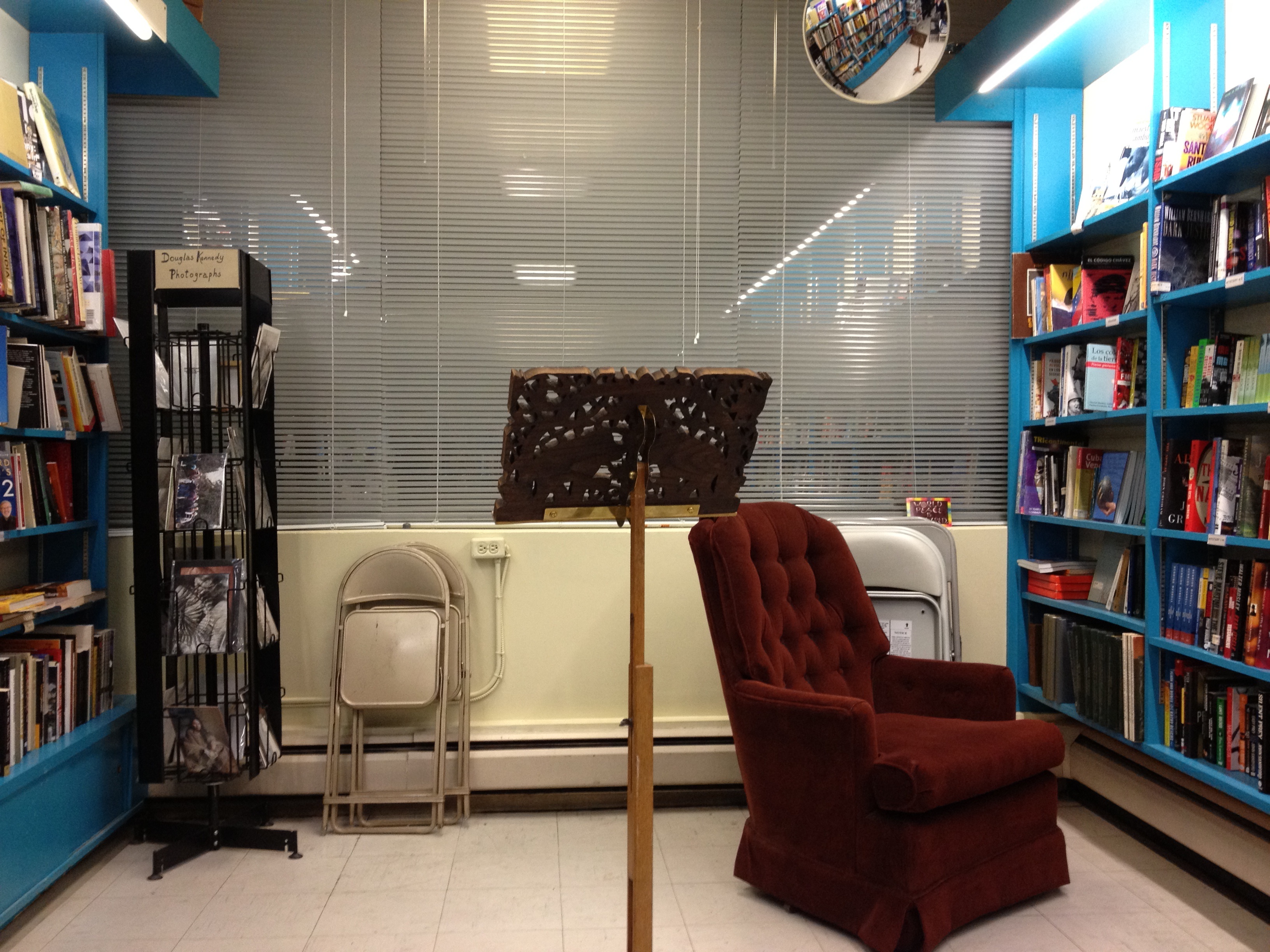
Co-Op Books. This is where the magic happens.

In my continued efforts to challenge my brain and improve my writing, I am once again taking a Creative Writing: Poetry course at Simon Fraser University (this one is the 400-level version of the 300-level class I took this spring). Rachel Blau DuPlessis (“poet and essayist, and feminist critic and scholar”) is currently in town so class was cancelled and we were STRONGLY encouraged to attend one of her Vancouver readings.

Last night about six or seven of us gathered at the People’s Co-Op Bookstore (1391 Commercial Drive) to hear DuPlessis read from her latest (and as of yet unpublished) work. It was obvious who the students were, as we sat eagerly in front while a formidable crowd of poets, poetry lovers, and scholars gathered behind us. We really were in for a special treat as DuPlessis read selections from her latest Draft poems (including what she called her “final” draft), and she told us afterwards that this was the first reading at which she had read these poems.

[Notes about the Drafts. There are over a hundred of them. This particular project has been in process for over twenty years.]

Listening to DuPlessis read made me realize that I connect with (good) contemporary poetry read aloud the way I connect with (good) contemporary dance. There is an arc there, carefully crafted, but it is emotional, intellectual, and/or intuitive rather than narrative or linear. Because one thing does not lead to another in a linear sense (and because, in a reading, I cannot see the page the poet is reading from), what I perceive or catch hold of are fragments, and I cannot for the life of me remember exactly what I saw or heard.

I’m used to this when watching dance. I’ve long known contemporary dance puts me into a mental state in which I am perceiving what is on the stage but also thinking and feeling a million different things which, I assume, are informed by what I see. Every once in a while I will be shaken from my reverie by an image or movement that particularly strikes me. Some could say what I’m experiencing is the act of “not paying attention”, but what I really think I am experiencing is something more transcendental.

This is what listening to DuPlessis read is like. I do not remember what any of the lines of poetry were, and I am not well-read enough to have caught the quotations or allusions within the poems, but goddamn, that woman can read. I was pretty lukewarm on the idea of attending a poetry reading because the last one I went to featured a poet who was so incredibly precious and flowery with the way in which she read the poems aloud I could not hear the poetry for the reading. DuPlessis is not flowery. She reads with conviction, and the climaxes and denouements of her “arguments” (because in a way I did get the sense there was an argument, a thesis here) reminded me of a political speech in the best possible sense–a speech that makes the people want to fight for something (but instead of lowest common denominator platitudes about God blessing America, we have poetry).

After her reading, DuPlessis took questions, and was kind enough to truly fully answer questions about her process, about her reading (she does not rehearse or prepare for the act of reading allowed, which was my question, but she does revise her poetry so many times that the arc and movement is built in), and about poetry as an art form in general. Poetry is different from other writing (fiction, etc.), DuPlessis says, because of the concern for the line, and the different ways in which syntax and structure must be taken into account (if I’m totally botching my paraphrasing here, I’m so sorry, I’m going by rather awestruck memory).

I cannot remember what happened while listening to DuPlessis read, but I do know I had moments of surprise, that something struck me as funny once or twice, that I was startled when she finished, and that I thought a million strange thoughts while DuPlessis read, none of which I can remember either. Very much like any evening I would spend with good contemporary dance. I just hadn’t expected the two to be so similar.

[I should mention that although the People’s Co-Op Bookstore was the venue for the evening, DuPlessis was actually hosted last night by the Kootenay School of Writing. The book store is also worth checking out–lots of interesting looking books, none of the crap “memoirs” of young reality stars written by ghost writers that you’d find in a Chapters nowadays.]

“The Rat Race” (Nifty Fiction)

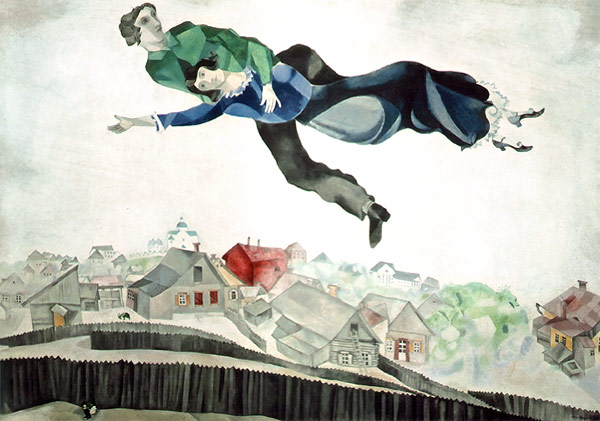
“On the City” – Marc Chagall

[Disclaimer: This is a work of fiction. I am not Delia, and TC is not Nathan. Nathan seems okay, but TC is much cooler. Here goes…]

The Rat Race

Maybe we should hire someone to clean the apartment.

This is an idea Delia has while she stands at the bus stop, the only one in the city where you can gaze out over the gray water to where the gray mountains meet the gray sky, shrouded in even grayer clouds. It’s a good idea, maybe. There are two of them working full time–they can certainly afford it. And the thought of the uncleaned bathroom waiting at home makes Delia feel as though she is failing at life. So maybe they can use their money to pay someone to clean (not everything, just pop over for an hour a week and clean the bathroom and maybe vacuum). It’s a good idea. Maybe.

By the time Delia boards the bus she is angry. There are two of them working full time. They both pitch in as far as household chores and errands are concerned. They shouldn’t have to spend their hard-earned money paying someone to clean. How is it that their dirty bathroom is allowed to make her feel like a failure? How is it that the world expects them not only to work full time to keep themselves alive, but to spend their leisure time cleaning and running piddly errands? Where’s the “leisure” in that?

As the bus launches along Cordova Street Delia leans her temple against the window, convinced that the world’s chief desire is to chew her up, suck the life out of her, and spit her out again.

By the time the bus turns onto her street, Delia has decided that she needs to quit her job. To hell with money–money has no use if she doesn’t feel alive. Besides, she isn’t making that much money anyways, at least not enough to buy a house or support a family. So what’s the point of sitting in an office shunting paper around all day long?

By the time Delia reaches her building she is feeling so reckless she takes the elevator even though she normally just takes the stairs. To hell with saving energy and the planet–the planet owes her for giving her this shitty gray day and a bathroom that despite her best intentions, still remains unclean.

Delia is careful not to slam the door when she enters the apartment but Nathan seems to sense the black dog on her shoulder and his conversation is light and inquisitive while they make dinner and Delia responds even though all she wants to do is lock herself in that goddamned dirty bathroom and have a cry. Once everything is on to simmer she leans forward and presses her forehead against the kitchen counter.

“Is there something I can do?” Nathan says.

“No, you’re perfect,” says Delia, “I just want to quit my job is all.”

“Oh.”

“Work is fine and everything. It’s just wearing me down. I’m supposed to be working so I can enjoy my life, except that I spend the rest of my life running errands or whatever, which is essentially work, except I don’t get paid for it. I work all day so that I can spend my time working. It’s stupid and I don’t want to do it anymore.” Delia says all this with her forehead still pressed to the counter, eyes searching the kitchen tile for her next moody thought.

“I think people work so that they can spend the rest of their time doing things that make them happy,” says Nathan (too optimistically, Delia thinks).

“Except they aren’t!” Delia cries and looks up at him, “We’re all running around doing stupid things just to take care of our homes and look like we’re having a good time but no one actually IS! I was supposed to clean the bathroom today except I spent all goddamn afternoon looking for a goddamn taupe sheet set and then the escalators at the Bay were broken so I got to tromp up and down three flights for no goddamn reason!”

“Did you find a taupe sheet set?”

“No I did not!” Delia sighs and puts her head back on the counter, squeezing her eyes shut. “Until this year I never quite understood the term ‘rat race’ and now I get it. Why do we do this? Is this all there is? I mean, it can’t be. If someone told you now that you would spend the rest of your life working all day so you could spend all of your spare time running around grocery shopping and scrubbing your toilet and taking your car to the mechanic only to retire and find out that the CPP had gone bust and inflation had eaten your savings and you were going to be busy and poor until you died, you’d kill yourself, wouldn’t you? I would. I mean, if that’s all there is.”

Nathan takes a breath.

“Do you want me to clean the bathroom for you?”

“No, it’s my turn. God, I just hate the city sometimes.” Delia looks up at Nathan again, into his bemused helpful face. “Do you think I would be a good farmer?”

“Um… I don’t know. Do you think you would be a good farmer?”

“I don’t know anything about farming.”

“Well then,” says Nathan, “probably not.”

“I just don’t want to live in the city forever.” says Delia.

“I know.” says Nathan, and then he washes the cutting board he’d been using.

In the middle of the night, Delia is woken by the terrifying realization that of course she will never be a farmer, that farming is not an easy life, and she will probably have to work at a desk FOREVER, especially if she has children, and they will bring her no end of errands and headaches.

An hour later, Delia wakes again and remembers that it could be much worse. She is also struck by a sudden comforting thought: the future children can clean the bathroom. Once they’re old enough. They can sweep floors once they can hold a broom, and probably do dishes too. It’s a good idea.

Nathan is warm and comforting beside her as Delia drifts back to sleep, content in her certainty that ten years old is plenty old enough to wield a toilet brush and some Comet. The universe provides.

I’m good at something. Now what?

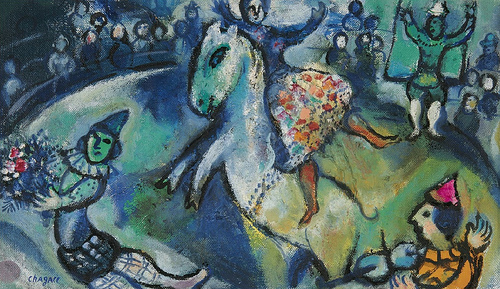
Scene de Cirque by Marc Chagall

When I was in high school, I read an essay in English class about a girl who wanted to grow up and play with Lego. When told that “playing with Lego” wasn’t a career like being a doctor or a teacher or a lawyer, the girl was undaunted. She went to university, eventually completing a master’s degree in architecture (incidentally, her final project model was built with Lego), and somehow or other she landed a job with the Lego company developing the new Lego sets. Now her office is filled with every Lego piece she could ever need (with people on call to provide her with additional pieces if required) and she makes her money playing with Lego all day long. The moral of the story for all of us high school students preparing to go out into the world and seek our fortunes was “Make your vocation your vacation!”

I guess this means that we’re supposed to find that thing we’re really good at doing, our calling, so to speak, and make pursuing it as fun and awesome (and lucrative) as possible. Appealing, but easier said than done.

The fact of the matter is that many people, like me, are decently good at several things but aren’t necessarily geniuses in any one thing. Our vocation is not obvious, and the means to turn whatever our calling is into our livelihood (i.e. into money we can LIVE on) are vaguer still.

It has now been almost three years since I finished my BFA in Theatre Performance, and finally it has begun to become abundantly clear to me why I have not jumped at every performance opportunity (for the most part unpaid) that has come my way since. At first, of course, I said I couldn’t possibly get time off work to audition or rehearse, and then, of course, I couldn’t quit my job because I had over $20 000 in student loans to pay off and then, of course, I moved into Vancouver from Burnaby and rent was simply too high to allow me to give up my job and then, of course, I got hired on a continuing contract WITH BENEFITS (and you’d be a fool to give those up), and then, of course, I was travelling, and then, of course, and then and then and then.

The result of all of these “and thens” is that I am not an actor right now. And you know what? I think I’m not supposed to be, at least not as my vocation. Obviously there are many actors in this city who aren’t acting all the time, but they are trying– they are getting flexible jobs that allow them to fit in rehearsal schedules, they are auditioning, they are continuing to train through workshops and intensives, they are performing in every damn thing they can perform in, and when they aren’t performing, they are itching to fulfill the artist within by getting back onstage, sinking their teeth into a role, and performing the hell out of something.

These people are actors. These people are not me. Firstly, I am either too lazy or too cheap (or maybe both?) to find a more flexible (i.e. less secure and well-paying) job, audition, pay for workshops (which are pricey!), etc. Secondly, and more importantly, when I have gone through static, less artistic periods of my life, it wasn’t performing that I itched for. It was creating.

Although I’ve always loved performing, and when I do perform I will always try my damndest and have lots of fun, I’m not itching to be Blanche DuBois, or Electra, or Lady Macbeth (well, maybe Lady M because WHO WOULDN’T?). I’m not really itching to be any character, or any thing. I’m itching to be the one to call amazing things into being.

Being an actor seemed to be a natural choice for me because I always loved to play pretend. But was it being somebody else that I enjoyed, or was it the creation of these other versions of my childhood self (their world, their powers, their adventures) that I loved? I think somehow I’ve always wanted to be all the characters, I’ve always wanted to make their whole world. I want to manifest what exists in my imagination and try to communicate it through language. I want to tell stories. I want to plant images in people’s heads. And I don’t just want artistic fulfillment, I want intellectual fulfillment. I want to write.

And that is why I do. That’s why I blog. That’s why I loved co-creating Troika! last year with my friends. That’s why I’ve got a bunch of (mostly crappy) unfinished work languishing in notebooks and, more recently, on my computer. That’s why I agreed to adapt a Greek tragedy for some theatrical friends of mine. That’s why I went back to school to study English literature and am currently studying writing poetry. THIS is what I’m not too cheap or too lazy to do. THIS is what I’m itching for.

And you know what? I’m decently good at it. I’m not being vain. I’m just owning up to what is becoming more and more obviously my vocation. Funnily enough, it’s in poetry that it has been suggested that I pursue graduate studies. Apparently, I’m decently good at it. At poetry. Huh.

I know I’m no genius poet. I’m not Inger Christensen, whose alphabet (brilliantly translated by Susanna Nied), a 70+ page poem based on the Fibonacci sequence, is the most elegantly constructed piece of literature I have ever beheld (and all this intense mathematical form without sacrificing contact and image at all!). I’m not Franis Ponge, whose obsession (and faculty with) describing the thingness of things has been intriguing and inspiring to me this semester. But I’m decently good at writing poetry. I feel good about it. Writing poetry is, to me, a delicious act.

I found something I’m good at! Yay!

Now what?

The last time I checked, being a poet was not a…lucrative…career choice, and unlike acting, there is no way to “make it big”. Studying poetry at the graduate level would be incredibly artistically and intellectually fulfilling. It would also financially impoverish me (and let’s not forget I want to continue to study other creative writing forms too! $$$!).

I am at the point in my life where I have realized that I can’t live my “double life” forever: the life of a responsible full-time administrative assistant combined with the life of the unpaid creative. Though I’m delighted that I’ve found a vocation (and delighted that I have a job that allows me to live comfortably for now), there’s no vacation in working at work and then going home and working on my creative pursuits. It’s taking its toll on me, and when I’m older and have kids and a mortgage and backyard chickens or what-not I simply won’t be able to do it all.

I’m also at a point where I realize that to go any further into any kind of career (except within my admin job, I guess), I need to further my education through either graduate studies or professional certification. While on the one hand I am worried that it would be irresponsible to spend money and time on an education that will not advance my career and earning opportunities (like a graduate degree in poetry), I am even more uncomfortable with the idea of spending time and money obtaining certification or a graduate degree in something that will not make me happy, especially when it’s not really the thing I’m really meant to be doing anyways.

So what to do? I’m not sure. At the moment, I’m grateful that I can make my life work for me. I’m grateful that I’m beginning to understand what my goals are. I’m grateful for my job and for all the amazing things that I’m learning in my classes. I’m grateful for my theatre degree–without it I would not have cultivated the work ethic and artistic questioning necessary to be as creative as I want to be. Hopefully I’ll find my way. We can’t all play with the proverbial Lego all our lives, but I’ll build my magical cities for as long as I can. I’m meant to.