“Libation Bearers (The Flame)” or “I Wrote A Play!”

This is not the first play I’ve written, and I hope it won’t be the last, but regardless, I’m pretty excited about this. I, NiftyNotCool, have written a play (cue trumpets and confetti)!

This play is an adaptation of the Greek tragedy The Libation Bearers (also known as Electra if you read the Sophocles version), called Libation Bearers (The Flame). It is the second installment in the three-play Oresteia series produced by my friends in Rice & Beans Theatre, and will be directed by Pedro Chamale.
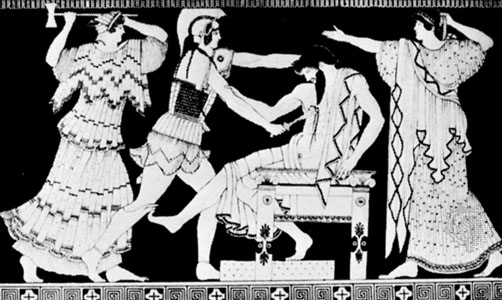
Electra and her brother Orestes kill Aegisthus, murderer of their father

Obviously, since the tragedy dates back to ancient Greece, the plot itself is not exactly a nail-biter. The gist of the story is pretty simple and well-known: In the ancient city-state of Argos, Queen Clytemnestra and her lover Aegisthus murder her husband (Agamemnon). The Libation Bearers itself takes place years later, as Clytemnestra’s children (Electra and Orestes) plot to avenge their father’s death. That’s it that’s all.

But not really. If that was all no one would bother adapting the play for contemporary productions (and there are countless adaptations of the Oresteia, for countless contemporary productions). Most of us know the what of the story (i.e., what happens, which we should all know now, because I just told you), but what seems to change from adaptation to adaptation, and even from ancient Greek version to ancient Greek version, are the how and the why of it all. That’s what was interesting to me when writing Libation Bearers (The Flame) and that is hopefully what will be interesting for the actors to explore and interesting for the audience to watch.

Betrayals happen. Murders happen. Revenge is plotted. Today’s headlines are relatively similar (which is probably why these old stories live on). The reason we read past those headlines into the macabre news report below is because we want to know why this thing happened, and how such a thing could be possible. Sometimes, I think we want to see what separates us, law-abiding non-murderers, from those who commit horrible crimes. What are the steps that would have taken us to that place? What would we have done, in the same situation?

Also contained within the question of how in an adaptation of an ancient work is simply the matter of how this story is going to be told. How does my script handle the events of the play? How does the rhythm of the language guide us through? How do the characters, as I’ve interpreted them, find their way towards their actions? Once the play is written, how does the direction affect the story? How do the actors interpret their roles, and blend their sensibilities and skills which the words they’ll be speaking?

If the cast/crew list for this show is any indication, the how will be very exciting. My conversations with director Pedro Chamale about his vision for the show leave me confident that he is going to take my words and make them truly work (the only way they really can work, which is in performance). I respect the technical and stage management team. As for the actors, I’ve seen them all perform and studied with most of them. They are exciting performers. I’m excited.

I’m very excited. I hope you will see the show.

Libation Bearers (The Flame) will run for four nights only, November 21 to 24, at 8 pm in the PAL Theatre, 581 Cardero Street (Coal Harbour).

Tickets are $15/$10 and are available online through Brown Paper Tickets: http://theflame.brownpapertickets.com/

A Night of Poetry with Rachel Blau DuPlessis

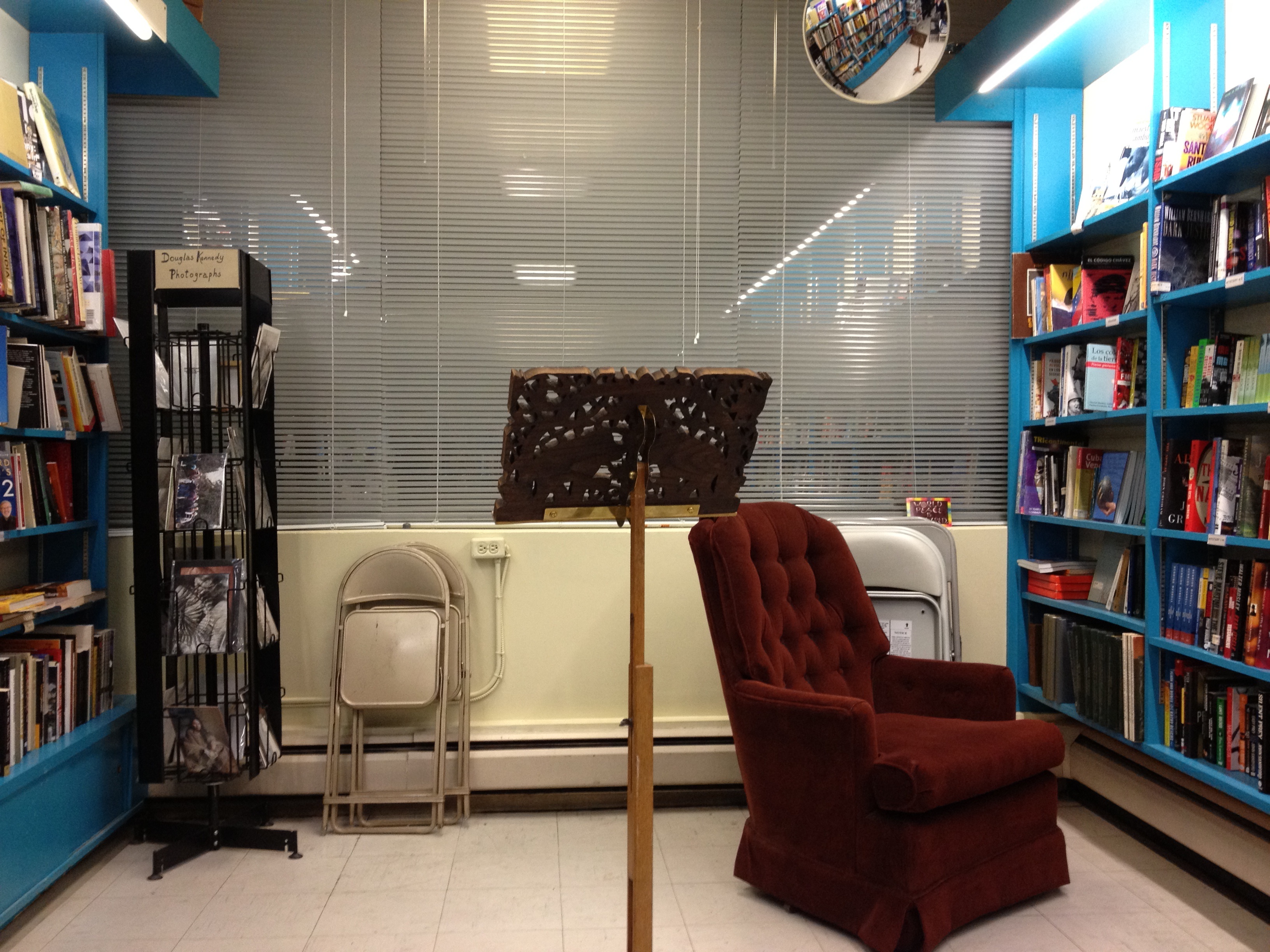
Co-Op Books. This is where the magic happens.

In my continued efforts to challenge my brain and improve my writing, I am once again taking a Creative Writing: Poetry course at Simon Fraser University (this one is the 400-level version of the 300-level class I took this spring). Rachel Blau DuPlessis (“poet and essayist, and feminist critic and scholar”) is currently in town so class was cancelled and we were STRONGLY encouraged to attend one of her Vancouver readings.

Last night about six or seven of us gathered at the People’s Co-Op Bookstore (1391 Commercial Drive) to hear DuPlessis read from her latest (and as of yet unpublished) work. It was obvious who the students were, as we sat eagerly in front while a formidable crowd of poets, poetry lovers, and scholars gathered behind us. We really were in for a special treat as DuPlessis read selections from her latest Draft poems (including what she called her “final” draft), and she told us afterwards that this was the first reading at which she had read these poems.

[Notes about the Drafts. There are over a hundred of them. This particular project has been in process for over twenty years.]

Listening to DuPlessis read made me realize that I connect with (good) contemporary poetry read aloud the way I connect with (good) contemporary dance. There is an arc there, carefully crafted, but it is emotional, intellectual, and/or intuitive rather than narrative or linear. Because one thing does not lead to another in a linear sense (and because, in a reading, I cannot see the page the poet is reading from), what I perceive or catch hold of are fragments, and I cannot for the life of me remember exactly what I saw or heard.

I’m used to this when watching dance. I’ve long known contemporary dance puts me into a mental state in which I am perceiving what is on the stage but also thinking and feeling a million different things which, I assume, are informed by what I see. Every once in a while I will be shaken from my reverie by an image or movement that particularly strikes me. Some could say what I’m experiencing is the act of “not paying attention”, but what I really think I am experiencing is something more transcendental.

This is what listening to DuPlessis read is like. I do not remember what any of the lines of poetry were, and I am not well-read enough to have caught the quotations or allusions within the poems, but goddamn, that woman can read. I was pretty lukewarm on the idea of attending a poetry reading because the last one I went to featured a poet who was so incredibly precious and flowery with the way in which she read the poems aloud I could not hear the poetry for the reading. DuPlessis is not flowery. She reads with conviction, and the climaxes and denouements of her “arguments” (because in a way I did get the sense there was an argument, a thesis here) reminded me of a political speech in the best possible sense–a speech that makes the people want to fight for something (but instead of lowest common denominator platitudes about God blessing America, we have poetry).

After her reading, DuPlessis took questions, and was kind enough to truly fully answer questions about her process, about her reading (she does not rehearse or prepare for the act of reading allowed, which was my question, but she does revise her poetry so many times that the arc and movement is built in), and about poetry as an art form in general. Poetry is different from other writing (fiction, etc.), DuPlessis says, because of the concern for the line, and the different ways in which syntax and structure must be taken into account (if I’m totally botching my paraphrasing here, I’m so sorry, I’m going by rather awestruck memory).

I cannot remember what happened while listening to DuPlessis read, but I do know I had moments of surprise, that something struck me as funny once or twice, that I was startled when she finished, and that I thought a million strange thoughts while DuPlessis read, none of which I can remember either. Very much like any evening I would spend with good contemporary dance. I just hadn’t expected the two to be so similar.

[I should mention that although the People’s Co-Op Bookstore was the venue for the evening, DuPlessis was actually hosted last night by the Kootenay School of Writing. The book store is also worth checking out–lots of interesting looking books, none of the crap “memoirs” of young reality stars written by ghost writers that you’d find in a Chapters nowadays.]

Fringe 2012: Resounding Scream Theatre presents “The Troubles”

Photo credit: Panos Argryopoulos

On Tuesday I visited Resounding Scream Theatre‘s final pre-Fringe dress rehearsal to watch and review their upcoming Vancouver Fringe offering, The Troubles. Avid followers of mine may recall that The Troubles was part of last summer’s double bill, combining Troika!, the show I co-created, and The Troubles into one night of hot Vancouver theatre. Since its 2011 runs, The Troubles has been revised and reworked to create the one-woman show on offer at the Vancouver International Fringe Festival this year. The Troubles is written and performed by Stephanie Henderson, based on the experiences of her father and his family in Northern Ireland, and directed by Catherine Ballachey.

The issues at the heart of the play surround what was referred to by the British as “the Troubles”, a period of violent religious-political conflict in Northern Ireland which spanned the 1960s through to the 1990s. As one of the characters quips, Northern Ireland is not “all ponies and roses.” The violence which overwhelmed the region is both real and recent. The Troubles is concerned not with specific religious or political issues, or with which side was right or wrong or caused more hurt or had more justification for their part in the violence, but with the everyday people–from mothers to schoolboys to blue collar workers to “footie” fans–forced to try to continue their “normal” lives during a time when violence and conflict has become the new normal. I was particularly struck by Henderson’s depictions of the effect the conflict had on children, whose play fights and mock battles became all too real with bricks and bottles, stones and beatings, forced to take on their parents’ issues.

Photo credit: Panos Argryopoulos

One of Henderson’s strengths as a performer has always been her ability to interact with her audience while in character. Five different “people” appear onstage through the text and performance of The Troubles, and each character speaks to us (readily or reluctantly, as the case may be) in their own unique way. Henderson has understood and embodied her five characters so thoroughly that regardless of an audience member’s response to her questions and remarks, she will have a quip or a cuss word at the ready–always in character, and always (Northern) Irish.

As an audience member, you will need to work a bit to keep up with Henderson’s North Irish lilt and the speed with which many of her characters speak. Overall though, the frank and good-humoured nature of her portrayals and the weight of her subject matter were enough to pull me in and keep me through the whole of the performance.

Photo credit: Everette Jelley

The Troubles will run September 7 – 16 at Studio 1398 (Playwright’s Theatre Centre) on Granville Island. For more information and specific show dates, please visit Resounding Scream’s Upcoming Projects web page. Tickets to The Troubles may be purchased online through the website of the Vancouver International Fringe Festival, or with cash at the door.

Disclaimer: Stephanie Henderson and Catherine Ballachey of Resounding Scream Theatre are personal friends of mine, as well as theatrical colleagues. However, I agreed to review The Troubles in my capacity as a blogger first and foremost, with the understanding that this disclaimer would be necessary. I do not feel as though my experiences of the show, reviewed here, were compromised by our personal friendship.

Book Review: Joseph Boyden’s “Three Day Road”

In a quick and dirty nutshell, Joseph Boyden‘s Three Day Road tells the story of Xavier Bird, a young Oji-Cree man from the bush near Moose Factory, Ontario. Together with his best friend Elijah, he travels far from home with the South Ontario Rifles and becomes an accomplished sniper. Afterwords, his spirit and body broken, Xavier returns to his aunt Niska, who paddles him deep into the bush towards the home of his childhood. Experiences in the trenches of the First World War are interspersed with memories of Niska’s coming of age as a diviner and healer for the few remaining “bush Indians” who continue to resist the pull of the white towns and the rum, exploitation, and prejudice that came with them.

A striking theme in this novel is the shock of Niska’s spiritual and natural world colliding with that of white Ontario–with its religion, RCMP, and residential schools. Through Boyden’s telling, it is obvious that the systems imposed on the First Nations of Canada were grossly out of touch with the practical and natural realities of life in this country. A familiar theme, yes, but its representation in Three Day Road took my breath away with its absurdity and immediacy.

In another quick and dirty nutshell, I liked this book. I liked Xavier, a quiet young man whose inner jealousies, comforts, fears, and joys play across the mind and heart we are privy to, but remain hidden from the soldiers in his company. I liked his Aunt Niska, a wise woman whose strength comes not necessarily from taught knowledge but from careful and close observation, a firm sense of self, and an ability to do, under any circumstances, what must be done. I loved the descriptions of the bush Niska and Xavier call their home, I loved its almost otherworldly beauty. I loved that this beauty is here, in Canada, though in smaller and smaller spaces now. I hated the war and the futility and brutality of trench life and the various suicidal “pushes” the soldiers were ordered to participate in, but then, who wouldn’t? I was taken by the sensuality of the book–physical, natural, spiritual.

I liked this book. What’s not to like? I suppose that Three Day Road is long, so if you don’t like long books, you may not like it, and it’s heavy, so if you don’t like literature that takes a more serious tone, you may not like it. But if you allow yourself to be pulled in by the beauty of the telling and the emotional threads of the story you will find yourself whizzing through the novel, dodging bullets and yearning for a comforting voice in the din and a warm fire in the rainy night.

If you like Canadian literature and/or history, or literature by and about the First Nations people of Canada, or action scenes and technical descriptions of early 20th-century warfare, or sensual descriptions of intimacy and the natural world, Three Day Road is a book you will like.

Or perhaps “like” is the wrong word. You will respect this novel, you will be pulled by it, you will be struck by it. You will start a long journey and reach the end sooner than you think. And like me, you will recommend this book to others.

We’re Not In Green Gables Anymore: Canada’s Revolutionary Reads

When I think about iconic Canadian literature, I think about Anne of Green Gables skipping in raptures over the red roads of PEI, the heartbreaking irony of Sinclair Ross’ Painted Door or A Field of Wheat, and maybe, if I’m in a more “contemporary” mood, I’ll think of Margaret Atwood and her much-lauded Cleverness. I don’t think of the word “revolution” when thinking of Can Lit any more than I would think of the words “outer space”. Sure, some Canadian out there is writing about it, I thought to myself, but they can’t be all that good or I would know about it.

Or maybe I’d have to take a class entitled Canadian Literature after 1920 (this year the course theme was “Revolution(s)”) and surprise myself immensely by enjoying it. Which is what I did. Considering three of the books we studied were Canada Reads winners, it seems I am not the only Canadian reader to discover a taste for revolutionary literature.

Readers of Canada (and beyond), allow me to present to you, in the order in which I read them, the books of the Summer 2012 semester of Canadian Literature after 1920:

    • In the Skin of a Lion– Michael Ondaatje (winner of Canada Reads 2002)This one is pretty obvious, and Michael Ondaatje certainly isn’t an unknown quantity to Canadian readers. This was my first encounter with him though, and I wrote my final paper about the book (a high-falutin’ affair entitled “Not Just ‘Men From Nowhere’: Narrative Inclusion as Revolutionary Act in Michael Ondaatje’s In the Skin of a Lion“). The book is big on beautiful language and lyricism, and big on telling stories, but light on the the proletarian rhetoric someone might expect from a book that deals primarily with the conditions of the (mainly immigrant) blue-collar workers who built key features of modern-day Toronto (which is alright by me). As expected, considering its author, In the Skin of a Lion is a fine book. A damn fine book, y’know?
    • Next Episode– Hubert Aquin (winner of Canada Reads 2003) This book gave me some difficulty. When you read it, it seems to be about a revolutionary imprisoned in a Montreal psychiatric facility trying to write a spy novel, set in Switzerland, about a revolutionary spy, but actually it’s about the political climate of 1960s Quebec. Get it? I didn’t, but according to my dad, who read the book in French back when he was a student, if you had been following Quebec politics at the time, you would get it. Give this book a whirl if you’re feeling brave and patient.
    • Louis Riel: A Comic Strip Biography– Chester Brown Considering the story of Louis Riel (and his involvement in the Red River Rebellion and the 1885 Northwest Rebellion) is told entirely by Brown in minimalist black and white comic-strip format (like the kind you would see in a newspaper), Chester Brown’s achievement is impressive. By Brown’s own admission, a lot of facts have been omitted or altered in his telling (since it’s pretty hard to fit major historical events in a comic), but his departures from historical fact are exhaustively cataloged in his notes at the back of the book, along with research information. If you don’t know much about Louis Riel, you’ll actually learn something from this comic-strip depiction.
    • Kanehsatake: 270 Years of Resistancea film by Alanis Obomsawin Kanehsatake is not a book, obviously, it is a documentary about the 1990 Oka Crisis. I was so struck by this film I am really quite speechless (and wordless) about it. Watching it will give you a very different, rather uncomfortable view of Canada and the way our rights as citizens are (dis)respected.
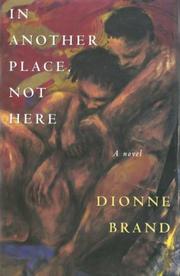
    • In Another Place, Not Here– Dionne Brand This book is a stylistically difficult, deliciously unsatisfying read. The underdogs do not “get theirs” in the end and the villains (when they can be defined) do not learn, or lose, anything. But the language (including Caribbean dialect in the voice of Elizete) is poetic and sensual with the ripe and sweating heat of Grenada pulsing against the empty greyness of Toronto. The plot centres around two people in a lesbian relationship but In Another Place, Not Here is not a novel about being gay. It is a novel about heat, and passion, and unfairness, with a final image that tears your heart right from your chest and just leaves it lying on the floor. It’s a book you can’t help but respect.
  • Something Fierce: Memoirs of a Revolutionary Daughter– Carmen Aguirre (winner of Canada Reads 2012) Despite its often heavy content, stylistically, this book is probably the easiest and fastest read. It is also the funniest. A natural storyteller, Chilean exile and Vancouver theatre artist Carmen Aguirre shares with the reader her (previously unshared) memories of growing up a daughter of the Chilean resistance movement. At the age of 11, Carmen’s mother and stepfather remove Carmen and her sister from the safety of their exile in Vancouver and return to South America to aid Chile’s resistance against the dictatorship of Pinochet. First kisses and doing the hustle are juxtaposed against bullets in the street and the all-important facade the family had to keep up at all times to ensure their safety from arrest and torture. At 18, Carmen officially joins the resistance as a fighter in her own right. This is a book not about gunning down baddies or blowing up buildings but about the physical danger and psychological and emotional toll underground resistance takes on ordinary people who are willing to risk all for a greater cause. The book created a bit of a controversy on the Canada Reads panel when panelist Anne-France Goldwater referred to Aguirre as “a bloody terrorist” and mused that she can’t understand “how we let her into Canada” (you can read more about Goldwater’s comments on the Globe and Mail website). Personally, I was quite taken with the book, and don’t see why anyone needed to use the “T-word”.

We’ve only got another month of summer. Get into your hammock or down to the beach and sink your teeth into some revolutionary reads. You might look at your country, or at least its literature, in a different way.

Covering the 2012 Jessies for Hummingbird604.com. Awesome!

Howdy arts fans!

The official purpose of this post is to direct you to my coverage of the 2012 Jessie Richardson Theatre Awards on Hummingbird604.com. The blog’s creator and chief contributor, Raul Pacheco-Vega wasn’t able to make it so I was only too happy to cover the Jessies for him again this year.

Hold up, you might say, this is not the first time you’ve mentioned Raul or covered something for his blog. Who is he, and how do you know him? Is this “Raul” a real person or some magical blogging elf man?

This really isn’t a good picture of either of us. Firstly, blame the fact that we took the photo ourselves. Secondly, blame a wee little bit of tequila.

The answer is that while Raul is probably, secretly, a magical blogging elf man (in addition to being a professor and consultant), he is also a friend of mine and is definitely real. We were introduced by a mutual acquaintance at a gala in 2010 and took a shine to one another. We stayed friend-ish but it wasn’t until a few months later when I started blogging that we became friends (I think it’s funny how the internet plays such a big role in facilitating new friendships nowadays, but I’m not complaining).

Though Hummingbird604.com is a very different blog from mine (in terms of its influence and reach, the number of times it posts, the fact that there are guest contributors, the “lifestyle” features that I don’t write much about, etc.), Raul has been very encouraging as I do my thing. Mostly, I draw on his experience and moral support, but he has also been tuned in to what I like to write about and has brought appropriate opportunities my way. Raul is the reason I was put in touch with Jessie van Rijn, General Manager of Carousel Theatre for Young People, last December, and reviewing Carousel shows this spring has been nothing but fun.

Friendships nurtured via the Internet are a relatively new phenomenon, but that doesn’t make the beneficial relationships that result any less real, only different. Friends are good to have, no matter where or how you met. And good friends? They’re just plain great.

And that, my dears, is why I always (sometimes profusely) say thank you to people like Raul, or Lois Dawson, or any of the other people who have provided fun opportunities to blog about things I enjoy. My blogger friends have been very good to me, they are good for me, and I’m always grateful for that.

If you read my coverage of the Jessies on Hummingbird604 (and I hope you do since technically I guess that was the point of this post), you will see that gratitude played a huge role in the evening and in the spirit of that gratitude, I just want to say thank you to the people who keep sending good things my way. You’re awesome!

“The Rat Race” (Nifty Fiction)

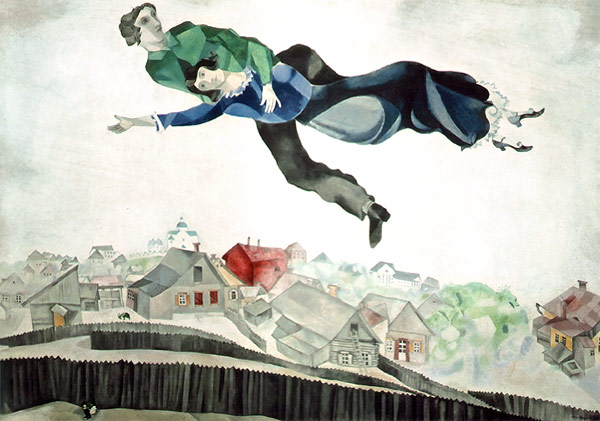
“On the City” – Marc Chagall

[Disclaimer: This is a work of fiction. I am not Delia, and TC is not Nathan. Nathan seems okay, but TC is much cooler. Here goes…]

The Rat Race

Maybe we should hire someone to clean the apartment.

This is an idea Delia has while she stands at the bus stop, the only one in the city where you can gaze out over the gray water to where the gray mountains meet the gray sky, shrouded in even grayer clouds. It’s a good idea, maybe. There are two of them working full time–they can certainly afford it. And the thought of the uncleaned bathroom waiting at home makes Delia feel as though she is failing at life. So maybe they can use their money to pay someone to clean (not everything, just pop over for an hour a week and clean the bathroom and maybe vacuum). It’s a good idea. Maybe.

By the time Delia boards the bus she is angry. There are two of them working full time. They both pitch in as far as household chores and errands are concerned. They shouldn’t have to spend their hard-earned money paying someone to clean. How is it that their dirty bathroom is allowed to make her feel like a failure? How is it that the world expects them not only to work full time to keep themselves alive, but to spend their leisure time cleaning and running piddly errands? Where’s the “leisure” in that?

As the bus launches along Cordova Street Delia leans her temple against the window, convinced that the world’s chief desire is to chew her up, suck the life out of her, and spit her out again.

By the time the bus turns onto her street, Delia has decided that she needs to quit her job. To hell with money–money has no use if she doesn’t feel alive. Besides, she isn’t making that much money anyways, at least not enough to buy a house or support a family. So what’s the point of sitting in an office shunting paper around all day long?

By the time Delia reaches her building she is feeling so reckless she takes the elevator even though she normally just takes the stairs. To hell with saving energy and the planet–the planet owes her for giving her this shitty gray day and a bathroom that despite her best intentions, still remains unclean.

Delia is careful not to slam the door when she enters the apartment but Nathan seems to sense the black dog on her shoulder and his conversation is light and inquisitive while they make dinner and Delia responds even though all she wants to do is lock herself in that goddamned dirty bathroom and have a cry. Once everything is on to simmer she leans forward and presses her forehead against the kitchen counter.

“Is there something I can do?” Nathan says.

“No, you’re perfect,” says Delia, “I just want to quit my job is all.”

“Oh.”

“Work is fine and everything. It’s just wearing me down. I’m supposed to be working so I can enjoy my life, except that I spend the rest of my life running errands or whatever, which is essentially work, except I don’t get paid for it. I work all day so that I can spend my time working. It’s stupid and I don’t want to do it anymore.” Delia says all this with her forehead still pressed to the counter, eyes searching the kitchen tile for her next moody thought.

“I think people work so that they can spend the rest of their time doing things that make them happy,” says Nathan (too optimistically, Delia thinks).

“Except they aren’t!” Delia cries and looks up at him, “We’re all running around doing stupid things just to take care of our homes and look like we’re having a good time but no one actually IS! I was supposed to clean the bathroom today except I spent all goddamn afternoon looking for a goddamn taupe sheet set and then the escalators at the Bay were broken so I got to tromp up and down three flights for no goddamn reason!”

“Did you find a taupe sheet set?”

“No I did not!” Delia sighs and puts her head back on the counter, squeezing her eyes shut. “Until this year I never quite understood the term ‘rat race’ and now I get it. Why do we do this? Is this all there is? I mean, it can’t be. If someone told you now that you would spend the rest of your life working all day so you could spend all of your spare time running around grocery shopping and scrubbing your toilet and taking your car to the mechanic only to retire and find out that the CPP had gone bust and inflation had eaten your savings and you were going to be busy and poor until you died, you’d kill yourself, wouldn’t you? I would. I mean, if that’s all there is.”

Nathan takes a breath.

“Do you want me to clean the bathroom for you?”

“No, it’s my turn. God, I just hate the city sometimes.” Delia looks up at Nathan again, into his bemused helpful face. “Do you think I would be a good farmer?”

“Um… I don’t know. Do you think you would be a good farmer?”

“I don’t know anything about farming.”

“Well then,” says Nathan, “probably not.”

“I just don’t want to live in the city forever.” says Delia.

“I know.” says Nathan, and then he washes the cutting board he’d been using.

In the middle of the night, Delia is woken by the terrifying realization that of course she will never be a farmer, that farming is not an easy life, and she will probably have to work at a desk FOREVER, especially if she has children, and they will bring her no end of errands and headaches.

An hour later, Delia wakes again and remembers that it could be much worse. She is also struck by a sudden comforting thought: the future children can clean the bathroom. Once they’re old enough. They can sweep floors once they can hold a broom, and probably do dishes too. It’s a good idea.

Nathan is warm and comforting beside her as Delia drifts back to sleep, content in her certainty that ten years old is plenty old enough to wield a toilet brush and some Comet. The universe provides.

The Artist-Audience Contract (and Why You Shouldn’t Break It)

When I was in theatre school, we were told to “see everything” we could, and that doing this would help our growth as artists. We were also encouraged to “do everything” (although obviously it was understood this wouldn’t quite be as possible).

It seems that I really took this maxim to heart. In the three years since graduating with my BFA and especially since I’ve begun blogging, I’ve made it a mission to attend shows, support my peers, and, by and large, be a part of the theatre-going community (it helps, of course, that since graduating I have had much more money and time at my disposal). In this time, I have taken in a lot of great theatrical and cultural events (and still missed many good ones, much to my chagrin).

But I’ve also suffered through a lot of stinkers. Yeah, I said it. STINKERS. And I think maybe I’m done. With stinkers.

There comes a time when some of the wisdom imparted to you by your betters is no longer relevant. It is this time when you realize that your betters, in their infinite wisdom, imparted the information to you that you needed at the time, but knew you likely wouldn’t stick with it forever. When I was a student, everything was a learning experience. I hadn’t developed my taste yet, and the more I saw, the more theatrical tools I’d have at my fingertips (and the more theatrical pitfalls I would know to avoid). To my teachers I say thank you for this piece of wisdom, and I know you will understand why it is now time to show this particular piece of wisdom the door.

The reason is this: not all theatre is equal, and not all artists are the same, but one thing that every show worth its salt SHOULD have is a respect for the unspoken artist-audience contract. What I mean by the artist-audience contract is the understanding that the artist(s) presenting the show have worked hard on what the audience is about to see. As an artist, if I expect someone to pay for a ticket, ride the bus, walk through the rain (’cause let’s face it, if you’re seeing a Vancouver show it’s probably raining), hang out awkwardly in a lobby wearing their wet coat and finally sit through my show for however long it is, I need to damn well ensure that I have done everything I could on my end to show respect for this person.

This does not mean making a show accessible to everyone, or to everyone’s tastes. This does not mean avoiding controversial subjects (or conversely, deliberately taking on a provocative theme so the audience can feel hard-core). This does not mean high-tech magic, fancy venues, or avoiding spontaneity (hell, improv performers work very hard at what they do). Having respect for my audience means taking their time as seriously as I expect them to take mine. If we want an audience to respect us enough to sit quietly during our performances and not leave unless they absolutely have to (even if they hate what they’re seeing), we need to respect them. The way to show respect for our audience is to work hard and PREPARE adequately.

For the most part this is a given, and most artists I know would never dream of putting their audience through a poorly-prepared or under-rehearsed production (the exception to this would of course be workshop or developmental showings of work in preparation for a more polished script/production). Sadly, however, there are some stinkers out there. For whatever reason, it seems these stinkers are so confident in the undefinable power of their talent/script/personality/vision that they take their audience for granted. They take a warm audience’s humouring of their lack of preparation for enjoyment of and connection to their “work”. They take their audience’s uncomfortable laughter as a sign that their train wreck of a show is funny. Or something. And they tend to do all this with either a big shit-eating grin on their face or a snooty high-brow attitude that just screams “I’m an artiste and my work is important!”

You know what, stinker? It’s not. And if you fail to prepare adequately for what you are presenting, you hardly have the right to call that theft of my time work. If I have to sit through your ill-prepared piece of crap, I’m the one doing the work here, and maybe you should need to buy a ticket from me to compensate me for my time.

Often the stinkers I encounter are the usual suspects–the so-called “emerging artists” who have big ideas perhaps, and big dreams, but spend all their energy on venue and promotion and forget, it seems, to make a decent show to go with their hot air. These stinkers really get on my nerves because they give REAL emerging artists (i.e. people who work really hard on their craft and on what they present but haven’t built a reputation or funding strategy yet) a bad name. Being “emerging” is not an excuse to do your work badly. It is not an excuse to disrespect your audience and their money and time. The emerging artists I call my friends are able to produce good (albeit underfunded) work on less than a shoestring budget, the whole time working paying jobs on the side. They understand their duty to their audience, and they understand their responsibility to themselves and to the people they work with. If you want recognition and exposure, you have to prove yourself. And proving yourself takes work.

Some of these stinkers don’t realize what they’re doing. They believe very strongly in their vision and can’t (or won’t) understand why it isn’t working for an audience–they’re giving a lot of time and energy but they aren’t using their heads and they’re not working effectively. These stinkers I feel sorry for. The stinkers I really can’t abide are the ones who know they haven’t prepared, who know that what they have to offer is not something they’ve worked hard on and for some reason they Just Don’t Care.

I want to make very clear right now that getting up on a stage and simply “being charming” and flying by the seat of your pants is not admirable. Your lack of preparation does not make what you managed to pull out of your butt any more impressive. It is what we in the theatre world like to call “wanking”. It is disrespectful to your audience and to the other artists you’re working with. Don’t do it.

“Wanking” is not unique to emerging work. There are also stinkers to be found among professional companies. I have sat through professional productions WHERE EVERYONE SHOUTED THE WHOLE TIME. I have sat through productions that had budgets that talented emerging directors would KILL for, and though the costumes were nice and the set was cool, the direction was merely perfunctory. I have sat through productions where every single transition was a black-out (adding, I’m not kidding, an extra 30 min to the show). I have sat through plays that were 40 min too long because of a clear lack of dramaturgy. The fact that I had to pay extra to see it at a “professional” production just made the breaking of the artist-audience contract that much worse.

Art deserves support. It can touch us, teach us, and add so much colour to our lives. Artists work very very hard to make this happen for their audience and I am pleased to support that. But there are some stinkers out there screwing it up for the rest of us, and to them I say this:

I am done.

To hell with what my teachers said. I am an intelligent adult and I know enough about theatre to know when I am being disrespected as an audience member. If you don’t take your work seriously, why the hell should I? Smarten up. Until you do, you will not be seeing me at your shows.

Hive: The New Bees 2 (Get your buzz on May 24-26)

Are you in need of a great night of arts and culture, but can’t decide what to see? Do you wish you could have the opportunity to experience a variety of work from a variety of theatre companies, without having to leave the venue? Do you wish that instead of watching one two-hour show, you could watch ten-minute shows, have a drink at the bar, and then just keep watching more bite-sized pieces of theatre? If so, Hive: The New Bees 2, produced this year by Resounding Scream Theatre, may just be the show for you.

In 2009, Simon Fraser University BFA Theatre graduates Aliya Griffin, Gina Readman, Natalie Schneck, and Caroline Sniatynski organized and produced the original Hive: The New Bees as part of the 2009 Vancouver Fringe Festival. The mission behind the original New Bees was to showcase the work of recent Vancouver-based theatre graduates from SFU, UBC, and Studio 58. This year, Catherine Ballachey and Stephanie Henderson of Resounding Scream Theatre have taken up the mantle to produce Hive: The New Bees 2, showcasing the work of 12 emerging Vancouver theatre companies (many of which had participants in the original Hive: The New Bees).

For those of you who have never been to either Hive: The New Bees or to any of the three Hives produced by Vancouver’s professional companies in past years, you are in for a wild and fun night. You can stay as long as you like. You can see as much or as little as  you want to. If  you want to try to watch every single show, you can! If you want to watch one show again and again and again, you can! If you want to sit by one of the two bars and watch roving performances or our musical and comedic guests, or simply stare into your beer all night long, guess what? YOU CAN!

I’ve been to two of the professional Hives and I performed in Hive: The New Bees in 2009 (shameless plug alert: I am also performing next week, as part of the ad hoc company The Troika Collective). It’s always a fun night and I’ve always been able to walk away with at least one gem of artistic creation that really blew my mind (in addition to the other theatrical work I enjoyed).

The 12 emerging companies (and ad hoc companies) participating next week in Hive: The New Bees 2 are:

After each company is finished performing for the night, New Bees 2 will present after-show entertainment for those who like to party. For more information on the after-show acts, please visit the show’s event page.

Hive: The New Bees 2 runs May 24-26 at 8:00 pm at Chapel Arts (304 Dunlevy  Avenue). After-show events will run from 10:00 pm to midnight each night.

Tickets are available at the door or can be purchased online at Brown Paper Tickets. Tickets are $20 for the whole evening or $10 for the after-party.

Emerging theatre companies often suffer from a lack of exposure as much as a lack of funds. We’re here! We’re theatrical! Come on down and get to know us!

[MORE SHAMELESS PLUGGING: The piece I am performing in is called “Chernobyl: The Opera,” directed by Aliya Griffin, with music for four voices, accordion, and cello composed and arranged by Elliot Vaughan. We’re a talented bunch (if I do say so myself), and plus, you get to hear me sing!]

UPDATE MAY 25th: This just in! Colin Thomas of the Georgia Strait had good things to say about the pieces in New Bees 2 and about the Troika Collective as one of the particulars! Read all about it!

My “Exquisite Hour” with Relephant Theatre

Nevada Yates Robart and Josue Laboucane. Photo: Tim Matheson

Would you give me your hour?

That depends, you might say, will I enjoy it? Will I be glad I did? What will I get in return for my hour? When this hour is gone, what will happen to the hours that follow?

If the hour you give is the hour you spend watching Stewart Lemoine’s The Exquisite Hour, produced by Relephant Theatre Co-op and presented at the Revue Stage on Granville Island, then I may be so bold as to reply, yes, you will enjoy your hour, yes, you will be glad you gave it to see this play, and as for the hours that follow The Exquisite Hour, that’s for you to decide (but I imagine you will spend some of them dreaming of sunshine and letting a private smile play across your face).

Would you give me your hour?

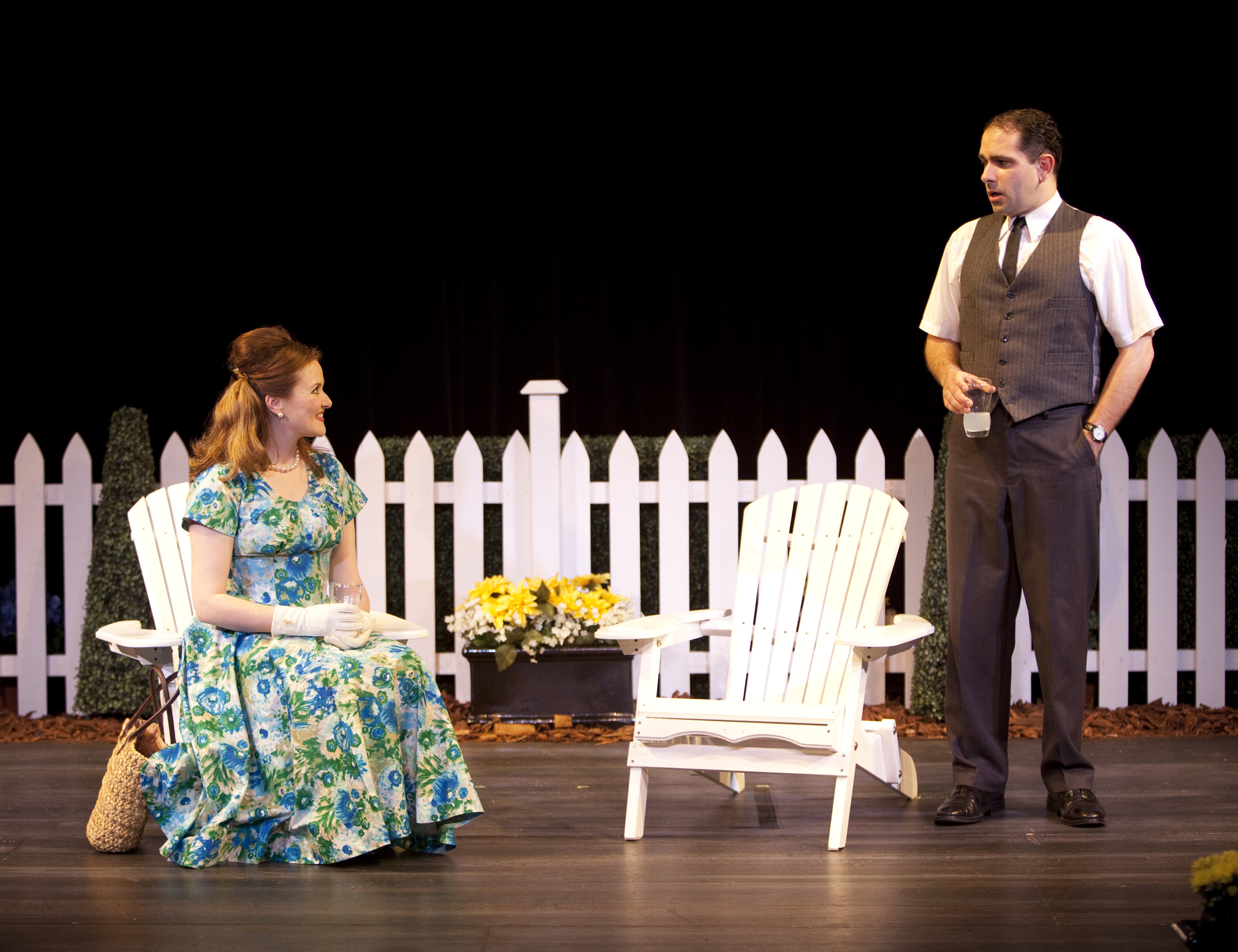
This is the question the oddly forward Helen Darimont asks shy bachelor Zachary Teale after she intrudes on his evening ritual of a quiet glass of lemonade in his garden. Zachary’s hour is the favour he grants, and it is this hour, played in real time, that the audience is privy to.

On the surface, this dainty two-hander, set in 1962, seems it may be perilously close to saccharine–the colours are bright, the patterns are floral, and there is a “just-so” simplicity to the story that could quite potentially grate against the sensibilities of any confirmed cynic.

But to hell with the cynics, I say, this play is lovely. To fault a story for being sweet is like faulting someone for smiling–if the impulse behind the good cheer is genuine, you’re probably just jealous. To dwell on the sweetness of this play as a flaw is to see the lemonade glass as half empty (and to not even notice that there’s a shot of bourbon inside).

Nevada Yates Robart…doing…something. Photo: Tim Matheson

Bourbon indeed. The saving grace of The Exquisite Hour is that it is not all sunny yellow sweetness. Actors Nevada Yates Robart (Helen) and Josue Laboucane (Zachary) infuse the good-natured humour of Lemoine’s script with a total and hilarious commitment to playfulness. It will likely be the strangest and nicest hour-long conversation you will ever eavesdrop on and I know I wasn’t the only member of the audience to scream with laughter or shake my head as an incredibly awkward but incredibly funny moment unfolded in front of me.

In case you are wondering, The Exquisite Hour is not an avant garde play. It is not high-tech. It will not cover your world in shades of ethical grey or expose the dirty underbelly of society. Plays that do these things are often good plays, and you find yourself leaving the theatre unsettled and challenged. The Exquisite Hour does not do these things, and yet, The Exquisite Hour is a good play, one that will leave you bright-eyed and tickled (take that, cynics!).

The appeal of The Exquisite Hour lies in its balanced combination of sunny nostalgia and refreshing verbal and physical humour. It’s a warm summer evening–spent with your weird but lovely neighbours. The world’s alright, the lemonade’s cool, and it’s that little kick of something just a bit stronger that makes your hour truly, well, exquisite.

Quite happily, I gave my hour to Relephant Theatre and I don’t want it back. If you would like to do yourself the favour of spending your hour at the Revue Stage, The Exquisite Hour will be running until May 12, with both evening and matinee performances. Tickets can be purchased online through VancouverTix.com, or by calling 604-629-8849.

Disclosure: My ticket (and +1) for the opening night of The Exquisite Hour was provided by Relephant Theatre. I remain the sole author of my content.