Why “How the Grinch Stole Christmas” is the Ultimate Christmas Movie

1210-grinch_full_600There are lots of classic and not-so-classic films vying for the title of the Ultimate Christmas Movie: Rudolph the Red-Nosed Reindeer, A Christmas Story, A Charlie Brown Christmas, Home Alone, and maybe even the relatively new Will Ferrell comedy Elf, to name a few.  But I think that the best Christmas movie of all, is the one about the Grinch whose heart was two sizes too small.

My own childhood watching the Dr. Suess classic certainly biases my choice, but I believe nostalgia is only one of the film’s important merits:

  • Script: Dr. Suess’ original poem How the Grinch Stole Christmas was a masterpiece. The journey from poem to animated film (including additional song lyrics by Dr. Suess himself) made the story a classic. Who can forget the instructions to “Trim up your pets with fuzzle fuzz/And whiffer bloofs, and wuzzle wuzz”? Or the heartwarming welcome to Christmas, “Fahoo Foraze”?
  • Performance: Has any film ever been more expertly narrated? Sorry Morgan Freeman, but Boris Karloff’s voice is so low, so refined, so Grinchy, so Christmassy! Besides, Karloff had to read words that weren’t even REAL. Words like “jing-tinglers” and “who-wonkas”. Did you have to do that? No.
  • Music: With instant hits like “You’re a Mean One, Mr. Grinch”, there’s no question the music in this film is awesome.
  • Whimsy: In a whimsy competition, Dr. Suess is sure to win hands down. From his imaginative characters and locations, to his creative use of language (I’m pretty sure “pantookas” and “whoboohoo bricks” are not native to this planet), to his wacky and wonderful line drawings, Dr. Suess is the definition of “whimsy”. And no film can truly capture the magic of Christmas without some whimsy.
  • The meaning of Christmas: this is by far the most important category, and How the Grinch Stole Christmas is not the only holiday film to decry greed and commercialization in favour of “the true meaning of Christmas.” Films like A Charlie Brown Christmas, for example, do just this. But unfortunately for me, the meaning of Christmas for Charlie Brown happens to be Jesus. There’s nothing really wrong about this. Christmas is, after all, technically a celebration of the birth of Christ (that just so happens to coincide with the winter solstice and the pagan celebration of Yule and the Jewish Hanukkah among other things). It’s just that the Christian theme of Christmas (the manger, etc.) has always excluded a person like me, who grew up celebrating holidays in a secular fashion but still believes in the magic of these special times of year. In How the Grinch Stole Christmas, the true meaning of Christmas is not revealed as being part of any particular religion. It is represented in the film as a glow created by the love and joy of the Who community coming together and welcoming Christmas, despite the loss of their material trappings. Dr. Suess’ message is also one of inclusion. Bitter and isolated in his mountain cave, the Grinch is able to join in the Whos’ Christmas cheer once he understands that their celebration isn’t about the superficial (toys, food, decorations, etc.), but about having a joyful spirit. With this spirit in mind, the Whos in Whoville immediately forgive the Grinch for taking their things and even grant him the honour of carving the Roast Beast.

I know everyone has their favourite Christmas film and that perhaps I have not managed to convince you. I don’t care. May the true meaning of Christmas give you the strength of ten Grinches plus two, on this Christmas and every Christmas.

xoxo, NiftyNotCool

Things That Spook Me

Happy Halloween!

(If you don’t have 3D glasses, hit play, then the “3D” button at the bottom to turn off 3D!)

In celebration of this ghoulish occasion, today’s post is devoted to the things that spook me. You know those things that are just really really freaky? The kind of ideas that pop into your head and immediately give you shivers down your spine? I do. Creatively, these scary archetypes are a gold mine for anyone trying to tell a spooky story on a dark night.

There is no better day than Halloween to list some of these deliciously spooky ideas. I didn’t come up with them, of course, they’ve always been there…just waiting…being spooky….and hungry for your fear………..

  • What if you looked at an inanimate life-like object, then looked away, but when you looked back it had moved? (Think the Weeping Angels from Doctor Who, or a taxidermied owl.)
  • What if you were looking in the mirror, and you saw something in your reflection behind you, but when you turned around nothing was there?
  • On that note, what if you were looking in the mirror, and you saw your own reflection doing something you weren’t doing?
  • What if you saw a friend/family member from behind, and called their name, but when they turned around they had no face?
  • What if you took a shortcut through the cemetery on a dark night, and a hand grabbed your ankle?
  • What if you were leaning over a dead body (at a wake, at your job at the morgue, after hand to hand combat with the forces of evil) and suddenly it reached out and grabbed you by the throat?
  • Similarly, what if a dead body opened its eyes?
  • What if Edward Scissorhands had turned evil without warning?
  • What if a ventriloquist dummy said something you didn’t make it say?
  • Creepy children. ‘Nuff said.
  • What if you were in an abandoned house that no one had been in for years and years, and up in the attic, a music box was playing?
  • What if you were in an abandoned house that no one had been in for years and years, and up in the attic, a rocking chair was rocking by itself…back and forth…back and forth…back and forth?

Have a safe and happy Halloween everybody. Sleep tight.

What would have separated me from Amanda Todd? Very little, actually

On October 10, in Port Coquitlam, a fifteen-year-old girl named Amanda Todd took her own life after years of horrific online and in-person bullying. She documented her personal hell in a YouTube video. I have chosen to post this video because according to the Vancouver Sun, Amanda’s mother, Carol Todd, believes that Amanda would have wanted the video to be used as an anti-bullying tool.

[Note: Please make your decision about whether or not to watch this video carefully. If you choose to watch it, you will be watching a young girl in incredible pain. Also, I urge you not to read the comments. For some reason posts like Amanda’s are a common target for trolls.]

After watching Amanda’s video last night, I lay awake and thought about my own junior high and high school years. I wondered what separated me from her, what had spared me from committing her desperate actions when I was a teenager.

The answer? Very little. Luck mostly. Like a large number of people my age, in high school I was no stranger to isolation. I was no stranger to self harm. I was no stranger to suicidal thoughts (that never went anywhere, thank goodness). I was pretty cavalier with myself and my self worth. And only because I was having difficulty coping with the regular teen stuff: boys, my body, academic and athletic pressures at school.

Luckily for me, I was never bullied. No one laid a hand on me, physically or virtually. If I had been, I don’t know what would have happened to me.  If I, as a teenager already stretched towards my limits, had experienced the cruel and (quite frankly) ridiculous, uncalled for HELL that Amanda Todd was put through, I can’t say with confidence that I’d still be here. Even without bullying, being a teenager is damn tough. Add this kind of torture, and I think many of us would have been in pretty serious danger.

Luckily for me, the technologies (Facebook, live chat, and cell phones) that made Amanda Todd so vulnerable to attack and exploitation either did not exist, or were not widespread enough where I grew up to provide the opportunities for harassment and torment Todd’s bullies indulged in.

Luckily for me, I spent most of my teen years in a very small town. I’m sure that bullying did exist, but in a town this small it would have been virtually impossible for any bully to hide behind the cover of anonymity. Being from such a small, tight-knit school and community (where everybody knows everybody’s business) can have its drawbacks, but at least your friends in kindergarten are generally your friends for life, and even though I was lonely sometimes, I was never alone.

Luckily for me, I had sisters who always kept an eye out for me and always made sure I was okay. I had an army of two on my side no matter what I did or what happened to me.

Luckily for me, the lack of technology and my physical isolation out on the Prairie meant I did not have the opportunity to make the so-called “mistakes” Amanda Todd mentions in her video as bringing on the abuse. With the kind of self-esteem teenaged girls generally have, I don’t really think many young girls (myself included) would have acted very differently in Amanda’s shoes. Who can truthfully say that all of their decisions between the ages of twelve and fifteen were good ones? Thanks to the internet, childhood decisions can hound people for the rest of their lives.

So I’m lucky. So incredibly effing lucky I feel sick about it. I feel sick that it took this poor child’s death (yes, she was just a child when all this happened to her) to show me this. What separated me from Amanda Todd or teens like her? Very little. Incredible good luck.

And now I have to ask myself, what separated me from the bullies that mercilessly and relentlessly abused Amanda Todd? I’d like to say a lot. I’d like to say there is a big difference between me and them. I think I was a good person, generally. I don’t think I ever bullied anybody. But I was a smartass with a big mouth. I did gossip. I did tell mean jokes sometimes. So I would like to say to anyone I may have hurt in high school: I’m sorry. I’m sorry I made you feel shitty. That was wrong. I have no excuse but my own insecurity and ignorance. I hope I will raise my kids to be stronger than I was and teach them that making someone else feel awful is never okay.

I hope I will raise my kids to understand how to protect themselves on the internet. And I hope I will raise my kids to understand that there are human beings on the other side of every nasty internet message or post they may wish to fire off. That using the internet to bully rather than your fists doesn’t make your hands any cleaner.

I hope I never forget what it was like to be a teenager. I know very few of us will forget Amanda Todd.

If you are a young person who is experiencing suicidal thoughts, or you know a young person who may be in crisis or thinking of suicide, please know that help is available. Here in BC, you can contact Youth In B.C. via anonymous chat on their website at youthinbc.com or by telephone at 1-866-661-3311 (604-872-3311 in the Lower Mainland). Help is available 24/7. You don’t have to face this alone.

The Joy of “Bopping”

When I was a kid, I had a habit of rocking my head (and often upper torso) back and forth. I did this constantly, primarily when seated (in the car, for example, or later, on the school bus). My parents called it “bopping”, and throughout my childhood the perceptions around it changed from viewing it as a funny idiosyncrasy to viewing it as a bad habit.

In some ways, bopping really was a bad habit, especially since I had difficulty determining what was an appropriate venue for it. Otherwise positive Grade 1 report cards would be sent home with comments about my singing and “bopping” in class. I understand that in a classroom setting, my inability to sit still (and silently) at my desk was distracting, and probably made me a target for friendly teasing (though nothing serious or scarring).

My bopping was a very obvious, very continuous kind of fidgeting. Everyone in the neighbourhood knew I was a bopper. One of my parents’ friends even told us kids a story in which I saved the day with my bopping. I can see how it would become less cute as I grew older, like thumb sucking or baby talking. I also understand why parents of a “bopper” might be worried by it. A six-year-old rocking back and forth like a Chechen orphan with PTSD is just kind of weird, I guess, and no one wants their kid to be made fun of.

[Note: Now that I’m an adult, I’ve a sneaking suspicion bopping was one of those bad habits my folks really did love me for, the way you might love your dad for his lame jokes or your grandma for the outlandish things she says.]

I’ve heard a few theories that rocking motions (and singing aloud, something I often did while bopping) can release feel-good chemicals like serotonin and endorphins and that children who “self-stimulate” by rocking may be suffering from serotonin imbalances. Cursory internet research has not provided any proof one way or another, and I don’t know if my childhood bopping was in response to any kind of chemical need. I do know that human beings are obviously soothed by rocking motions, hence rocking cradles, rocking chairs, hammocks, etc.

I think what no one really understood about bopping, and what I couldn’t articulate at the time, was that I wasn’t just rocking for the hell of it. I also don’t think bopping was a symptom of any sinister deficiency. The fact is, whether I was singing aloud or not, I was always bopping to the beat of music. Sometimes the music was on the radio, and then it made a little more sense to everyone else to see me boppin’ along. Often, though, the music was just a tune stuck in my head, but my drive to move with it was just as strong.

So that’s it. There was simply music with me always. I wasn’t “self-stimulating” or displaying a tic. I was dancing (inelegantly and repetitively). That’s it. Dancing. No need to worry about me, parents and teachers. In fact, if you don’t have so much music in your head you just have to bop along, it’s you I pity. Don’t try to shut down my one-girl party just ’cause you aren’t throwing your own inside.

Still, bopping has a time and a place (and an appropriate age) I guess, and eventually I did grow out of it. Sort of.

But you know what? The music never left. The rhythm never stopped. Catch me at a bus stop and you’ll see my right knee bobbing like crazy. Sometimes at work or on the bus I’ll wonder where a tapping sound is coming from and realize it’s my own foot. TC says that on a car ride I still do it a bit, to which I reply, well, yeah, ’cause there’s music on in the car! In addition, I often get pretty carsick, and as mentioned above, we all know a little bit of rocking soothes the soul. Really, I think my obsession with rhythm is just further proof TC and I are made for each other–I mean, he’s a drummer for goodness sakes!

Maybe you don’t buy the theory that I’m just dancing in an isolated part of my body. Maybe you think I do have a tic, or slight serotonin imbalance. Maybe I am “self-stimulating” when I fidget. To which I would reply, so what? Who cares? A grown woman taps her foot on the bus, maybe bops her head along to music sometimes? Completely harmless and none of your goddamn business. If I was using bopping (in my head, knee, or toe) to reach a state of chemical equilibrium, would that really be such a bad thing in light of the alternatives (i.e. drugs)?

I think not.

So bop on, my flower children and soul parents, bop on.

The Story of my “TC” (and Salt Spring Island)

I’ve been using the moniker “my TC” or just “TC” to refer to my, well, TC, for so long that I sometimes forget what it originally meant or why I chose those initials in the first place.

Taking a trip down memory lane (and into my archives), “TC” actually stands for “travel companion”, a label I originally made up so I could mention TC when he brought me to visit Salt Spring for the very first time (March 2011). Even though we hadn’t gone abroad or anything, I needed to invent a label because at the time, TC was not my boyfriend, technically. It was all about convenience.

Back then, I hadn’t quite expected two things:

  1. That I would shorten it to “TC” and continue using the term a year and a half later.
  2. That a year and a half later, my TC and I would still be making little travels ’round the province/country together, and living together, and being in love.

You see, I wanted to be practical. I needed a label–I found one. I liked TC and enjoyed his company. And I respected him. So sure, let’s go to Salt Spring, I could really use a weekend away. My heart was feeling grey and pinched in the grey and pinchy city. Away, away!

And then–ocean. Space. Looming rocks and weather-beaten piers. And then–a small yellow-painted cafe. Tea. TC’s fun Australian aunt and two little cousins lifting big shy eyes to look at this new lady (me!). And then–a house with a fireplace and full of books. The girls’ shyness falling away and sudden overwhelming energy taking its place. Sock puppet shows and board games. Scotch for the adults. Bed for the girls. Reading Goodnight Moon to TC’s (then) four-year-old cousin and nearly crying over it. Telling TC that I was glad he brought me here because now I knew the hard choices I’d made in my life thus far were the right ones.

The second time we went to Salt Spring, I needed it badly then too. I’d heard only two weeks before that one of my childhood friends was gone–suddenly, tragically, irreversibly. I snuck away to look at the view and have a cry. TC found me and sat quietly with me until I was done and I had to go inside to change because there was tree sap on my pants.

During our third visit to Salt Spring, TC and I acknowledged that we were officially “in a relationship” with one another, not that we hadn’t been unofficially for months anyways.

By the our fourth visit to Salt Spring, TC and I were officially “in love”, not that we hadn’t been for months anyways. I watched a blood red sun rise over the Gulf Islands. TC was sleeping so I shared the moment only with a little brown rabbit who was hopping by. I was terrified by the idea that because my TC loved me, it was possible for me to hurt him. Could I continue under the threat of this possibility? The thought stopped my heart.

By our fifth visit to Salt Spring, I had moved in with TC and his rabbit, who has an actual name, but whom I prefer to call Bunny. I had returned from my month travelling in Europe by myself, and I knew that TC was a choice I wanted to make. Everywhere I went, I had carried him with me, and at the end of that month we were carried back to each other.

We visited Salt Spring for the sixth time in April. Spring was busy this year–sometimes I would have only 15 min at home after work to change or grab a bite before rushing off to class or a rehearsal. During these times my TC would have a grilled cheese sandwich waiting for me so I wouldn’t starve. I never slept enough. I was irritable most of the time. Emotionally I was very fulfilled but mentally and physically I was exhausted and feeling grey and pinched in the grey and pinchy city.

And then–ocean again. Playing “C is for Cookie” on the ukulele with the girls. And then–a silence so present and soothing I slept for ten hours. Waking up and drinking tea in the sun on the back deck. So much fresh air I begin wondering how I could ever breathe anything else.

August. Our seventh Salt Spring visit. This one a little more hectic than usual, much of it spent helping TC’s parents move into their new summer house on the island. The sunny window seat in the dining room is dubbed “Lauren’s Spot” because I spend as much time as possible there, napping or telling stories to one of TC’s cousins. I’m struck with the realization that I have been accepted into TC’s family–they like me and care about me. Suddenly, in addition to my beloved own, I have a whole other family who wants the best for me. It’s such a gift and such a responsibility.

Labour Day weekend. Visit number eight. Through the window of a little Salt Spring Air float plane, my TC and I wave to his parents and (visiting) grandparents who are waiting on the dock and step out of the plane into a flurry of hugs.

This time, I’m not visiting the island merely to be rescued by its beauty and tranquility. Sure, we’re a little sleepy from our early flight but our eyes are bright and our hearts are smiling. This time, no euphemisms or nifty monikers are required.

I know just what to call my TC. On his own, he’s a lot of great and interesting things. To me, he is my partner in everything, my confidante, my support, and my best friend. But to use a quick term, I’ll just call him my fiance.

[P.S. Of course, I’ll still use TC. It’s worked out so well so far.]

“The Rat Race” (Nifty Fiction)

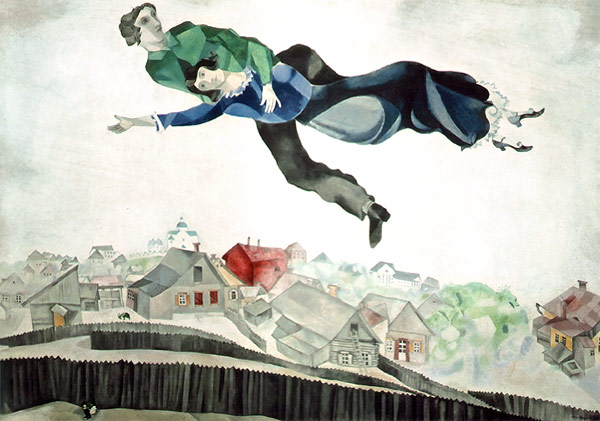
“On the City” – Marc Chagall

[Disclaimer: This is a work of fiction. I am not Delia, and TC is not Nathan. Nathan seems okay, but TC is much cooler. Here goes…]

The Rat Race

Maybe we should hire someone to clean the apartment.

This is an idea Delia has while she stands at the bus stop, the only one in the city where you can gaze out over the gray water to where the gray mountains meet the gray sky, shrouded in even grayer clouds. It’s a good idea, maybe. There are two of them working full time–they can certainly afford it. And the thought of the uncleaned bathroom waiting at home makes Delia feel as though she is failing at life. So maybe they can use their money to pay someone to clean (not everything, just pop over for an hour a week and clean the bathroom and maybe vacuum). It’s a good idea. Maybe.

By the time Delia boards the bus she is angry. There are two of them working full time. They both pitch in as far as household chores and errands are concerned. They shouldn’t have to spend their hard-earned money paying someone to clean. How is it that their dirty bathroom is allowed to make her feel like a failure? How is it that the world expects them not only to work full time to keep themselves alive, but to spend their leisure time cleaning and running piddly errands? Where’s the “leisure” in that?

As the bus launches along Cordova Street Delia leans her temple against the window, convinced that the world’s chief desire is to chew her up, suck the life out of her, and spit her out again.

By the time the bus turns onto her street, Delia has decided that she needs to quit her job. To hell with money–money has no use if she doesn’t feel alive. Besides, she isn’t making that much money anyways, at least not enough to buy a house or support a family. So what’s the point of sitting in an office shunting paper around all day long?

By the time Delia reaches her building she is feeling so reckless she takes the elevator even though she normally just takes the stairs. To hell with saving energy and the planet–the planet owes her for giving her this shitty gray day and a bathroom that despite her best intentions, still remains unclean.

Delia is careful not to slam the door when she enters the apartment but Nathan seems to sense the black dog on her shoulder and his conversation is light and inquisitive while they make dinner and Delia responds even though all she wants to do is lock herself in that goddamned dirty bathroom and have a cry. Once everything is on to simmer she leans forward and presses her forehead against the kitchen counter.

“Is there something I can do?” Nathan says.

“No, you’re perfect,” says Delia, “I just want to quit my job is all.”

“Oh.”

“Work is fine and everything. It’s just wearing me down. I’m supposed to be working so I can enjoy my life, except that I spend the rest of my life running errands or whatever, which is essentially work, except I don’t get paid for it. I work all day so that I can spend my time working. It’s stupid and I don’t want to do it anymore.” Delia says all this with her forehead still pressed to the counter, eyes searching the kitchen tile for her next moody thought.

“I think people work so that they can spend the rest of their time doing things that make them happy,” says Nathan (too optimistically, Delia thinks).

“Except they aren’t!” Delia cries and looks up at him, “We’re all running around doing stupid things just to take care of our homes and look like we’re having a good time but no one actually IS! I was supposed to clean the bathroom today except I spent all goddamn afternoon looking for a goddamn taupe sheet set and then the escalators at the Bay were broken so I got to tromp up and down three flights for no goddamn reason!”

“Did you find a taupe sheet set?”

“No I did not!” Delia sighs and puts her head back on the counter, squeezing her eyes shut. “Until this year I never quite understood the term ‘rat race’ and now I get it. Why do we do this? Is this all there is? I mean, it can’t be. If someone told you now that you would spend the rest of your life working all day so you could spend all of your spare time running around grocery shopping and scrubbing your toilet and taking your car to the mechanic only to retire and find out that the CPP had gone bust and inflation had eaten your savings and you were going to be busy and poor until you died, you’d kill yourself, wouldn’t you? I would. I mean, if that’s all there is.”

Nathan takes a breath.

“Do you want me to clean the bathroom for you?”

“No, it’s my turn. God, I just hate the city sometimes.” Delia looks up at Nathan again, into his bemused helpful face. “Do you think I would be a good farmer?”

“Um… I don’t know. Do you think you would be a good farmer?”

“I don’t know anything about farming.”

“Well then,” says Nathan, “probably not.”

“I just don’t want to live in the city forever.” says Delia.

“I know.” says Nathan, and then he washes the cutting board he’d been using.

In the middle of the night, Delia is woken by the terrifying realization that of course she will never be a farmer, that farming is not an easy life, and she will probably have to work at a desk FOREVER, especially if she has children, and they will bring her no end of errands and headaches.

An hour later, Delia wakes again and remembers that it could be much worse. She is also struck by a sudden comforting thought: the future children can clean the bathroom. Once they’re old enough. They can sweep floors once they can hold a broom, and probably do dishes too. It’s a good idea.

Nathan is warm and comforting beside her as Delia drifts back to sleep, content in her certainty that ten years old is plenty old enough to wield a toilet brush and some Comet. The universe provides.

Making Contact with Gifted Students in the VSB

This Friday, I will be attending the end of semester celebration for the Making Contact Mentorship Program, offered as Gifted/Enrichment Education programming through the Vancouver School Board. This is the second year in a row that I have participated in the program as a Creative Writing mentor. The program is always looking for more great mentors, so my purpose in blogging about Making Contact is to hopefully drum up more interest among my brainy and talented readers.

I was originally referred to the program by my friend, playwright and thesbian extraordinaire Emily Pearlman of MiCasa Theatre (Ottawa) who had volunteered with Making Contact as a writing mentor in the past. She is no longer living in the city but she found the program rewarding and thought I would enjoy it. She was right.

The purpose of Making Contact is to connect gifted Vancouver students with mentors who have expertise (or, in my case, skills and a helluva passion) for the same subject. The subjects explored could be almost anything. Making Contact is really only limited by the interests of the students participating and the ability of the program to find suitable mentors (in my limited involvement with the program, I have become aware of a variety of mentorships which included the following subjects: comedy, insects, film making, history, marine biology, comic book art, robotics, and transit planning). At the end of the program, students share the projects they have made with their peers, parents, and mentors at a celebration and in the Vancouver School Board office (projects will be on display there later this month if you’d like to check them out).

A unique characteristic of this particular program is that it is designed to provide enrichment programming to gifted VSB elementary students. Though several mentorship programs determine eligibility based on financial need or family circumstances, participation in Making Contact is determined by the talents and gifts of the students being referred, and their ability to make commitments of time and effort to the program. People have sometimes been surprised that the young writers I have mentored were not in financial or academic need, but to me a child is a child. The gifted children in Making Contact come from a wide range of socioeconomic and cultural backgrounds and are not necessarily in financial need, however, gifted children often experience isolation and frustration stemming from differences between them and their peers, and the inability of school programming to keep pace with their skills and interests. A program such as Making Contact allows these gifted students to benefit not only from focused exploration in their area of interest, but also from having a role model who shares these passions and interests.

I have been very lucky to have met both of the students I have mentored through Making Contact. They are extremely bright, talented, and humorous young women and I feel privileged to have been able to help them express their creativity through writing. I have also been able to strengthen my own writing through sharing my skills–a benefit which several Making Contact mentors across disciplines have discovered and discussed with me.

At the end of the day, participation in this kind of volunteer work just gives me the warm fuzzies. I get to spend an hour or so every week talking about writing and books (yay!) with a promising young person who shares my interest (yay!) and, well, I get to be a human being, making contact with another human being in a structured and mutually beneficial way. And that’s fantastic.

The subjects that interest the students referred to the Making Contact Mentorship Program are in fact so varied that you may not be aware that your skills and knowledge (either through your job or your hobbies) could be of interest and help to a Vancouver elementary student (for example, I had no idea so many K-7 students were interested in chess!). For information regarding which areas of expertise Making Contact is currently seeking mentors for, please visit their Current Needs page.

It’s time to impart my 26-year-old wisdom

This past year I was in Lisbon! Wowee!

Birthdays seem to be favourite times for people to reflect on their lives, the year that has passed, and what, if anything, they have learned about themselves and their world. Given that I possess a long memory (so long, it seems, that I also remember things that didn’t happen), and an obsession with things past, I am no exception.

As I turn 26, and enter what I consider to be the last year I can truly refer to myself as being in my “mid-twenties”, I’ve been turning over the events of the past year in my mind. I’ve been examining them and trying to figure out what I did right, what I could have done better, and what had nothing to do with me at all. My 26th year was a good year, as years go. I was very busy, and was challenged to be braver and smarter than I usually think I am, but I was also very engaged, very supported by those around me, and very loved.

If there is one common theme to be found among the many little things I’ve learned in my 26th year, it is this: my own decisions govern a much larger portion of my life than I had originally thought (though obviously life still throws in events, obstacles, and lucky breaks all over the place).

On the one hand, this scares me. To be in the driver seat of my life is a big responsibility (and one, at the age of 26, I really can’t escape). On the other hand, on my birthday at least, it feels incredibly empowering, and exciting. Be gone, stupid things that bother me, it’s my world now!

ANYWAYS, I’m not getting any younger so let’s cut to the chase: now that I am a super wise 26-year-old and am no longer held back by my 25-year-old naivete (ha ha), the gift I will give to the world this year is a list of decisions that, before my 26th year, I never knew were really decisions at all:

1. My own limitations are my decision.

I learned this when I travelled across Portugal and Spain last October. I was very anxious about travelling by myself for a month. I expected to be overwhelmed. I expected that I would be subjecting myself to the cruelty of the universe and my inability to read directions on a map and I’d spend most of the trip having an awful time. But I was fine. Yeah, I got lost. Yeah, I wasted some time and money. Yeah, planning on the fly can get a bit stressful, especially with shoddy internet connections and foreign keyboards. But I saw the things I wanted to see and did the things I wanted to do (with a couple of exceptions). I knew where the boundaries of my comfort zone were, and I decided to step outside of them.

In Barcelona’s Sagrada Familia

I also tried to recognize where having limitations was beneficial, and in those cases, I decided to honour those limitations. For example, because I was travelling alone, I decided that my health was paramount. So I didn’t drink much, and I didn’t stay up too late (Barcelona is a pretty expensive place to just lie around and be hungover in). Sure, I missed out on some of the clubbing, but hey, I’ve spent the past six or so years in highly physical training of one kind or another. I am very aware of the limits of my physical stamina, and I decided to respect them by being good to my body while I was travelling. So did I miss out on things? Did I limit myself? Yes. But my limitations were my decision and the compromises I made were ones I can live with.

2. Falling in love is a decision.

I don’t think I so much fell in love this year as made a decision to step forward into it. There is a moment, in love, when you can decide to leave certain things unsaid, or undone. You can turn back, you can pull away. It might not be this way for everyone, or every time a person is in love, but this time, I decided. I decided to accept the potential for heartbreak. I decided to make space for a new past, one that included a person who had never been in my past before. I decided to make space in my imaginings of my future.

It is a big thing, to take on the potential for hurt, to include someone else in your wishes. I’m glad I didn’t tumble headlong into it, sight unseen, and just stick with it because it was too late to turn back. I’m glad I decided. It was worth the decision.

3. A family is a decision.

There’s a funny old saying that goes, “You can’t choose your relatives”, and biologically speaking, no, you can’t. Your parents will always be your parents, your siblings your siblings, and your children your children. But that’s beside the point.

My parents’ vegetable garden on the Prairie, July 2011

The family I will always want to have is a family that is close and supportive, whose memories of funny moments and happy times outnumber the memories of arguments or strife. I don’t ever want to have a family that dreads seeing each other on the holidays, or dreads telephoning each other, and fortunately for me it is unlikely that I ever will.

That said, it occurred to me this year that just because I will always have my family, that doesn’t mean that they can be taken for granted. The same attention I give to my romantic relationships (because there is the potential there to lose the other person if things don’t work out) can and should be paid to my relationships with my family. This means trying to watch my temper, trying to be helpful, and trying to be understanding of my family’s peccadilloes, (the way they are understanding of mine). My family has always been close to me, and we are funny and awesome. Now that I don’t get to see my family as often as I’d like, I want to make sure they will always remain close to me. Whether or not I put in the work to maintain strong supportive relationships with my family depends on me.

4. Being a nice person is not one decision, it is many many decisions.

I’ve always wanted to be a nice person. I presently want to be a nice person, and I’ll always want to be a nice person. But deciding to “be nice” is only the first decision of many. Being a nice person means making a decision every time I am faced with the opportunity to prioritize my comfort over the comfort of another. Sometimes it means deciding not to be snappy or rude to a stranger just because I’m having a bad day. Sometimes it means giving up something that I want, but don’t actually need as badly as someone else does. Sometimes it means inconveniencing myself a bit for the convenience of someone else.

Does my good side always win out? No, it definitely does not. I’m still a work in progress, and I’m okay with that (no one’s perfect). That said, do I think I am a nice person? Yes, for the most part I do, because instead of resting on my laurels and assuming I’m nice because I’m polite and don’t kick puppies, I recognize that being nice is a continuous process.

It’s not just about how good I feel when I do something nice (and I do feel good), it’s about deciding to make my coveted identity as a “nice person” an effortful and continuous state of being. Or, you know, an effortful and continuous struggle. Because as anyone who knows me well can probably tell you, I’m no saint. But at least I try.

So “Happy Birthday” to me.

I’m probably one of the luckiest ladies alive, considering the often-charmed circumstances in which I spent my 26 years. Now that I’m a little bit older, I hope I am indeed a little bit wiser (otherwise I just wasted a lot of everyone’s time imparting my wisdom) and I hope at this time next year I will be able to look back on continued growth, and more bitchin’ good times. I hope you will too.
Granada, October 2011

[Note: This year I had hoped to repeat my Five for Five Project in the weekend before my birthday, but unfortunately a personal matter took me out of the province. Instead, to express my gratitude for 26 years on this great planet I have donated $26 to the David Suzuki Foundation.]

I Wanna Go Home–to High School

Lately I’ve been homesick–for high school.

I’m not one of those “summer of ’69, those were the best days of my life” types whose flower bloomed when they were seventeen and who’s been wilting ever since. High school was an emotionally messy, facially pimply, gossip and insecurity-ridden angst-filled existence. But it was also a period full of promise.

When I was in high school, I thought 25 was old. I thought I would have a career (in the theatah, of course!), a husband, and maybe even a kid by now (ha ha ha ha ha). I felt like the only thing separating me from my dreams was time and a university degree. I guess I assumed the rest would just arrive in due course as time went by. What I failed to understand then was that time does bring our futures into our lives, but that we don’t make that step from here to there without choices along the way, and sacrifices. The fulfillment of one dream may mean the compromise of another. You don’t just wake up one day and BANG! your future  arrives. You get to where you’re going through the decisions you make.

In high school, the only decision with long-term consequences I really had to make was where to go to university. It wasn’t much of a contest–I went to the U of A because I wanted to audition for their theatre program in the future and they gave me money (and even that wasn’t long term because I transferred after first year).  Other than that, I didn’t need to decide anything. Love? That wasn’t a decision. I just knew I had to be with so-and-so because he was The One (update from 2012: he wasn’t). Friends? I’ve had the same bestie since kindergarten. Career? I had a part-time job, it was okay and then I quit but that’s alright because my parents were feeding and housing me.

Done and done. All of the pesky decisions regarding survival and building a future out of the way, I had plenty of time to obsess over my clothes and go to parties and have crushes and heartbreaks and decide that no one understood what a sensitive intelligent soul I was (I just couldn’t wait for university where my brilliance would surely be discovered and celebrated).

My journey from high school has been a good one. For the most part, I’ve had a great time, with great people alongside me every step of the way. I’ve learned so much–about me, about the world, about all kinds of crazy things I never dreamed existed. I’ve travelled, I’ve been in and out of love, I’ve lost some things and found new ones and here I am, doing just fine, though definitely an adult for real now with some adult choices to make about my life’s direction.

Things are pretty good.

But when I was in high school, friendships didn’t need to be maintained–there were only 23 people in my graduating class so by Grade 12 we had put our junior high pettiness aside and become a family. We had each other, without even trying.

When I was in high school, no one I knew had died yet.

When I was in high school, our potential was unlimited because of our ignorance about the way the world worked.

When I was in high school, tomorrow was a dream so tonight was Party Time.

When I was in high school, we were all invincible and there were no choices that had lasting consequences one way or another (or so we thought).

If today was April 13, 2004, the ditches at home would still be full of run-off water and snow would still exist in front of the north sides of buildings.

I would be training for track and field.

My class would be studying Hamlet and we’d be dressing up in silly costumes to read the parts.

Most of the girls would have their dresses for graduation already hanging in their closets (mine was ivory–I still have it).

The 23 of us would be engaged in the easy comradery that comes of having known each other most of our lives and from knowing that we’d be graduating soon–we were all forging ahead together for one last push towards the Unknown. There is almost a patriotism that binds the graduating class of a small rural town to each other and to the community. Respect and pride would be felt in all facets of our lives.

We would all be together, on the verge of our dreams, before the pits and rocks would become visible. We’d be suspended in a beautiful moment of optimism.

We’ve all experienced loss since we’ve been in high school. When we talk to each other now, there’s a weight in our voices and on our shoulders that wasn’t there before. Some of these losses have been felt by all of us, and they pull us together across time and distance. Some of these losses have been private. We are becoming the adults that had sent us on our journeys and wished us so well, whose bright hopes for us masked their concerns about what we would face. We’re growing up–we haven’t been spared it.

If I could capture April 13, 2004 in a bottle, it would be the colour of milky yellow sunshine. It would smell like wet grass. It would sound like easy laughter and taste like a warm clandestine beer. And if I had my way, all 23 of us would be there to see this distillation and shake our heads at our silliness together. All of us.

Invisible Suffering (and what we can do)

Van Gogh’s Room at Arles

According to the Canadian Mental Health Association (CMHA), “approximately 1 out of 4 people know someone who died by suicide.”, which is a frighteningly high number of people confronted with shock and grief at the sudden loss of their friend or loved one. This post is an acknowledgment not only of the distress experienced by those who attempt or complete suicide, but also of the incredible loss experienced by those left behind.

I have been so fortunate in my life that I am able to say, and believe, that the world is a beautiful place and that life holds glorious things. But the sad truth of the matter is that the world is also full of pain, and for many people (more people than you’d think), the weight they have been forced to carry (by tragic events, an illness, etc.) is more than they can bear. Do not mistake this for weakness, selfishness, or ingratitude. This is simply suffering. Regardless of where it is found–in an old person, in a young person, beneath a tough exterior or behind a smile, it is suffering.

An important tenet of most (if not all) systems of ethics and morality is that people should, if possible, attempt to alleviate the suffering of others. This tenet does not extend only to those who are physically and financially suffering, but to those who may be suffering mental and/or emotional illness and distress as well. Unfortunately, unlike visible suffering such as physical illness or poverty, mental and emotional distress is often invisible–a secret pain closely guarded by the sufferer.

Unlike with visible suffering, there is no obvious solution—if we saw someone bleeding we would give them a Band-Aid. If a friend was ill we’d cook for them or offer to watch their kids for a while. But if someone is in mental or emotional pain, we seem to clam up, unsure of how to help, or if we should. If the sufferer doesn’t tell us they’re in pain, we often don’t even realize there is a problem in the first place.

When I say that it is our responsibility to try to alleviate suffering, I am not by any means condemning those who were not able to prevent the attempted or completed suicide of a friend or loved one. In any tragedy, several complicated factors are at play and seeking to lay blame with those who are left behind will only further stigmatize issues surrounding mental health and suicide.

So what can we do to help someone, especially if we don’t always know who is in need of our help? First and foremost, I believe we should remove once and for all the stigma surrounding suicide. In recent years, several brave families have decided not to hide the cause of their loved one’s death and have brought mental health and suicide into our consciousness (in the media, in our communities, etc.).  Suicide is not an attention-seeking dramatic act perpetrated only by “crazy” people.  It is a desperate act committed (and attempted) by human beings of various ages, lifestyles, backgrounds, and cultures. What these people have in common is that they are in pain. The more we acknowledge that this pain exists, the less we try to sweep it under the rug and pretend it doesn’t happen, the more likely it is that those experiencing this pain will share their troubles with someone and seek help and support. Knowledge is power, and the more we know about suicide and mental health, and about what those around us are going through, the more we can help each other or ourselves.

To that end, I have come across some links which may be helpful:

If you are concerned that someone you know may be considering suicide, the CMHA’s website has a very informative page on suicide prevention. According to the CMHA, “There is almost no risk that raising the topic with someone who is not considering suicide will prompt him/her to do it.” so even if you’re wrong about a person’s intentions, it can’t hurt to talk about your concerns and let them know that you care about what happens to them.

In addition to the information above, on their “Media Guidelines” page, the Canadian Association for Suicide Prevention (CASP) asks that the following information be included when someone (like me) is writing about suicide:

Warning Signs of Suicide

  • Suicide threats
  • Statements revealing a desire to die
  • Previous suicide attempts
  • Sudden changes in behaviour (withdrawal, apathy, moodiness)
  • Depression (crying, sleeplessness, loss of appetite, hopelessness)
  • Final arrangements (such as giving away personal possessions)

What to Do

  • Discuss it openly and frankly
  • Show interest and support
  • Get professional help
  • Call your local Crisis/Distress Line

If you are considering suicide, please know that help and support are available. To locate a crisis centre nearest you, please visit the “Find a Crisis Centre” page on the CASP website (suicideprevention.ca). To give you an idea of how important your life is, on CASP’s website there are 27 different organizations listing Crisis Lines in the province of BC alone. I urge you to reach out to one of these resources and/or a loved one.

Unfortunately, even with our best intentions, we cannot always prevent tragedy. For the survivors of suicide (i.e. those left behind), CASP provides information for those trying to cope with grief after a suicide. Their site also provides information and resources for helping you find Survivor Support. Like the crisis centres mentioned above, you can find these resources listed by province.

As with the suffering of those who attempt or complete suicide, it is important to remember that the survivors of suicide are suffering as well. If your friend or loved one has become a suicide survivor, the most important thing you can do is listen, without judgement, without “solutions”, and without pushing them to talk.

I wrote this post with the purpose of supporting an environment where anyone, no matter what their reason or background, will feel safe reaching out and seeking help for what they are going through. Sometimes this means seeking professional help and there is nothing shameful about this. Yes, the world may be full of a lot of pain but it is also full of people who want to help lighten the load, and professionals who have the tools to do so.

I am aware that Mental Health Week is in about a month’s time (May 7-13) but this post couldn’t wait–every week is the right week to try to alleviate any suffering you find, whether the suffering is your own or that of a friend.

Disclaimer – This post is technically an opinion piece, a result of my desire to minimize harm using the tools I have available to me (which include this blog). The information I have provided appeared on either the Canadian Mental Health Association or the Canadian Association for Suicide Prevention’s website at the time of posting. I am not a mental health professional, and the content of this post is not a substitute for the assistance of a mental health professional.