My “gendered job” and me

To preface, the following is not in any way a complaint about my job. It is simply the beginnings of a personal examination of a gender role I have chosen to play in my professional life.

secretary (1)When people ask me what I do, I say I am a secretary.

I say I am a secretary because when people ask what I do, I know they’re asking what I do for money. And I also say I’m a secretary because I think it sounds more glamourous than saying I’m an administrative assistant, even though the two terms are more or less interchangeable. The point being, I am a secretary.

I am a secretary in a small office in a large department in a much larger institution. And it’s a pretty great job, as far as jobs go–the pay is decent, the benefits are too, and my coworkers and managers are fantastic. In a world where I can’t sleep in until 10:00 every morning and collect a paycheque just for being lil’ ol’ me (a post-recession world where Canada continues to shed jobs like it’s going out of style and most job growth is in the part-time, temporary sector), a job like mine is highly prized.

To make a long story short, I like my job.

I like my job, but…

I’m beginning to wonder if being a secretary is just a teensy weensy bit gendered. I’m also wondering whether or not this matters at all.

To start with, of course being a secretary is gendered. Even if I didn’t know that administrative assistance is still a primarily female occupation, like nursing and childcare, I only need to look around the offices in my department to see that there are a LOT of women here. I currently work in a building that houses five administrative offices. Every single staff member here is a woman (including the managers, which makes sense considering they probably started as clerks or secretaries themselves). My office is fairly typical for my department and for most of the other departments that make up the institution. A trip to HR would reveal, as Mitt Romney infamously gaffed, “binders full of women.” So yes, in that this particular role is typically filled by women (whether intentionally or no), my occupation as a secretary is a gendered one.

Which is totally okay. I am comfortable enough with my feminism to know that staying in a good job with decent pay and a respectful and friendly work environment is a smart choice at this point in my life, even if I’m not exactly tearing down the glass ceiling every day (and even if my undergraduate degree is completely unrelated to my work; I know many other degree holders who are faring much worse). I know that the various roles played by secretaries are stereotypically female ones (receptionist, event planner, filer, typist, note-taker, organizer, pacifier, assistant, etc.), but these roles are necessary to fulfilling the duties outlined in my job description and I feel the roles are valued by my supervisors and manager.

Still, at some point in every term of employment, it becomes clear what those “other additional tasks and duties consistent with the position” line in your job description is all about. It means that certain tasks will fall on your shoulders because there simply isn’t a different place to put them, and you’re there, and your job is to be helpful.

I am particularly thinking about the times when I have been involved in food prep, food disposal, clearing tables, washing dishes, cleaning fridges, decorating, etc. while at work (and dressed in office attire, of course). None of these duties are spelled out in my job description, however, as an administrative assistant the umbrella  covering everything one might do to “assist” their office or department is pretty large (of course, my coworkers and often managers do their fair share of this kind of work and more, wrapping gifts, stopping by the grocery store to pick up a cake for someone’s birthday, etc.). The assumption inherent in the very definition of being an administrative assistant is that your job is to make life smoother for your superiors, clients, and coworkers. In other words, an administrative assistant’s job is to assist the administration, regardless of what the job description for that particular position actually says.  I am compensated quite fairly for this. And I really don’t mind.

BUT (and there really is a but, small as it may seem):

Because the employees in secretarial roles are overwhelmingly female, I worry that these “additional tasks and duties” are seen by many not as a natural extension of the role of assisting the administration a female employee works for, but as a natural extension of being female. Of COURSE we’re cleaning and decorating and preparing food and planning baby showers for coworkers, one might think, we’re WOMEN and we’re “good at that stuff”!

Well, yes and no. We’re “good at that stuff” because we do it all the time, and for many of us, we do it all the time because we were raised that way, but it really has nothing to do with being male or female. I’ve met guys who can barely hold a broom, and I’ve also met guys who can clean a bathroom better than I can (and I’m pretty damn thorough so that’s saying something). It really comes down to what you’ve been taught.

Western society is full of women who were taught to be acquiescent and obliging, self-sacrificing and silent. Western society is full of women who learned to anticipate the needs of others and to take care of those needs while ignoring their own. Western society is full of women who learned to make themselves invisible, as if the gleaming home and the well-fed children and the glass of scotch on the end table occurred by magic. This was fortunately not my experience growing up, but it is still the legacy I have inherited. As much as I enjoy my workplace and the security and comfort my secretarial job brings me, I worry that I might be contributing to this legacy in ways I did not intend. I mean, I don’t agree with the idea that a woman’s worth relies solely on her ability to facilitate the grander and more recognized work of others, but this is the only thing for which I have allowed myself to be paid in my professional life.

In other words, I have let society, in the form of my employment, gauge my worth using exactly the kind of yardstick I have always claimed to despise. What’s more, I’m good at it, and I like being good at it. I take pride in my ability to talk down an upset client, or to anticipate a manager’s needs, or to maintain a cabinet of files just so. I love my “telephone voice” too. I have put on the role of secretary as if it were a costume in a play, and let me tell you, I wear the hell out of it.

Am I wrong to do this? I honestly don’t know. It’s something I’ve started thinking about and something I will probably continue to think about as my life changes and I become a wife and eventually (hopefully) a mother. What roles do I want to play? How do I want to play them? And is what I am doing now negatively impacting my future ability to escape roles I don’t want? TC is no Don Draper, but the roles I take on within my family shouldn’t have to hinge on the fact that I picked a good man; they should be something I can come to with both eyes open. Fulfilling a traditionally female role is not a bad thing (this kind of work is tremendously important and has a lot more worth than society usually assigns it), but I don’t want to be expected to fulfill certain roles just because of my biology.

At any rate, I’d be interested to hear if other women working as administrative assistants have had similar experiences or concerns, or if they have found their roles to be gendered in more ways than just the fact that they are in a traditional female role (I hardly ever get comments on this blog but if you’d like to leave one, go for it!).

A Feminist’s Case for Men’s Centres on University Campuses

male-sign-bathroom-bw-boarder-hiWomen’s Centres have been a regular fixture on many university campuses for a number of years. These spaces provide a safe environment for self-identified women to hang out on campus, but also to access support, referrals, and resources pertaining to sexual and reproductive health, sexual assault, domestic abuse, and mental health. Women’s Centres are usually pro-feminist, pro-choice, anti-racist, and anti-homophobic. Which is all to say that Women’s Centres on university campuses are something I wholeheartedly support. There are numerous issues that affect women and I understand completely the need and desire for women to have a safe, non-pressured space at university.

What often dismays me is the backlash that follows any institution’s forays into developing Men’s Centres. While I know that the fear of a designated “male space” being co-opted by MRA groups to push an anti-woman agenda is legitimate, I feel that the status quo is not really working either. If disenfranchised young men can’t find support on campus, where do you think they’ll end up? MRA internet forums are ready to welcome angry young men with open arms, and believe me, the discussions there are a lot more scary and stomach-churning than anything that would occur under a university administration’s purview.

The issue of whether or not Men’s Centres belong on campus is very complex and a lot of factors are at play here. I suppose when I voice my support for Men’s Centres on university campuses, I should clarify what I mean and why: I mean a safe space for self-identified men to hang out on campus, but also to access support, referrals, and resources pertaining to sexual and reproductive health, sexual assault, domestic abuse, and mental health. When I say “self-identified men” this of course includes trans men and men of any age, ethnicity, or sexual orientation. As a woman, I have always felt more comfortable discussing my emotional, mental, and sexual health with other women, and I imagine that men would feel similarly about discussing these issues with men.

Of course, it’s not as simple as this, as last year’s debate over Simon Fraser University’s proposed Men’s Centre demonstrates (I should note that while I support Men’s Centres in principle, the way in which funding for this proposed Centre was acquired and the reasoning behind it was problematic and over-simplistic to me). There are very legitimate concerns, including a long-standing history of female oppression, that would need to be addressed before a Men’s Centre should go ahead. Open and cooperative communication between Women’s and Men’s Centres on campus should be a must. The attitudes expressed in either Centre should never be adversarial or competitive towards its counterpart and the objectives of each Centre, including a code of conduct for staff and volunteers, should be clearly stated and adhered to (this would hopefully prevent a Men’s Centre from devolving into a misogynistic clubhouse).

I think debates around the rationale for Men’s Centres are important because the “target” of such a Centre would need to be identified. Is the Men’s Centre being established to blame, fight, or otherwise “push back” at women/feminism? If so, such a Men’s Centre would not be an appropriate use of university space or funds–it would basically be a university-sanctioned hate-space. But if the Men’s Centre is being established to address issues related to men’s mental and physical well-being, and to recognize the harmful ways patriarchy puts pressure on young men (by telling them that “real men” don’t cry, or providing them with only a very rigid and outdated framework for what it means to “be a man”, promoting steroid use or violence as a problem-solver, etc.), then this is absolutely the kind of initiative I would support.

I’ve heard the sound byte that “every space outside the Women’s Centre is already a Men’s Centre”, and I see where this is coming from. Historically, the world we live in was for centuries strictly a man’s world, and in the majority of private and public spaces, it still is. That being said, I also know the following:

  • Men suffer from mental health issues; many suffer from drug and alcohol addiction; many commit suicide
  • Men are victims of sexual assault (their attacker can be male or female)
  • Men are victims of domestic abuse (their abuser can be male or female)
  • Men are victims of childhood abuse (their abuser can be male or female)
  • Men have health concerns specific to their gender (prostate cancer, for example)

It has always seemed strange to me that what would be immediately (and rightfully) recognized as assault (by most people) if it happened to an unconscious woman at a party is often dismissed as “hazing” or “a joke” if it happens to a man (a couple examples involving amateur sports teams come to mind). I’m always surprised to hear from those who believe that a man can’t be raped by a woman because “something has to be cooperating” in order for the rape to occur (news flash: boner or no, if the guy is passed out and hasn’t said yes, it’s not consensual and it’s not okay). Most of these male victims are shamed into invisibility–they’re “pussies” for not being able to prevent their own assault, and “reporting” usually gets no further than hallway whispers on Monday morning or a pained admission to a spouse. I believe that creating a space for men to receive help and support sends three important and very useful messages:

  1. Rape, sexual assault, and domestic abuse do occur.
  2. No one, regardless of their gender, and regardless of the gender of their attacker, deserves to be raped, assaulted, or abused.
  3. If you are a victim of rape, assault, or abuse, you can receive help regardless of your gender. Being attacked does not make you a less worthy woman, or a less worthy man.

While it is true that women are victims of sexual assault more often than men, an official acknowledgement by men (as enshrined in the mandate of a Centre, for example) that these crimes do exist would, in my opinion, be a very good step in the fight against rape culture. And I am simply not interested in comparing wounds. How can I say that a woman’s rape is worse than a man’s (except to say that it was more likely to happen to the woman)? I can’t. And how can I say a male rape victim would be less deserving of a safe space on campus? I can’t–the patriarchy that put him in an historically-advantaged position obviously did not prevent his rape, and is not his fault.

I should note that the resources and referrals offered through Simon Fraser University’s Women’s Centre are also available to men, and that the Women’s Centre welcomes the involvement of “Male Allies”. While I applaud these initiatives, I don’t think they can be as effective as they are well-intentioned. The fact of the matter is, if you are the kind of “manly man” that cares about his masculine image to the point that it would be hard for you to ask for help or support if needed, I highly doubt you would be caught dead approaching the Women’s Centre for assistance (I’m not saying it’s a very sophisticated attitude to have, I’m just saying it’s true). I also believe that a man wishing to learn more about the effects of gender constructs and the legacy of patriarchy in his own life shouldn’t have to do so through the Women’s Centre as an Ally, he should be able to do so simply as a man who is interested in gender (yes, I know he could just go to the library but he might not know where to start). A male gender studies professor might be the perfect person to help curate such resources in a Men’s Centre on campus.

Finally, while I am not a fan of patriarchy, I don’t believe men themselves are the problem. I respect that there are some instances in which men would prefer to turn to other men for advice, resources, or support, the way I expect men to respect my preference for discussing sensitive personal matters with women. The bottom line is, I trust men to investigate and support their gender without being misogynistic, the way I expect my feminism not to be aligned with misandry. The more we push against Men’s Centres, the more MRA groups (the exact opposite of the kind of groups we want to see on campus) will use this as “evidence” of some kind of feminist conspiracy to oppress men. What I want to see is less angry, suffering, and disenfranchised men on campuses with nowhere to turn. I think Men’s Centres could help.

All I’m saying is give the guys a chance. Established correctly and run with sensitivity and a spirit of collaboration, Men’s Centres could become some of our most useful allies as we try to make university campuses a safe and supportive place for everybody, no matter their gender.

To speak up or shut up, that is the question

Jane Austen banknoteLast December, when I wrote a post about casual misogyny on the anniversary of the gender-based massacre at Montreal’s Ecole Polytechnique, I realized, I think for the first time, how much my blog has exposed me. I also got a small glimpse of the sheer, immeasurable, and baffling amount of hatred and anger that exists on the internet, and how much of that, for whatever reason, is directed at women.

I’m not saying that misandry does not also exist on the internet. I am certain that it does, and I do not agree with it, but that being said I have seen nothing to suggest that the amount of misandry on the net is anywhere close to the tsunami of misogynistic vitriol (including rape and death threats) being directed at female bloggers, media personalities, and public figures just for speaking out about an issue that affects them, while also being a woman.

A recent example of this is the case of academic and blogger (and my former school chum) Lucia Lorenzi. After reading reports that UBC frosh leaders from the Sauder School of Business led their students in the now infamous St. Mary’s University Y-O-U-N-G rape chant (and encouraged them to keep it a secret), Lorenzi spoke out. She wrote a passionate and well-researched post on her blog, which led to her being featured in the Vancouver Sun, on CBC’s the National (though much of her interview was cut from broadcast) and as a guest on the Bill Good Show on CKNW. While taking part in outrageous chants is a rite of passage during university frosh weeks Canada-wide, this particular chant is so obscene and so dismissive of the serious issue of rape (“Y is for your sister, O is for oh so tight, U is for underage, N is for no consent…”) I really can’t see what frosh leaders could possibly have been thinking, and you really can’t blame students like Lorenzi for having a major problem with a chant like this being encouraged at the institution where they work, study, and pay tuition (and where many survivors of rape and assault also attend).

But some people do blame her, and women like her. In the few days since her media appearances, Lorenzi has already been receiving nasty messages, and, more worryingly, has been trashed on a well-known and very creepy MRA website as part of a more targeted attack aimed at Denise Ryan, the Vancouver Sun columnist who wrote about the rape chants. To some, it seems, the problem is not the rape chant, which is “tradition” and “no big deal”, the problem is Lorenzi, for being a “bitch” and expressing her outrage (at something that might reasonably spark outrage among both women and men). Even for those who don’t agree with Lorenzi’s point of view, surely harassing her for speaking out only further proves her point that misogynistic attitudes (like those embodied by the rape chant) are present in society and have compromised her right to physical and emotional safety as she pursues her studies and career.

Here’s another example for you: across the pond, the Bank of England revealed plans to replace Elizabeth Fry with Winston Churchill on the new £5 note, meaning the only woman’s face on British currency would be the Queen’s. British journalist and activist Caroline Criado-Perez thought that was a bit crappy, so she spearheaded a successful campaign to have Jane Austen replace Charles Darwin on the new £10 note by 2017. Sounds good, right? Austen is arguably Britain’s most well-known female author, her work is still popular and well-loved (spawning countless film adaptations, mini-series, and literary spin-offs, including the inventive Pride and Prejudice and Zombies), and her popularity (and representation of a certain kind of quaint, genteel England) certainly helps bring tourist dollars (er, pounds) into the country. What’s not to like?

A lot, for some. Surprisingly, there are many people who did not like the campaign at all, and not because they’re just not Jane Austen fans. Within hours of the announcement that her bid to place Jane Austen on the banknote had been successful, Criado-Perez began receiving rape and death threats on her Twitter account. When Member of Parliament Stella Creasy spoke out in Criado-Perez’ defense, Creasy received rape and death threats too (some of them quite graphic). According to their online attackers, it’s not okay to want to see a woman on your currency (even though women form half the British population and make significant contributions to society). It’s also not okay to be a woman who takes issue with another woman receiving rape and death threats. The cause of this shit storm? Apparently, some online trolls are upset about the idea of Jane Austen’s face on the tenner and took the campaign as a form of misandry.

Which is ridiculous. I mean, this is a celebration of JANE AUSTEN, people, not Lorena Bobbitt. How full of hate must you be that you find it justifiable to threaten to kill someone over JANE AUSTEN? (This is not to say you have to like Jane Austen on your money, literary critic Frances Wilson certainly doesn’t, but you’ll notice she’s not planning to rape anyone about it.)

You don’t have to change your entire country’s currency to incur the wrath of internet trolls. Sometimes you just have to be a female gamer. Or a a female student who doesn’t like rape chants, like Ms. Lorenzi. Or a woman who happens to be caught on video protesting for women’s rights. Or a female blogger on a popular website like Jezebel. The fact is that when people notice you speaking up, some of them want to take you down. Even with my tiny readership, I’ve still been afraid to write about this issue because I don’t want to draw negative attention to myself.

I just want to speak. I just want to be able to speak about the things that bother me. And this is something that bothers me–this fear that I have felt whenever I have wanted to blog about certain things. And it’s inherently unfair:

If I speak out, I may draw negative attention to myself. Reading about the experiences of other women makes me hesitant to speak up, which is likely exactly what the trolls who indulge in this kind of heinous behaviour are going for.

If I stay silent because I am afraid, the trolls win.

If I speak up and say that I am afraid, the trolls know that they are successfully frightening women, and they still win.

In my first year of university, I took an introductory course in ethical and political philosophy. My brain just about exploded when I encountered Iris Marion Young’s “Five Faces of Oppression” in my readings–it had never occurred to me that I could be oppressed just because I was a woman. Sure, I knew women in other countries were oppressed (women who couldn’t vote or go to school or wear what they wanted for example), and I knew that women who were in physically abusive relationships were oppressed, and I knew that obviously the wage gap existed and the glass ceiling and all of that. But my mind was blown when I began to grapple with Young’s idea that women in general are oppressed, not necessarily because anyone is actively trying to hurt them or keep them down, but because they live with the constant fear of rape, a fear they are subject to simply for being a woman (whether or not you agree with Young, this idea is incredibly compelling and worth considering). A woman’s choices and behaviour, therefore, must be different from those of her male peers because she is constrained by a threat of violence they are not subject to.

This idea that the threat of rape is a form of oppression translates well to what I see happening on the internet: the threat of gender-based trolling is certainly giving some female bloggers (like myself) pause, and affects what we say and do online. If I say the wrong thing, if I make the wrong choice, I may put my physical and/or emotional safety on the line. And that’s really scary.

I really really like this blog, small as it is. I really like writing about things that are important to me, and sharing those things. Most of the time, I don’t write much that could be considered all that provocative (I think my views are fairly in line with most left-wing Canadian values, so they’re not all that radical, and even if they were, that’s no reason to send someone a death threat), and I don’t feel the need to be provocative. But there are a few blog posts (this one included) that I have wanted to write for a long time, but probably won’t (or not for a much longer time), because whenever I think about the idea of posting them I feel a tug of fear.

So I won’t be writing anything directly about the MRA movement anytime soon, though I think it’s a complicated and incredibly charged topic that deserves as much conversation from as many sides as possible. I won’t be writing about the emotional abuse I experienced at the hands of a romantic partner in my younger days, even though I think it might help people of both genders notice the red flags of emotional abuse earlier on. Unlike the trolls I am afraid of, I do not have the luxury of sending disgusting violent messages to people I don’t agree with, because I’ve attached my real name to my online identity (I think I once told former Heritage Minister James Moore on Twitter that he should be ashamed of himself and I felt bad about it all day–he’s the Industry Minister now; I doubt I hurt his feelings much).

So do I speak up or do I shut up? Do I let the trolls win by staying silent, or do I let the trolls win by letting them know that I’m scared, but in doing so perhaps join a growing chorus of women and make speaking up easier for someone else next time? I guess if I’m writing this post, I’m choosing the latter, though as of this moment I haven’t hit “Publish” yet.

If you’re reading this, I guess I chose “Publish”. I hope the internet’s okay with that. I’m not asking for a flame war here, just the right to safely speak my mind on the website I pay for.

What’s in a (Last) Name?

I recently read a Big Think article by the controversial (pseudo) academic Satoshi Kanazawa, entitled Why Children Must Inherit Their Last Names from Their Father, Not Their Mother. I should have known better. Kanazawa’s reasoning was, of course, ridiculous (I mean, this is the guy who published an article supposedly explaining the “truth” about “why black women are considered less attractive than other women”. I’m paraphrasing but not much. Please. Gag me with a spoon). I should not have given that idiocy (and thinly veiled misogyny) another thought and, at first, I didn’t.

But seeing as how I’ll be a married woman in not so very long, I have been thinking about this issue a lot lately. First and foremost, with my own name. My last name, Kresowaty, is long(ish). It’s Ukrainian. The only situation in which people meeting me for the first time have ever pronounced it correctly, or read it aloud without confusion or panic, was when I lived in Poland (and then uber correctly, pronouncing the “w” as a “v”, which in Canada I don’t bother to do). But despite suffering through years of mispronunciations (or having people address me simply as “Miss” rather than attempt my surname), I like my last name. I feel my last name very strongly to the core of my being. I want every good thing I do in my life to have the name “Kresowaty” appear on it. And I don’t think that will change.

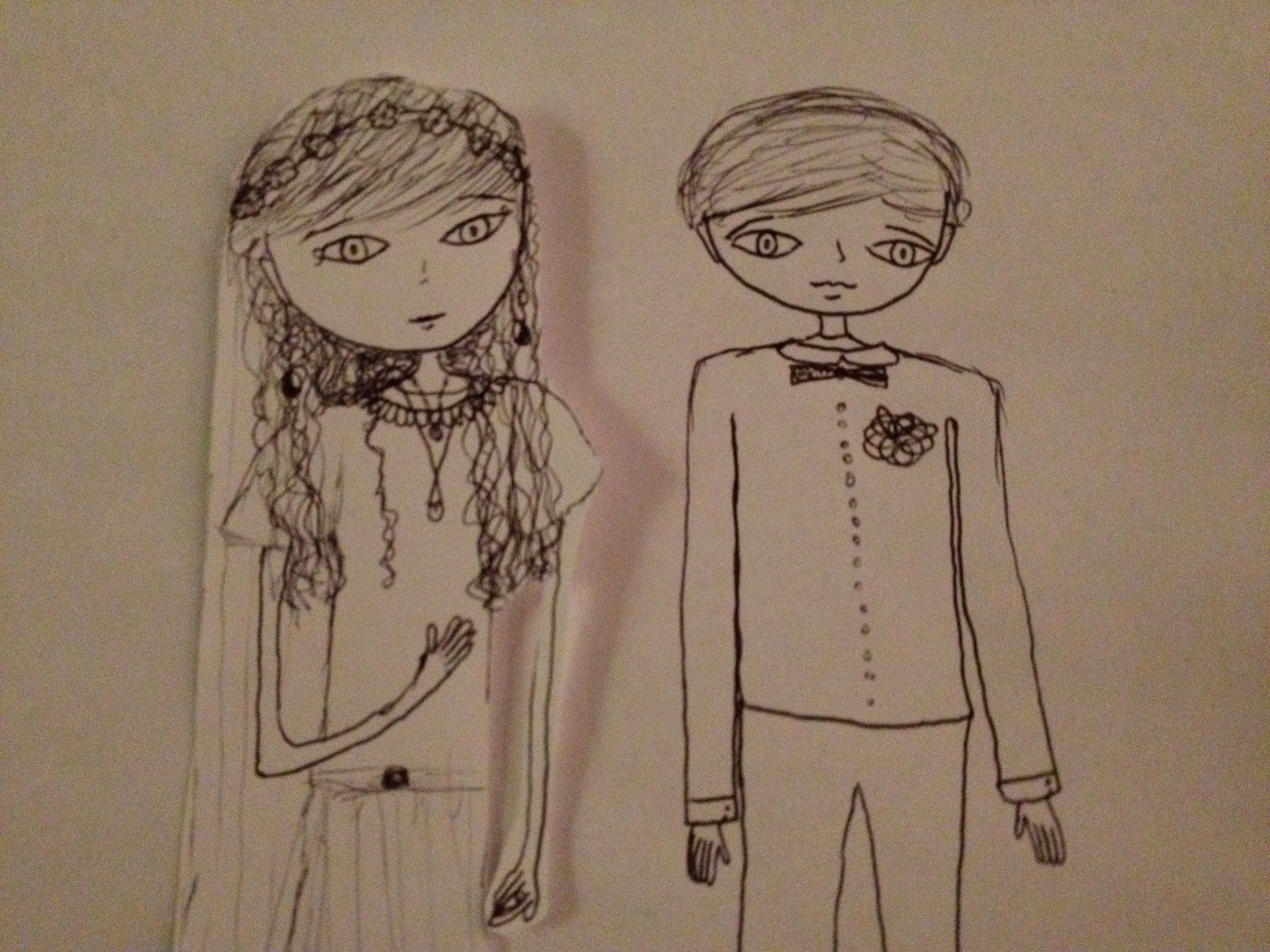
Illustration by TC's little cousin, who was 9. I like my drop earrings.

Illustration by TC’s little cousin, who was 9. I like my drop earrings and double necklaces.

I remember reading a blog post several years ago by a woman who explained why she kept her maiden name, rather than take on the last name of her husband and children. I was very surprised by the vitriolic comments her post received. People called her a “feminist c–t”. People told her she was a terrible mother, psychologically damaging her children by sending the message that she does not love or respect their father, or truly consider herself to be part of their family.

Bullshit. My mother has used her own surname, Zilans, both personally and professionally all her life. Her marriage to my father nearly thirty years ago did not change that, and I never felt for a second that she didn’t love us or didn’t want to be part of our family. Still, when I was a kid I once asked my mom why she never changed her name. She said, “Why would I?” That’s all the reason I’ll ever need.

That’s not to say that I don’t respect the choice of women who want to go the “traditional” route and take their husband’s name after their wedding. Knowing how I feel about my own name (and my mother’s) I was surprised when some of my contemporaries changed, or told me they were planning to change, their names. But when I think about it, it’s a lovely choice to make. Some people feel true to themselves when they have the name they were born with. Some people will feel more true to themselves by marking this milestone in their life by changing their last name. And it’s a choice I respect.

But the choice of whether or not to change your surname should remain just that–a choice. This means that while I support a woman who wants to take on her husband’s name, I also equally support any man who wants to take on his wife’s. Why not? A choice is a choice. In contemporary Canadian society, a woman is not the property of, nor subservient to, her husband. So if he wants her name, why the heck not? Or if they both wanted to change their last name to “von Sparkleson”, why the heck not? The argument that such arrangements are “untraditional” holds no water when you consider that Canadian law now recognizes marriages between couples of the same gender. What heteronormative “tradition” is to be honoured in these marriages, marriages which are fully sanctioned and recognized by Canadian law? How about whatever they want? And if gay couples can do whatever they want with their names, why can’t I?

And now back to the question of children. While my mother broke from Western tradition by keeping her last name, my parents still went the traditional route by making my sisters and me “Kresowaty’s”. I don’t dispute their choice–as I said, I feel so much a Kresowaty I can’t imagine being anything else. It’s worth noting, however, that in the hospital the first name I ever bore was “Baby Girl Zilans”, marked on my bassinet because my parents took their time naming me and the hospital needed to call me SOMETHING. So if I could survive those days in the hospital with my mother’s name rather than my father’s and not suffer from some non-traditional naming identity crisis, it’s entirely plausible I could have been a Zilans (yet another formidable Eastern European name) all my life and been perfectly happy.

But it feels different, doesn’t it? Keeping one’s “maiden” name after marriage is generally considered acceptable nowadays but boy oh boy, tell a person you think that your future children should bear YOUR name (since you’re the one doing all the pushing and shoving to get that baby born after all) rather than their father’s, and watch their confusion. Watch the cogs of “That’s not normal!” and “That’s just not how we do things!” turn in their head. It’s an interesting experience. And it’s not just men that seem to feel this way, it’s, well, mostly everyone it seems. Even my own parents seem to have accepted that their line of “Kresowaty’s” ends with their daughters and don’t really see why a couple would bother with the hassle of going against the grain by using the mother’s name, or, as suggested by super genius Marilyn vos Savant (IQ of 228, people) giving maternal surnames to daughters and paternal surnames to sons.

I actually don’t really care if any future sons don’t bear my name, maybe because in my mind I would identify them, by virtue of their gender, with their father. But if I have daughters, I want to have “Kresowaty girls”. I was a Kresowaty girl (now a Kresowaty woman, I suppose). My sisters were Kresowaty girls. And we were awesome girls, who grew up to be awesome people. So if it ain’t broke…..

But it’s not normal. It’s not traditional. It’s not done. And according to the aforementioned controversial Kanazawa, it would cause paternal uncertainty, and a father would be less likely to invest in his kids if they didn’t bear his name, hurting the children and society in general.

Bullshit. Kanazawa’s argument is based around the evils of cuckoldry, and it’s a bunch of bullshit. As he points out, like (good) human fathers, the fathers of many bird species invest heavily in the offspring of their mate, and unfortunately for those poor birds, they have no way of knowing if the eggs are really theirs or not, meaning they are potentially investing their energy in somebody else’s sperm. You know who doesn’t give a hoot? Me. You know who else doesn’t give a hoot? The birds. They take care of their mate and her eggs, they further the species (which was probably strengthened by the mother making some discerning choices between biological mate and social mate) and they all live to flap and crap another day. So much for the birds.

As far as humans go, if you think a name is any proof that a child is yours, you’re an idiot. Either you trust your partner or you don’t. And if you don’t, why ask a name to do what birth certificates, adoption certificates, and blood tests can do so much better? So much for names as proof of paternity (besides, this argument assumes a family to be a biological, nuclear one, completely ignoring the single parent, blended, and adoptive families that also contribute to our society’s fabric).

It’s not that I don’t like TC’s surname, or don’t think it could or should be bestowed upon our future children. It’s that I resent, with all my might, that no one thinks I should have a choice in the matter. One of the reasons I am marrying TC is because I have never in my life felt more that I am in a true partnership of equals. This equality will not end after the wedding, and it will not end when I give birth. If I thought it would, I wouldn’t be getting married (and quite frankly, if TC was not the man he is, I doubt a stubbornly independent soul like me would interest him much anyhow). And I know many equally intelligent people in many similarly equal partnerships. So why, after nine months of pukey swelly pregnancy, and hours of painful labour (or, conversely, after the months/years of bureaucratic hurdles that precede an adoption), does everyone think it’s completely normal for the agency of the female member of the partnership to be stripped in this situation?

I guess it’s normal because it’s done. But that doesn’t make it logical, or rational, or correct. It’s simply a preference. And if passing on the father’s name to the children is what the couple prefers, that’s great. But what if it’s not?

When I talk to people about my feelings on this issue, invariably I am asked, “Can’t you just use a hyphenated or double last name?”. The answer is no. I can’t. For one thing, when a person has a double or hyphenated last name, the first name (usually the mother’s) often gets treated as merely a second middle name and is dropped from normal use. So it’s not a satisfactory solution for me. Secondly, what if my hyphenated kid married another hyphenated kid, and they both wanted to keep their names, and their kid ended up with not one but FOUR last names? Ridiculous. And finally, my last name has four syllables. TC’s has three. Some people have seven-syllable last names, that’s the name they have to pass on to their kid, and it’s not their fault. But I really wouldn’t feel kind giving a seven-syllable surname to a child on purpose.

I’ve been told that giving sons one surname and daughters another would be very confusing for other people trying to identify my family. And that’s probably right. But names don’t make a family. Blood doesn’t even make a family. Love, and shared experiences, and sacrifices make a family.

Which is why, when the time comes, despite all this rantin’ and ravin’, I may sacrifice my last name after all (as far as the kids go). And I will love my family no matter what they’re called–I just wish the situation were different. I wish that TC and I could make this choice on our own, and that what society considers to be “traditional” and “expected” had nothing to do with it. Because with those huge pressures at play, how can we possibly make a choice that reflects how we really feel? How can we even identify how we really feel? We can’t. I’m not even sure if my feelings now reflect my real wishes, or are just a reaction to a structure I find outdated and unfair.

And I guess what I truly, desperately want, more than a name, is the opportunity to make a private decision with my husband about our children’s last names. But in the structure we live in, still old-fashioned in so many ways, we will never, never have that.

It’s December 6, and casual misogyny abounds

Green-AppleThis morning Canadians on Facebook and Twitter have been calling on us to remember the 14 female engineering students whose lives were taken by a gunman on December 6, 1989, and to pledge that violence against women will stop.

I was particularly taken with this address made by NDP MP Megan Leslie in 2008 and shared on Twitter today. Leslie said, “We live in a culture of casual misogyny…And we don’t do enough to fight it.”

This year, like any year, I would agree with Megan Leslie. But this year in particular, I have been provided (via an argument on Facebook no less, if you want to really talk “casual”) with an example of casual misogyny in action which has proven, beyond a doubt, that we need more than ever, to oppose violence against women, and first and foremost, to vehemently oppose, wherever they arise, the misogynistic attitudes that lead to gender-based violence in the first place.

The argument started with an opinion piece called The war on men, written by Suzanne Venker and published on FoxNews.com. Venker opines that women these days are having a hard time finding a marriageable man these days, and it’s feminism’s fault:

Women aren’t women anymore…

Now the men have nowhere to go…

Men want to love women, not compete with them. They want to provide for and protect their families – it’s in their DNA. But modern women won’t let them…

Fortunately, there is good news: women have the power to turn everything around. All they have to do is surrender to their nature – their femininity – and let men surrender to theirs.

If they do, marriageable men will come out of the woodwork.

Pretty nauseating stuff. Almost laughably bad, and I was laughing at it. I was laughing at this horrible piece of “journalism” because I didn’t know a single person who actually thought the article had any truth or merit.

Until last weekend when I found myself in a Facebook argument I couldn’t ignore because this man’s opinions were so disturbing to me. A friend had posted the article and we were all having a nice time poking fun at its flaws when for some reason a guy up and decided that this was the day he was going to reveal his true feelings about feminism at last. At first, pretty small potatoes. This guy said that he had met too many “liberal transient single women with zero goals” who problematize masculinity to say feminism was without its problems. I have also met such women, but as was immediately pointed out, perhaps the issue was not the women’s feminism itself but perhaps other aspects of their personality (or, as my friend suggested, “a lack of critical thinking”).

Sounds good to me. But no. The guy then told me that “the line of of thinking” in feminism is not the belief that everyone should have equal value in society, but that feminists believe that society itself is invalid because it is patriarchical. To which I replied:

“As a feminist, I think I know what my own line of thinking is thank you. And I think it’s a bit much to say “THE line of thinking” is or isn’t anything. At its base, it’s about being an equally valued member of society no matter your gender, and this is the line of thinking I hear most often from the feminists in my life. After that, the idea of feminism becomes complicated and I believe personal, affected by where and when I live, historically and geographically. Just as I assume your own beliefs and values surrounding gender, femininity and masculinity are. If YOU personally believe that society is invalid because it’s patriarchal, that’s fine. Either way, you don’t really have the right to paint your particular idea of feminism on me or any other feminist. I’ve been a feminist for as long as I’ve been socially conscious. I’m more than capable of knowing what my line of thinking is.

The issue for me wasn’t really what this guy thought about feminism, it was that he, not I (a woman and a feminist) knew what THE line of thinking in feminism was. Some feminists may very well have this belief about society and patriarchy, but this is not an absolute. Many people joined in at this point to agree that “isms” are flexible and personal, and that there is a whole spectrum of feminism to which a person and their line of thinking can belong. In fact, my friend who posted the article in the first place even stepped in and tried to smooth things over by clarifying that it was the stupid article, not masculinity, that was under attack, and she was sorry if the guy had felt differently.

To which he replied with a bunch of mumbo jumbo no doubt picked up during a philosophy class, about spectrums and how they are “very clearly finite” complete with a mathematical example. Other people tried to shut down this crazy train but this guy was intent to keep on chugging:

“i replied in this manner because i sensed the feeling behind the sheepish bashing of crude right-wing news is coming from a place of pain and darkness. the punches are too easy… are you just externalizing your pain?. so its like hey u kno what? there’s a ton of pain and obscurity and distancing and dissociating within the feminist movement. Inside. if we confront that pain well be 10x stronger in creating the world we want.”

Again, there’s a tiny kernel of truth there. Yes, a lot of women (like a lot of men) experience pain and darkness in their lives. Many of them at the hands of men or at the hands of a gender-biased society. It’s one of the reasons people (both men and women) might become feminists in the first place. But it seems to me that this guy, while pretending he is part of the “we” that needs to “confront the pain” (while so obviously demonstrating he is not on the same team), is experiencing some pain of his own around the idea of feminism that he needs to deal with. Why else would he be trying to prove he is not misogynistic by calling women “sheepish” and essentially saying they just need to deal with their baggage?

And this point I just couldn’t ignore the conversation anymore and had to step back in:

“Here’s the thing. When _____  first shared this article, we were laughing at the stupidity of it, making jokes like “good thing you’re a great cook” and having a fun time with a poor piece of journalism. The butt of the joke was always the ARTICLE (which was, incidentally, written by a woman), never men themselves. Somewhere along the way things went way off the tracks. I’ve no doubt we’ve all met a feminist or two we didn’t like. I have. But was the problem their feminism or that maybe they just weren’t very nice people? Keep in mind, for example, that _____, a wonderful intelligent person I respect and admire, is a feminist (I make this assumption based on the 20+ years of conversations we’ve had). I assume we’re all friends of _____’s or we wouldn’t be on her Facebook wall. Does anyone truly believe their friend _____ blames her problems on men or indulges in “sheepish bashing”? Or enjoys how crazy this has gotten? If you are her friend, you know she doesn’t. Don’t let bad experiences with a “feminist” or two in the past colour your opinions of the kick ass feminist who shared this post in the first place. For my part, I’m out now before things start to get more nuts, though it’s been an interesting conversation.”

And foolish as I am I truly thought that might be it. I tried to be diplomatic. I didn’t single this guy out. I didn’t use his name or try to make the attacks personal, though I just wanted to scream, “Listen to yourself, you f**king misogynist!”. I thought, surely no rational twenty-something educated Canadian man would want to both insult his friend and appear misogynistic by continuing his kamikaze mission of crazy talk. But he DID:

ok, two last things and this can all roll under the bridge forver if u like ……
i. The handful of women i’m thinking of are lovely intelligent gorgeous human beings, consciously feminist. i personally find them adorable and fun. i see a part of their being is a terrible sadness. a fundamental radical source of negativity seems to be the undercurrent of their choices, shaping a life to be flighty transient and obscure. negating something very primary about the universe: wielding energy over objects is control. so going thru life rejecting this immutability of using masc. power-over, whilst simultaneously relying on others doing it for survival. Weird adolescence without end. seeing giant industry and going NOpe not real ZOOOOOOOoooom.

ii. (my cultural view) by being unable to accept power-over in any form, relationships suffer since the natural dance & ebb and flow of (u>me + me>u = meu) is stifled into oblivion. any decent man versed in feminist thought undeniably recognizes Woman possesses of her Being her own kind of creative power and nonrational wisdom distinct from his, but from which he may borrow. In union, let man go out face the world with his devices (fights for what’s his) and let woman freedom to apply & refine her creation, her genesis at home, in the private realm; or if she decides to leave it, it is her complete choice and not obligation for survival. (you decide what these entities are, ‘Woman’ ‘man’ maybe they are aspecst of your own self, yet this motif comes up again and again). If this basic concept of ‘home’ isn’t satisfied then it is replaced with a series of ugly public conventions, a myriad way of contending with REEEELING against the flow of dominion of men over nature.

I don’t respect this as multiculturalism. It’s simply degradation of the feminine in the name of misdirected freedom. good luck

I just. I just don’t know. I just don’t know what the hell this guy is talking about. I mean, he uses disclaimers like “you decide what these entities are ‘Woman’, ‘Man'”, etc. but hold the phone… “adorable”? The feminists he knows are adorable but have a terrible sadness (and this sadness is somehow feminism’s fault)? And women possess their own kind of “nonrational” wisdom? And that as a woman I am free to express myself in my home and in the private realm? (Or leave my home, if I choose, but don’t worry, he’s told me I’m not “obligated” to do so.)

I have never read anything more patronizing in my life. Like capitalizing the word “Being” just for us feminists (because you can’t be a feminist without also being New Age, apparently). Like admitting to our  “nonrational wisdom” but declaring “power-over” (whatever that is) to be a distinctly and irrevocably masculine power. Like kindly admitting women’s dominion over their homes and private lives, allowing them to enter public life, but assuring women they are not obligated to (assuming, I suppose, because their masculine counterpart is already out there, makin’ the bacon). The whole thing was like getting a huge “F U” wrapped in an ugly bow.

To really really give this clown the benefit of the doubt and say he’s using the words “Man” and “Woman” in symbolic rather than literal terms, I still find his argument sexist: to infer that the power which is public and shapes the world must always be a masculine power, and that the feminine power is wielded in the private realm. I don’t buy it. If I were to divvy up my own yin and yang, I would say it is actually my more stereotypically feminine qualities (my sociability, my rapport, my organization and attention to detail) that allow me to be very good at my job, to support myself, and to get what I want in my public life.

I did read and reread this guy’s comments, wondering if they truly are as sexist as I felt they were. And they are. I am also aware this kind of not-so-thinly veiled “philosophical” misogyny is not the same as committing violent acts against women, and that this guy probably has no idea, in his heart of hearts, that what he was saying makes him appear incredibly incredibly sexist.

Which is why it scares me so much. Just like when someone says, “I’m not racist, but…” before making a gross racial stereotype, a person who claims not to be sexist but simply rational (unlike, apparently, “nonrational” women) is the worst kind of sexist. It is hard to change their minds because they believe they are realists, rationalists, and it is feminists or people who agree with feminism that are crazy and out of touch. And it was all so casual, the way this person just lay these ideas out there as if he was having a drunken philosophical argument with a roommate with no real-world implications. As if all that matters is winning the argument, rather than the repercussions those arguments (as widely held beliefs) have on women, real women, in real life. As if there aren’t people out there, people less in control of their impulses, who come across these so-called “rational” arguments against feminism and use them to justify discrimination and violence.

The misogynists I have had the misfortune to encounter in my life (and not all through the screen of Facebook, unfortunately) all seemed to labour under the misconception that there is a finite amount of success/happiness in the world, and that women wanting to achieve success and happiness means that they want to take this success and happiness away from men. So I want to make something very VERY clear:

When I say I am a feminist, I am saying that I believe all people, regardless of gender, should have equal rights, equal worth, and equal regard in the eyes of the law, society, employment, and any institution or organization they are a part of.

When I, more specifically as a woman, say I am a feminist, I am saying that I believe I have the right to equal opportunity to go out into the world and try to get what I want. I don’t want to take something belonging to a man away from him. But if I want something out of my life, I believe I should have just as much opportunity to try for it as any man has had to achieve his dreams. Dude, I don’t want your dreams. I want mine. And I don’t want the biggest thing standing in my way to be the fact that I am a woman.

When I say I am a feminist, I am saying that I believe that gender-based violence is a hate crime. I am saying that the man who shot and killed fourteen women at the Montreal Ecole Polytechnique 23 years ago because he felt they did not belong in a place of higher education, committed a hate crime, and as Megan Leslie calls it, an act of “gender terrorism” designed to keep women out of traditionally male spheres of life.

And I am saying that gender-based hate crimes begin with attitudes. Begin, as Leslie says, with “casual misogyny”. Begin with the idea that feminism is a threat to men and to masculinity. Begin with the belief that women in the public sphere give men “nowhere to go.” Begin with the idea that there is something tragic, flawed, or simply unnatural about pursuing something outside of traditional gender roles. Begin with the idea that women and feminists are a fringe group, not representative of a large number of people possessing intelligence, practicality, and reason. Begin with the idea that it okay to tell me, a rational intelligent adult, what my “line of thinking” is, as if my deeply held beliefs are up for debate.

No gun kept further generations of Canadian women from going to university. Does anyone really think their high-flung philosophical misogynistic rhetoric is going to shake me?

But it does make me sad. Because it proves that we have so, so very far to go.