Eazy-E, My TC, and Me

[I should probably mention that in this post Eazy-E is a rabbit, not the deceased N.W.A. Godfather of Gangsta Rap.]

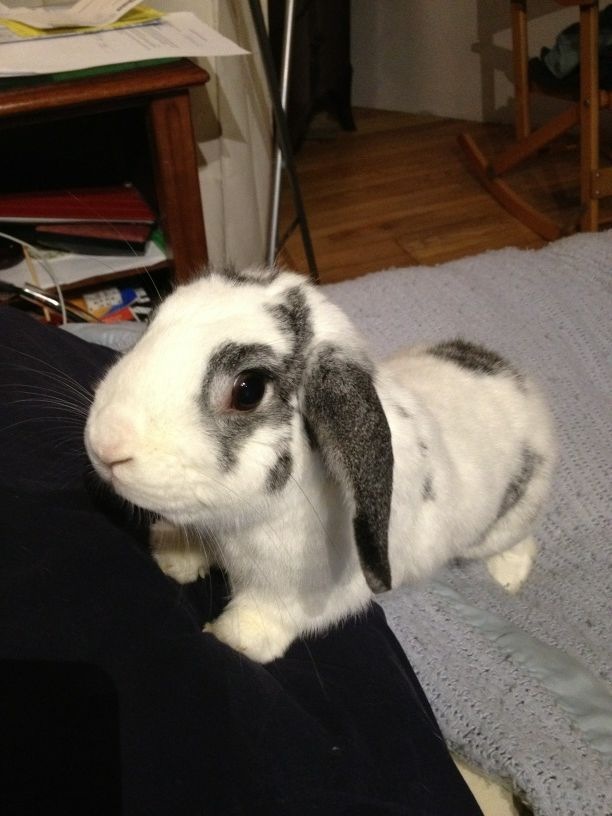
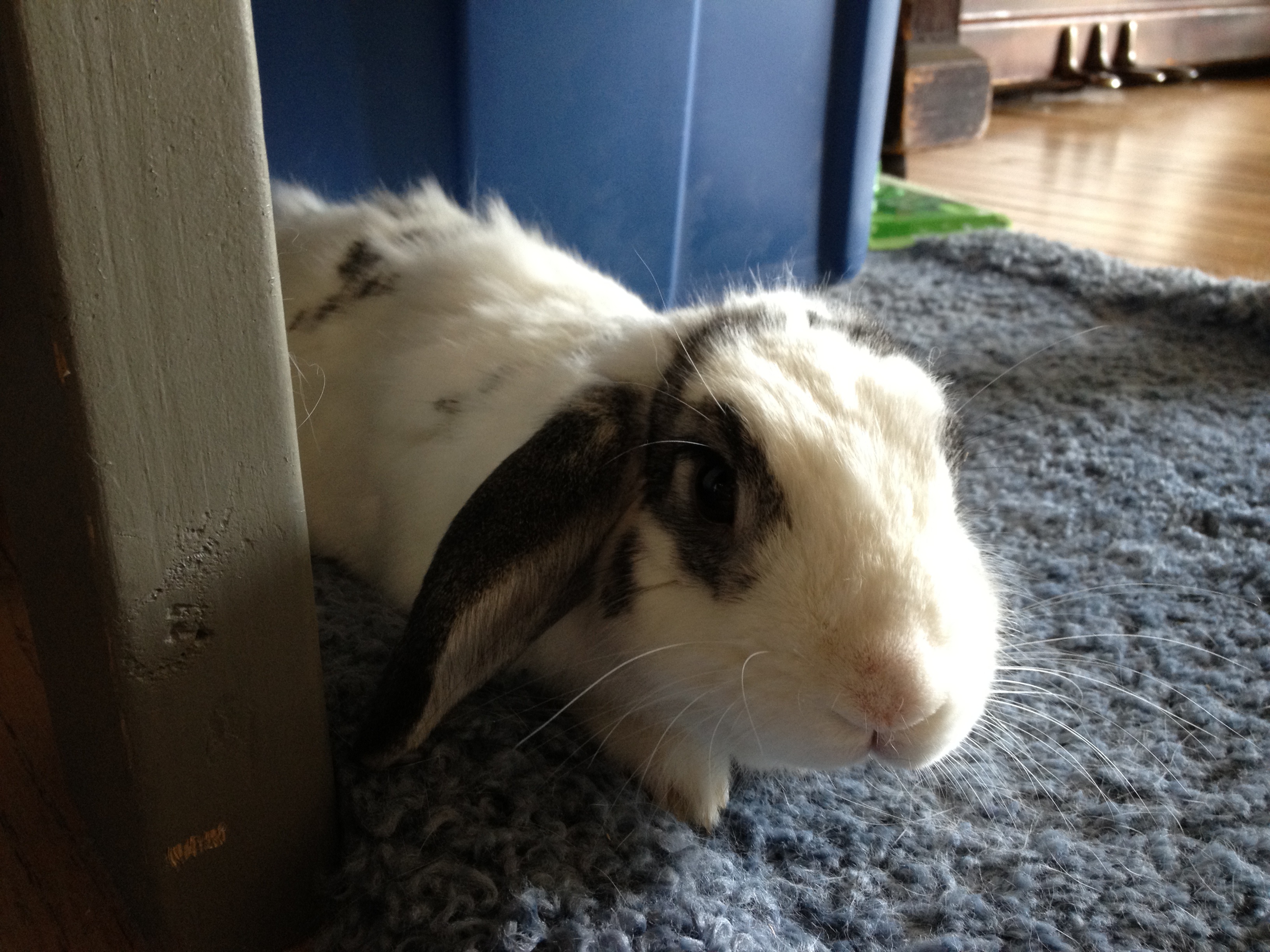
Once upon a time, Eazy-E the rabbit lived in a children’s summer camp in Kincardine, Ontario with a bunch of other rabbits who were all named after rappers. At the end of the summer, my TC (who used to work at the summer camp) took Eazy-E home with him because he is the Best Bunny.

Just look at him.

Bunny1

My TC had Eazy-E for a few years before I met him, but when I moved into the household, he became known simply as Bunny (the rabbit, not TC). Bunny needs no other name. As TC says, “He’s good at being a bunny.”

And he is. I say again, just LOOK at him!

Bunny3Could anything be more adorable than a rabbit hopping around the apartment, eating our apple cores, yawning, and cleaning his little face with his little paws? No. Nothing is cuter.

In addition to his aforementioned cuteness, Bunny is also a good bunny because he is litter trained. Did you know you can litter train a rabbit? I sure didn’t. This means that Bunny gets to live a “free range” lifestyle. Apart from the fact that he tries to eat electrical cords (which is dangerous for him), I think the life of a free range rabbit is far superior to that of his hutch-dwelling comrades. For one thing, Bunny can have adventures under the couch eating my Maclean’s magazines, and also, he can hop onto our bed and headbutt us in the morning so that we’ll give him treats. If you’ve never been headbutted by a rabbit you should be. It’s magical.

When you read about Bunny eating my magazines and chewing on our electrical cords and headbutting us, you may think that perhaps the bunny is a bit of an asshole. And you would be exactly right. Our bunny is an asshole and it’s all part of his charm. What use is a pet that gives you unconditional love and doesn’t occasionally make weird growly noises at you from under the coffee table? What use is a pet that DIDN’T eat your degree transcript and the cover of several books and part of the new waterproof bag you just bought (rendering it completely not waterproof at all)? Very little use in our household, partner.

The thing is–our bunny is the essential Bad Boy. He’s aloof. He’s elusive. He takes your love (and your yoghurt treats and your carrot ends and the assignment you’re working on) and runs away with it leaving you with nothing but rabbit hair on your clothes. He chews on your drywall and one time he bit you on the hand because you wouldn’t pet him (because you were asleep). But he is just so damn small and soft, and he does such a sweet “electric bunny dance” that you can’t help adoring him. “Bunny,” you say, “I love you.” And he replies, “Yeah baby, I know it.” Cheeky bastard. You deserve a pet that’s more appreciative.

And yet–and yet–you can’t help hoping that one day, one day if you give him treats and bits of spinach and don’t startle him too often, One Day maybe the Bunny will love you as much you love him. He won’t, but I keep trying. Because that’s just how love is sometimes.

[In case you couldn’t tell, this is my “Easter” post. Have a great holiday everybody!]

My Student Loan is “Paid in Full”

StudentLoanPaidYep. You read me right. My  ~$23 000 student debt has been paid off. In full. The Canada Student Loan Service Centre says so, and they must be right (except when they aren’t, and they have to make an “adjustment”, or when they lose a hard drive containing my personal information, etc). Anyways, I’m going to believe the fancy letter they sent me and celebrate (TC said he would take me to dinner at Hawksworth, makers of my favourite gin cocktail, the “Hotel Georgia”).

Now that I’ve finished paying for my BFA degree (nearly four years after convocation), I’m reflecting what it is I actually got out of my four years studying theatre. I know what I didn’t get–a job (I mean, I have one, which is great, but it is not a direct result of a BFA in Theatre Performance). Am I working in theatre now? Nope. You may think that this means my undergraduate degree was a waste of time and money, or a disappointment in some way. But I disagree. I’m not a professional actress, or a professional anything really. But I fully believe that moving to BC to complete a BFA at Simon Fraser University was one of the best decisions I’ve ever made.

So what did I get for my $23 000 you ask? Well, enough to be grateful for:

  • My BFA degree gave me good posture. Good posture is a gift that just keeps on giving (to my confidence, my vanity, and my back). I’d always wanted to have good posture, theatre school certainly makes it happen (though it’s a bit of a fight to keep it when I work in an office).
  • My BFA degree fixed my lisp. It was never incredibly pronounced, but I spent most of my life saying my “S” all wrong. Totally wrong. Enter my voice teacher Lisa Beley and Edith Skinner’s diction bible, Speak With Distinction and I am happy to report that my S, while still slightly sibilant, is sounded with my tongue hovering near my TOP teeth like it’s supposed to, not my bottom, and definitely not between.
  • My BFA degree gave me self-awareness. Most people surround themselves with a lot of bullshit. It’s the layer of attitude and bad habits and insecurity we use to cover up our vulnerabilities. The theatre does not have time for your bullshit. We were all subjected to a process known as the “strip-down”, which can be as small as taking out your piercings and as big as acknowledging the traits you hate the most about yourself. I learned how to take myself seriously, and my work seriously, and I realized that I’ll never be able to “coast” again–sure, Cs get degrees but if I’m not going to do my best why bother doing it at all? And I realized that I’ll always have some bullshit to deal with. But at least I know it’s there.
  • My BFA degree gave, and took away, relationships. Two and a half months into my first year of the BFA (second year of university), my relationship with my high school boyfriend ended. A lot of people lost their high school or early-university relationships in that first year. And I won’t say the theatre program is directly responsible, but I will say that when you have no time to eat or sleep, and you’re being forced to confront your own bullshit in class everyday, you really stop having time for anyone else’s. To put it another way, if it’s meant to end–theatre school will end it (which I guess just saved us both some time by hurrying the inevitable). But my BFA degree wasn’t all take; it also brought me two relationships. One was a whirlwind two month affair. One was a slow off the blocks two year relationship. But they were both important and fun. While they lasted I was a sponge, soaking up all the things I liked about the other person’s world and would find useful later (like circus school and the wonders of the internet). And when they ended, like most relationships do, the periods of growth that followed continued the trajectory of self-awareness that theatre school had already started. I could never wish away experiences that made me happy, and I could never wish away sad experiences that took me to more marvelous happy experiences down the road.
  • My BFA degree gave me amazing friends, and taught me that making art does not have to be a competition. The same is not true of every theatre school, or every theatre program. I’ve heard horror stories of programs that pit students against one another on the assumption that they’ll work harder. But my program didn’t work that way. The most sacred part of our work was the ensemble (i.e., the members of our class or our cast). My late teacher Marc Diamond used to say, “If you trash the ensemble, you go out with the trash” and he meant it. That meant that we never tore each other’s work apart when offering critiques or comments. That meant that we never came to class/rehearsal late or unprepared, because to do that would disrespect the work of our ensemble-mates. And that meant we left our bullshit at the door. I became very close to my ensemble mates, both in classes and in shows, and though I haven’t kept in touch with all of them, many of my past ensemble mates are still my rocks–I’ve crashed on their couches and cried in public with them and drank way too much with them. And we aren’t in competition–I’m happy for their successes and they’re happy for mine. I’ve always hated the competitiveness of the art world (the kind of back stabbing ladder climbing you see on TV), but my degree taught me another way to work, and it’s a lot friendlier this way.
  • My BFA forced me to go to class without make up every day for four years. I also had to take out all my earrings and pin my hair back. For most of my degree I looked like a thirteen year old. But I had to suck it up and just look like myself. And you know what? It was kinda great. All of my friends (and both of my two aforementioned paramours) first knew me with no make up, a ponytail, sweatpants and a sports bra. And everyone liked me anyways. So take that, vanity.
  • My BFA degree taught me to work my ass off. Heck yes. I think I’ve mentioned this one before, but that’s only because it’s so incredibly important. My ability to work hard and work well with others is probably the most bankable product of my degree, and to be honest, I think it’s the only one that current and future employers of mine would care about anyways.

So was it worth $23 000? Well, I won’t say there’s nothing at all I’d change–but you can’t buy happiness or maturity. What you can buy is the opportunity to have experiences and to meet people and to learn things that make you happy and help you grow. And I did. So thank you, National Student Loan Services Centre, pleasure doing business with you. I daresay I’ll be seeing you again if I ever decide to pursue a graduate degree.

Beyond “Raising Awareness”: Theatre for Living presents “maladjusted”

From now until March 24, a much-needed conversation will be taking place at the Firehall Arts Centre. maladjusted, created, workshopped and presented by Theatre for Living (formerly Headlines Theatre), explores the challenges facing our mental healthcare system through a “forum theatre” event.

Micheala Hiltergerke and Pierre Leichner. Photo credit: David Cooper

Micheala Hiltergerke and Pierre Leichner. Photo credit: David Cooper

In the wake of recent tragedies, much lip service has been paid to “removing the stigma” of mental illness and ensuring that people suffering from mental illness or emotional distress are able to access the help they need. Unfortunately, with many of us, our involvement stops there. What we don’t realize, and what maladjusted exposes so well, is that getting people into the mental healthcare system is not enough–what do we do with them once they’re there? Is our current system, increasingly mechanized in the name of “efficiency”, sufficient to ensure our most vulnerable citizens receive care that is compassionate, sensitive to their needs, and actually healthy for them?

The answer, according to the many generous patients and mental health caregivers that comprised the show’s workshop participants, is a resounding no. The failure of an overburdened and increasingly impersonal system to properly diagnose and treat people with mental health issues is contributing to the escalation of already urgent situations. The first half hour of maladjusted is a play (in the traditional sense) that provides logical examples of the ways in which these shortcomings play out for patients, families, and caregivers in a system like ours.

But this would be nothing new. We are used to theatre that exposes. We are used to theatre that points a finger and says, “This. This is a problem.” And we are all used to theatre, films, art, and events that “raise awareness”. Theatre for Living takes this process further, beyond the pointing of the finger and the raising of the awareness. They say, “This. This is a problem. Now what would YOU do about it?” And most importantly, they let us answer.

It’s hard for me to describe just how the forum theatre format allowed me to participate in a discussion about mental health and human-centred care (you’ll have to experience it for yourself), except to say that my own understanding of the issues was heightened, my ability to empathize was increased, and I felt that my role in the evening was empowered. Instead of passive audience members, we became actors in our own right (some on the stage, and some within the human transactions and interactions we’ll be having in our own lives).

Central to the empowerment provided by this important conversation is the creation of a Community Action Report. As different issues are addressed during the forum portion of the evening, the audience is asked to suggest specific policy changes that could help patients, caregivers, and families better navigate the mental health system in a way that works for them, rather than for efficiency or budget figures. Each night, the show’s Community Scribe takes down the ideas put forth. According to the company,

“Theatre for Living has written agreements from various mental health organizations including The Mental Health Commission of Canada and The Canadian Alliance on Mental Illness and Mental Health to use the  maladjusted project and the resulting Community Action Report to inform their policy development.”

By attending the show as an audience member, you contribute to this necessary conversation. I left the Firehall that night feeling, somehow, that I had done a good and necessary thing. I didn’t feel powerless against the huge issue I’d been presented, though I had a better appreciation of the challenges and the stakes.

maladjusted runs at the Firehall Arts Centre, Tuesday to Sunday at 8pm, from now until March 24. Tickets can be purchased online through the project webpage.

Disclosure: My ticket to maladjusted was provided by Theatre for Living. The content of my review remains my own.

Walking With My Keys in My Hand

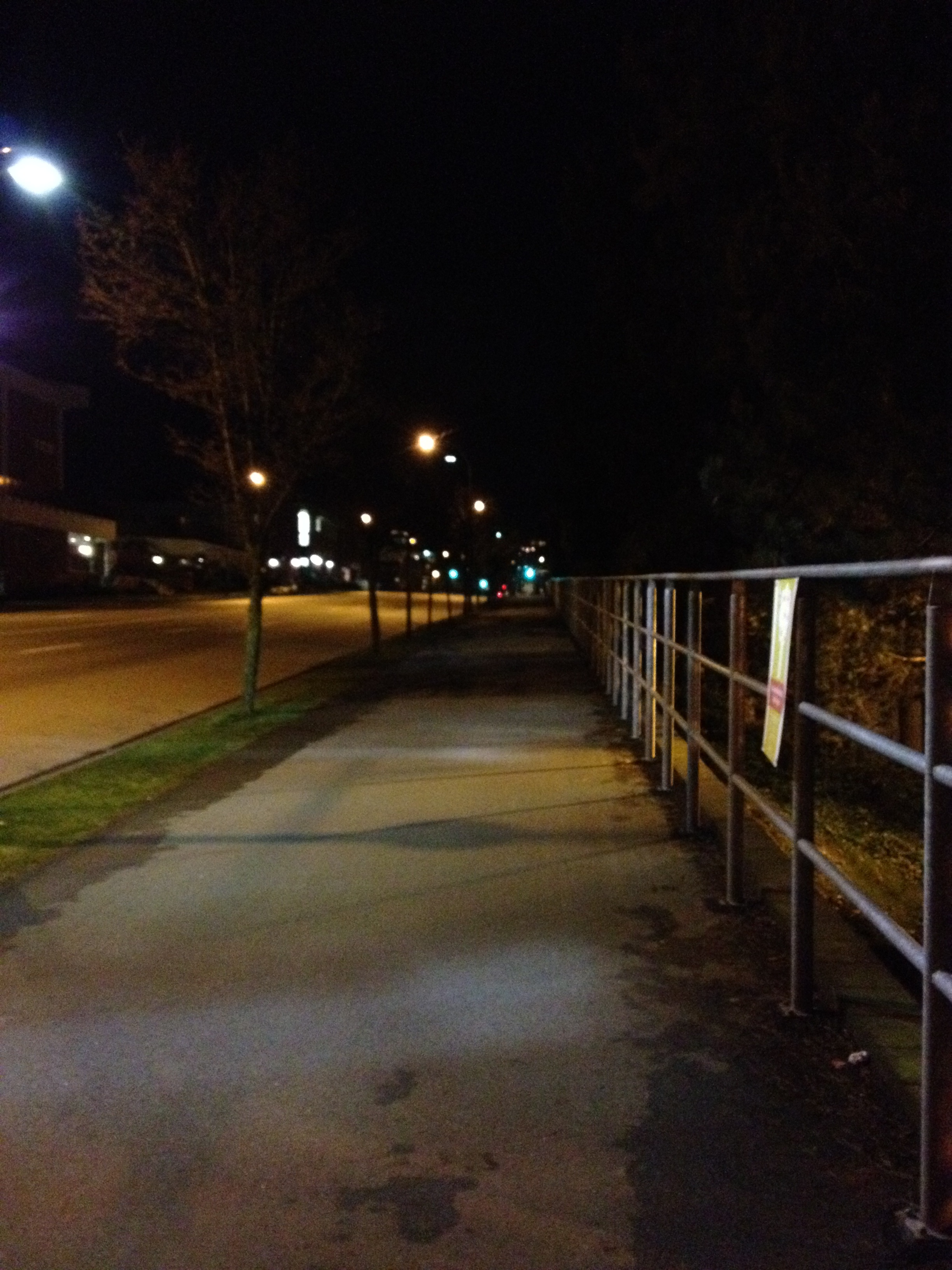
nightstreetLet me begin by saying that I understand the smallness, the near insignificance of my experience compared to the horrifying experiences of many other women in Canada, and worldwide. But here goes.

If you’re a woman who lives, or has ever lived, in a city, then you’ll know what I’m talking about when I say that when I walk alone at night, I usually walk “with my keys in my hand”. I’m not just holding them because digging them out of my bag when I get to my front door is annoying. I am carrying my keys in a particular way: the lanyard is wrapped tightly around my hand and the points of three different keys poke out between my knuckles. If you’re a woman who lives in the city, you’ll know why I do this, and why you’ve likely done it yourself.

Because you’re scared that someone will attack  you, and you need your first punch to cause as much pain as it possibly can. Most of us, thankfully, will not be attacked while walking home at night, but still. You are scared, and you walk with your keys in your hand.

I don’t live my life in perpetual fear. I like Vancouver and I love East Van in particular. But it doesn’t take so very much to compel me to put my keys in my hand. A dark street. The lateness of the hour. A vacant lot.

A couple of years ago, when I lived alone at my last apartment, I was heading home late on the number 16 bus. There are usually strange characters on this bus and I’ve had (or overheard) some pretty strange conversations. The conversations are usually funny and I forget them as soon as they’re over. But sometimes, I just get a feeling. A feeling that the attention directed at me is no longer safe for me. That night was such a night. A young man sat next to me on the bus and started to talk to me. Which is fine. It’s a free country. But there was an intimate tone in his questions that was too personal, that wanted to know too much about me. And it was late, and I was tired, and I had been drinking, all things that weaken me and make me feel more vulnerable. When I pulled the bell and excused myself at my stop, the guy said, “Oh, is this where you live? We should hang out.” I said, “No” and got off the bus. I tucked my keys between my knuckles and ran all the way home.

Of course, I made it home safely and never saw that person again. Reading this anecdote, you might not understand why such a seemingly harmless interaction would frighten me so much. But somehow, it’s been ingrained in me that a woman’s survival depends on reading tone, and trusting her intuition. Nine times out of ten, the person who seems inappropriate and threatening to her is merely inappropriate. But the tenth–there’s a good chance that tenth could be a Threat. And if she’s unlucky, that Threat could be an Attacker. Problem is, we have no way of knowing who to protect ourselves from, so we have to act on our red flags, whenever we see them. I don’t know where I learned these lessons. I grew up in the country and never had this issue. I can’t remember my mom or any other authority figures teaching me these skills. But when I moved to the city, there they were, waiting for me to need them.

So when I’m walking alone at night, I walk with my keys in my hand. I eye every stranger I pass. I eye cars too, to make sure they aren’t slowing down or stopping beside me. When my friends and I part ways on a cab or in the bus one of us asks the other to “text me when you get home”. Do I feel like I’m too paranoid? Do I feel a bit crazy? Do I feel like I’m overreacting?

Sometimes. To be honest, I know that my little precautions would likely do very little to help me if someone did want to attack me. But I’ve got to do something. Because if I didn’t, and something happened to me, I know people would ask questions, not of my attacker, but of my actions: Why was she walking alone? Why did she talk to strangers? Why didn’t she do more to protect herself? The truth is, I would ask myself those questions too: How silly could I have been to think nothing bad would happen to me?

When I was in my first year of university, I took a political philosophy course, and my conception of myself as a female in society exploded. For the first time I actually entertained the idea that I might be oppressed. Not by any purposeful forces, not by any men in my life who were trying to keep me down. But by the simple fact that I had to make different choices from my male peers. I had to have a “buddy system” for walking home from bars. I had to be careful who I spoke to. I had to make sure I didn’t get so drunk that I didn’t have my wits about me (unlike my classmates of the male sex). And, of course, I learned to walk with my keys in my hand. Nothing has hurt me so far, or even greatly inconvenienced me, but it isn’t fair, is it?

Obviously, my anxiety is manageable, and until the onus stops being on me to prevent my own potential assault, it’s just the way I’ll feel sometimes. But I am at the most harmless end of a huge spectrum of threat and violence that spans through muggings and rapes, all the way to the vicious beating and gang rape that left a Delhi woman dead in December. And I want off before I move any further along it.

This International Women’s Day, that is my wish. Take us off. Take us all off the spectrum. This request is from someone who exists on the best possible part of it she could possibly be located on, so I can’t imagine what it’s like to go any further. Actually, I can, a little. Just enough to scare me. Just enough to make me walk with my keys in my hand. And it’s stupid, and I’m ashamed of myself, and I really don’t know why.

What’s in a (Last) Name?

I recently read a Big Think article by the controversial (pseudo) academic Satoshi Kanazawa, entitled Why Children Must Inherit Their Last Names from Their Father, Not Their Mother. I should have known better. Kanazawa’s reasoning was, of course, ridiculous (I mean, this is the guy who published an article supposedly explaining the “truth” about “why black women are considered less attractive than other women”. I’m paraphrasing but not much. Please. Gag me with a spoon). I should not have given that idiocy (and thinly veiled misogyny) another thought and, at first, I didn’t.

But seeing as how I’ll be a married woman in not so very long, I have been thinking about this issue a lot lately. First and foremost, with my own name. My last name, Kresowaty, is long(ish). It’s Ukrainian. The only situation in which people meeting me for the first time have ever pronounced it correctly, or read it aloud without confusion or panic, was when I lived in Poland (and then uber correctly, pronouncing the “w” as a “v”, which in Canada I don’t bother to do). But despite suffering through years of mispronunciations (or having people address me simply as “Miss” rather than attempt my surname), I like my last name. I feel my last name very strongly to the core of my being. I want every good thing I do in my life to have the name “Kresowaty” appear on it. And I don’t think that will change.

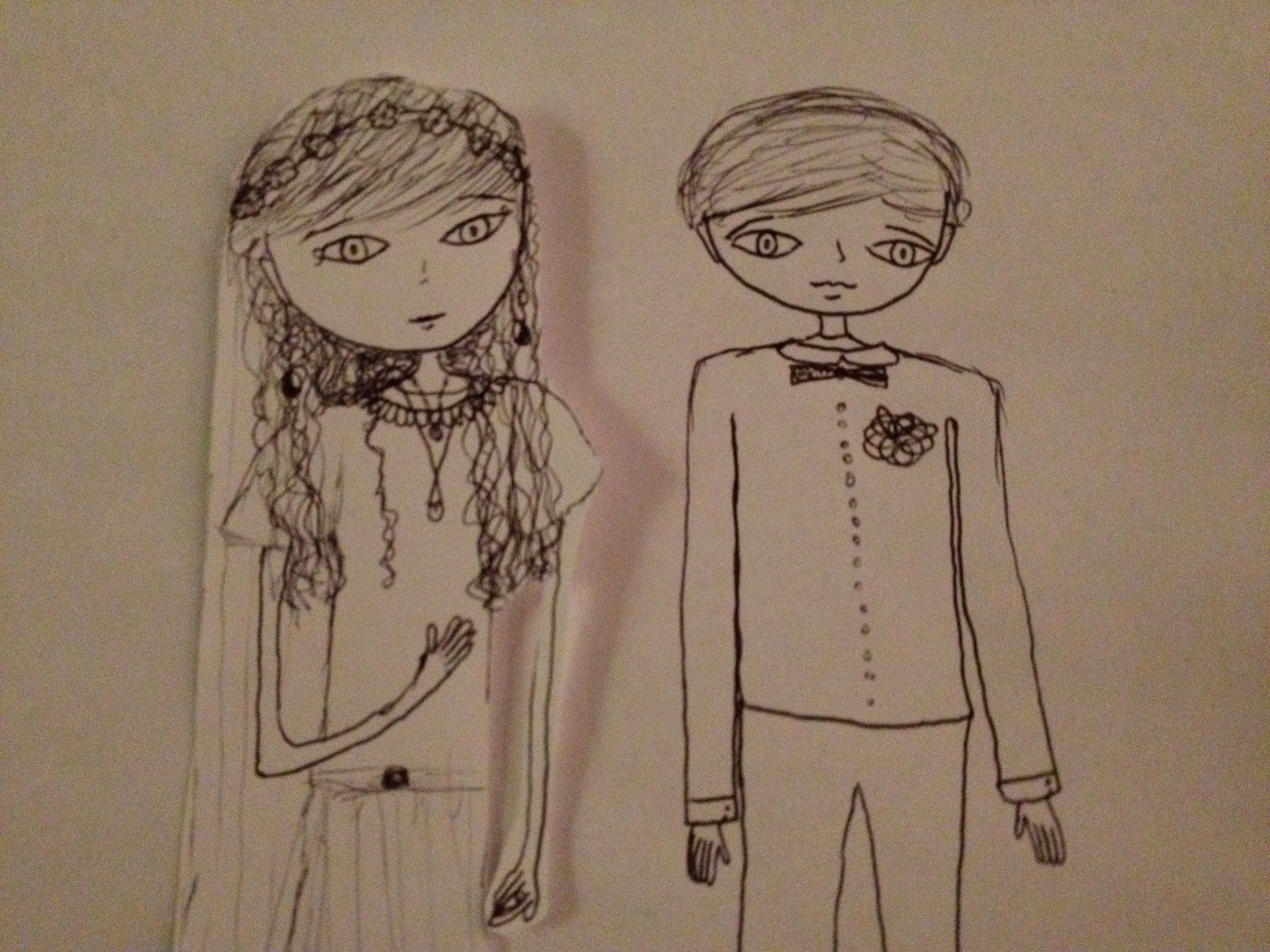
Illustration by TC's little cousin, who was 9. I like my drop earrings.

Illustration by TC’s little cousin, who was 9. I like my drop earrings and double necklaces.

I remember reading a blog post several years ago by a woman who explained why she kept her maiden name, rather than take on the last name of her husband and children. I was very surprised by the vitriolic comments her post received. People called her a “feminist c–t”. People told her she was a terrible mother, psychologically damaging her children by sending the message that she does not love or respect their father, or truly consider herself to be part of their family.

Bullshit. My mother has used her own surname, Zilans, both personally and professionally all her life. Her marriage to my father nearly thirty years ago did not change that, and I never felt for a second that she didn’t love us or didn’t want to be part of our family. Still, when I was a kid I once asked my mom why she never changed her name. She said, “Why would I?” That’s all the reason I’ll ever need.

That’s not to say that I don’t respect the choice of women who want to go the “traditional” route and take their husband’s name after their wedding. Knowing how I feel about my own name (and my mother’s) I was surprised when some of my contemporaries changed, or told me they were planning to change, their names. But when I think about it, it’s a lovely choice to make. Some people feel true to themselves when they have the name they were born with. Some people will feel more true to themselves by marking this milestone in their life by changing their last name. And it’s a choice I respect.

But the choice of whether or not to change your surname should remain just that–a choice. This means that while I support a woman who wants to take on her husband’s name, I also equally support any man who wants to take on his wife’s. Why not? A choice is a choice. In contemporary Canadian society, a woman is not the property of, nor subservient to, her husband. So if he wants her name, why the heck not? Or if they both wanted to change their last name to “von Sparkleson”, why the heck not? The argument that such arrangements are “untraditional” holds no water when you consider that Canadian law now recognizes marriages between couples of the same gender. What heteronormative “tradition” is to be honoured in these marriages, marriages which are fully sanctioned and recognized by Canadian law? How about whatever they want? And if gay couples can do whatever they want with their names, why can’t I?

And now back to the question of children. While my mother broke from Western tradition by keeping her last name, my parents still went the traditional route by making my sisters and me “Kresowaty’s”. I don’t dispute their choice–as I said, I feel so much a Kresowaty I can’t imagine being anything else. It’s worth noting, however, that in the hospital the first name I ever bore was “Baby Girl Zilans”, marked on my bassinet because my parents took their time naming me and the hospital needed to call me SOMETHING. So if I could survive those days in the hospital with my mother’s name rather than my father’s and not suffer from some non-traditional naming identity crisis, it’s entirely plausible I could have been a Zilans (yet another formidable Eastern European name) all my life and been perfectly happy.

But it feels different, doesn’t it? Keeping one’s “maiden” name after marriage is generally considered acceptable nowadays but boy oh boy, tell a person you think that your future children should bear YOUR name (since you’re the one doing all the pushing and shoving to get that baby born after all) rather than their father’s, and watch their confusion. Watch the cogs of “That’s not normal!” and “That’s just not how we do things!” turn in their head. It’s an interesting experience. And it’s not just men that seem to feel this way, it’s, well, mostly everyone it seems. Even my own parents seem to have accepted that their line of “Kresowaty’s” ends with their daughters and don’t really see why a couple would bother with the hassle of going against the grain by using the mother’s name, or, as suggested by super genius Marilyn vos Savant (IQ of 228, people) giving maternal surnames to daughters and paternal surnames to sons.

I actually don’t really care if any future sons don’t bear my name, maybe because in my mind I would identify them, by virtue of their gender, with their father. But if I have daughters, I want to have “Kresowaty girls”. I was a Kresowaty girl (now a Kresowaty woman, I suppose). My sisters were Kresowaty girls. And we were awesome girls, who grew up to be awesome people. So if it ain’t broke…..

But it’s not normal. It’s not traditional. It’s not done. And according to the aforementioned controversial Kanazawa, it would cause paternal uncertainty, and a father would be less likely to invest in his kids if they didn’t bear his name, hurting the children and society in general.

Bullshit. Kanazawa’s argument is based around the evils of cuckoldry, and it’s a bunch of bullshit. As he points out, like (good) human fathers, the fathers of many bird species invest heavily in the offspring of their mate, and unfortunately for those poor birds, they have no way of knowing if the eggs are really theirs or not, meaning they are potentially investing their energy in somebody else’s sperm. You know who doesn’t give a hoot? Me. You know who else doesn’t give a hoot? The birds. They take care of their mate and her eggs, they further the species (which was probably strengthened by the mother making some discerning choices between biological mate and social mate) and they all live to flap and crap another day. So much for the birds.

As far as humans go, if you think a name is any proof that a child is yours, you’re an idiot. Either you trust your partner or you don’t. And if you don’t, why ask a name to do what birth certificates, adoption certificates, and blood tests can do so much better? So much for names as proof of paternity (besides, this argument assumes a family to be a biological, nuclear one, completely ignoring the single parent, blended, and adoptive families that also contribute to our society’s fabric).

It’s not that I don’t like TC’s surname, or don’t think it could or should be bestowed upon our future children. It’s that I resent, with all my might, that no one thinks I should have a choice in the matter. One of the reasons I am marrying TC is because I have never in my life felt more that I am in a true partnership of equals. This equality will not end after the wedding, and it will not end when I give birth. If I thought it would, I wouldn’t be getting married (and quite frankly, if TC was not the man he is, I doubt a stubbornly independent soul like me would interest him much anyhow). And I know many equally intelligent people in many similarly equal partnerships. So why, after nine months of pukey swelly pregnancy, and hours of painful labour (or, conversely, after the months/years of bureaucratic hurdles that precede an adoption), does everyone think it’s completely normal for the agency of the female member of the partnership to be stripped in this situation?

I guess it’s normal because it’s done. But that doesn’t make it logical, or rational, or correct. It’s simply a preference. And if passing on the father’s name to the children is what the couple prefers, that’s great. But what if it’s not?

When I talk to people about my feelings on this issue, invariably I am asked, “Can’t you just use a hyphenated or double last name?”. The answer is no. I can’t. For one thing, when a person has a double or hyphenated last name, the first name (usually the mother’s) often gets treated as merely a second middle name and is dropped from normal use. So it’s not a satisfactory solution for me. Secondly, what if my hyphenated kid married another hyphenated kid, and they both wanted to keep their names, and their kid ended up with not one but FOUR last names? Ridiculous. And finally, my last name has four syllables. TC’s has three. Some people have seven-syllable last names, that’s the name they have to pass on to their kid, and it’s not their fault. But I really wouldn’t feel kind giving a seven-syllable surname to a child on purpose.

I’ve been told that giving sons one surname and daughters another would be very confusing for other people trying to identify my family. And that’s probably right. But names don’t make a family. Blood doesn’t even make a family. Love, and shared experiences, and sacrifices make a family.

Which is why, when the time comes, despite all this rantin’ and ravin’, I may sacrifice my last name after all (as far as the kids go). And I will love my family no matter what they’re called–I just wish the situation were different. I wish that TC and I could make this choice on our own, and that what society considers to be “traditional” and “expected” had nothing to do with it. Because with those huge pressures at play, how can we possibly make a choice that reflects how we really feel? How can we even identify how we really feel? We can’t. I’m not even sure if my feelings now reflect my real wishes, or are just a reaction to a structure I find outdated and unfair.

And I guess what I truly, desperately want, more than a name, is the opportunity to make a private decision with my husband about our children’s last names. But in the structure we live in, still old-fashioned in so many ways, we will never, never have that.
Galapagos Islands Day 6: Islas Santiago and Bartolome (a.k.a. the moon and Mars)

Yesterday as I was complaining about the cold that is currently mushing my brain, my co-worker mentioned to me that the last time I had a bad cold was after my trip to the Galapagos Islands. By golly, she was right! I did get a cold in the Galapagos (probably from all the snorkeling and the fact that nothing that got wet ever dried). On Day 6 of our trip I began to get a nasty nasty cold that rendered my ability to process the crazy terrain of Isla Santiago and Isla Bartolome pretty much nil. The best my observational skills could come up with was, “This looks like the moon. I want to run around on it.” or, “This looks like Mars. I want to run around on it.” But still. Recognizing that you are somewhere that looks like it belongs on a different celestial body is pretty bitchin’. No complaints here.

So now, for your viewing pleasure (because I am too sick to write well and because I don’t think I could do justice to the lava field at Sullivan Bay or the view from the top of Isla Bartolome even if I wasn’t), I give you the Islas Santiago and Bartolome! Enjoy the results of volcanic activity and pretend you are looking at a lunarscape or the best real estate on planet Mars.

I’ve always loved clambering around on rocks so the lava field at Sullivan Bay on Isla Santiago (only a hundred years old or so) allowed me to indulge this particular compulsion almost fully. (Really giving in would have meant leaping and bounding away across the lava-y horizon, likely breaking my ankle and screaming until TC managed to find me in that big black expanse, and then TC having to carry me back to shore and he wouldn’t like it, so I just stayed with the group. Phooey.)

The hike to the volcanic summit of Bartolome was a lot more contained and did not allow for reckless clambering over lava, however, it was very educational (I learned about spatter cones!), and pretty effing cool. Huge chunks of red porous rock littered the slopes of the islet. Our guide Pedro called them “lava bombs”–lumps of molten rock that had been spit out by the volcano and had, for the most part, been lying in pretty much the same place since. Basically, the entire landscape, EVERYTHING, came from inside a volcano. If that’s not enough to make a person mildly interested in geology I don’t know what is.

The view from the top of Bartolome is stunning. Pinnacle Rock looms in the distance, leaning precariously over the sea. Wanna know why that pointy shaft of rock is separated so awkwardly from the mainland like that? Before telling us, Pedro checked to make sure that none of us were Americans. We weren’t, so here’s the story: Pinnacle Rock used to just be part of a big rock hill that sloped towards the water. When the US military stationed themselves in the Galapagos during WWII, they decided to shell the hill for practice. Eventually, the structure of the rock weakened and a big chuck broke away. And so that is how the United States of America created one of the most famous land formations in the Galapagos Islands. The end.

So not natural at all. Still makes for a beautiful photo though.

But the day wasn’t all barren lava fields and geology (though that’s all I took photos of). In the morning we sat in a dinghy while a group of 15-20 dolphins jumped and played all around us. I don’t think any dolphin show in any marine park could ever compare to watching pairs and triplets of wild dolphins leaping and diving for the sheer joy of it. Some of them had fish in their mouths. Some of them had babies (BABY DOLPHINS!). A few of our ship mates were taking photos but TC and I knew that if we hid behind a lens, we’d miss something amazing, so we decided that this moment was just for us.

The other moment that was just for me came while I was snorkeling off the beach near Pinnacle Rock. I rounded a point and surfaced. There, standing on the rock just a metre or so away from me, was a Galapagos penguin. There was no dinghy or naturalist guide this time to distance the experience. Just me, and this penguin. He stood on his rock and I floated in the water and though all I wanted to do was reach out and try to somehow own this rare wild creature and my experience with him, there is nothing in this world that could have made me disturb him, or break the strange and incredible trust Galapagos wildlife has in humanity.

It’s enough to break a heart.

Project Limelight Presents “There’s No Place Like Oz”

When I was growing up in rural Saskatchewan (and partially in Europe), the opportunity to participate in theatre was one of the greatest gifts my parents and schools could have given me. Theatre gave me a way to keep playing dress-up long after my peers no longer thought it was cool. The stage was a place where I could be confident, unselfconscious, and (blissfully) anything, or anybody, I wanted to be. Being involved in productions kept me focused, gave me something to look forward to, and brought me those weird, it-all-happened-in-the-dark, we-bonded-in-cue-to-cue type friendships that only other theatre artists can understand. In my darkest hours, the responsibility of maintaining myself as a performer (body, voice, health) kept me from making some bad choices as I tried to deal with the academic and emotional hurdles life brought me.

d58e5a79e1deb00e6b78f5f9f952197dWhen I learned about the Strathcona-based Project Limelight Society, a free theatre program for East Vancouver youth, I couldn’t think of a more positive way to engage children and young people with the arts, their community, and with their own talents. According to their website, the Project Limelight Society was founded by former film industry professionals (and sisters) Maureen Webb and Donalda Weaver, as a way to support and give back to the community they were raised in. Designed for youth aged 8-15, each four-month session teaches and develops performance skills as participants prepare for a full-length production. Enthusiasm and commitment from participants seems to be the name of the game, with no previous experience required. And of course, it’s offered at no cost to the participants.

Hold on, you say, what about that full-length production you mentioned? Oh yes! The young performers of Project Limelight will be treading the boards later this month at the Djavad Mowafaghian Cinema (SFU Woodward’s) in their upcoming production, There’s No Place Like Oz, loosely based on the children’s classics by L. Frank Baum.

Project Limelight Society presents THERE’S NO PLACE LIKE OZ, featuring 18 young performers, ages 8 – 12, who have worked together to create a show for their friends, family and community. THERE’S NO PLACE LIKE OZ, in the tradition of Pantomime, combines audience interaction, music, comedy and dance, and is suitable for audiences from the very young to the young at heart.

At Project Limelight, we want to unleash the imagination, awaken curiosity and give young people the opportunity to experience the magic of applause. Our program offers youth living in Vancouver’s Eastside, a safe place to build an artistic community.

[Read the full show description on Project Limelight’s website.]

There’s No Place Like Oz will be running for ONE DAY ONLY (two performances) so make sure you know the details:

Sunday, February 24, at 2:00 pm and again at 6:00 pm

Djavad Mowafaghian Cinema in SFU Woodward’s (Goldcorp Centre for the Arts)

Tickets are $15/$10 and can be purchased online through the Project Limelight website.

If you would like to support the work of the Project Limelight Society but will not be able to attend the show, donations to the program can be made through their website.

Happy Valentine’s Day everybody (once again, it seems, East Vancouver has stolen my heart…)!

xoxo

Anne of Green Gables, NOW BLONDER AND BUSTIER!

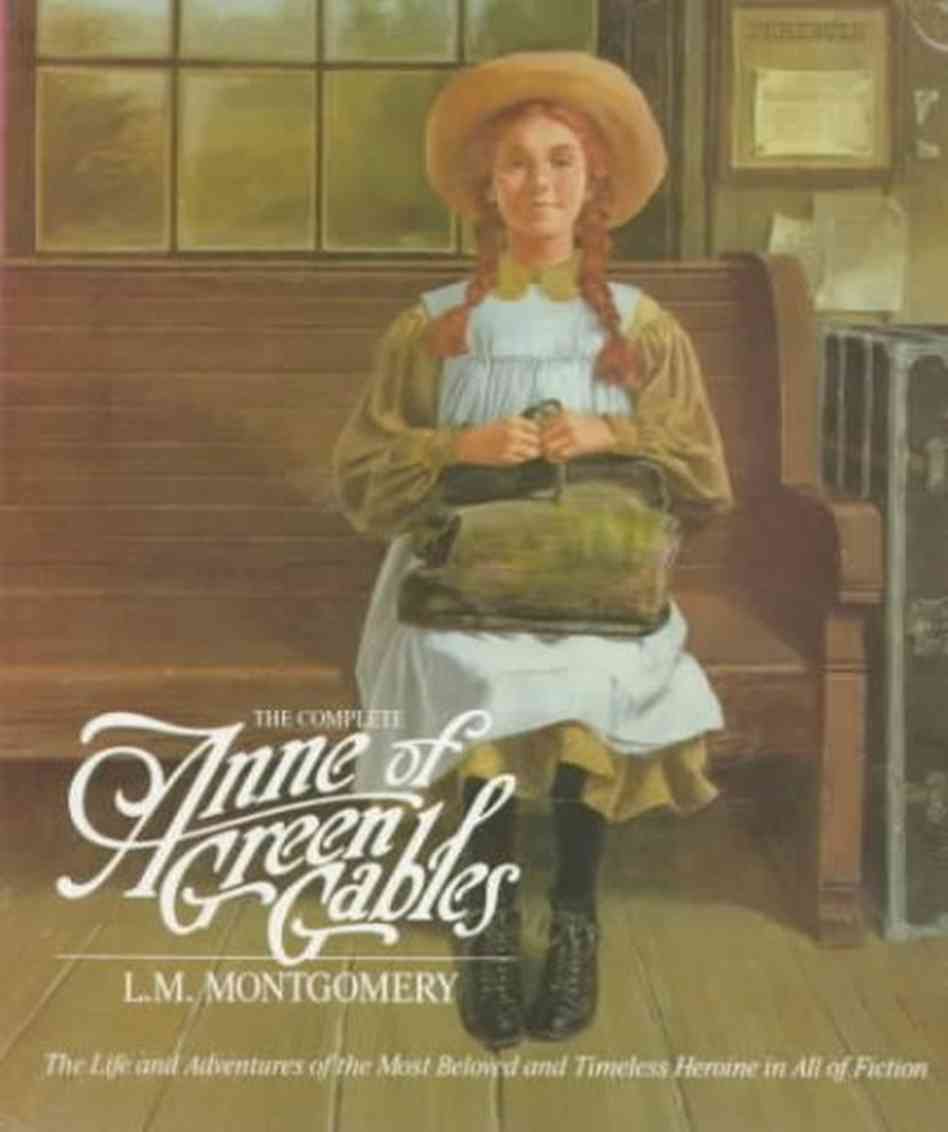
Even if they haven’t actually read the classic book by L.M. Montgomery, people who are at all familiar with western literature or culture will know that THIS is Anne of Green Gables:

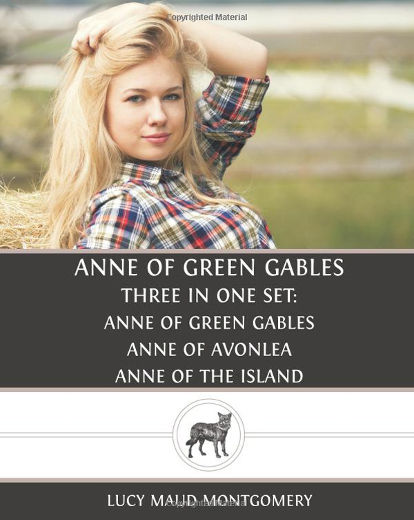
9780553609417_custom-ca4455d0c15d99fc51ea2900942fec2d9c13388c-s6-c10And that this monstrosity, on sale on Amazon.com since November 2012, is most definitely NOT:

1297373144312_ORIGINAL

[If the sexy photo moves you to indulge in some turn of the century Canadian kid’s lit, look no further than right here on Amazon.com!]

I mean, what the hell is going on here? There are two very, VERY big problems with this:

PROBLEM ONE: Anne of Green Gables is a redhead (though amazingly no one at the bookselling giant Amazon.com seems to know it).

Everybody knows that Anne Shirley has red hair. This fact is repeated over and over and OVER in the book. Anne’s redheadedness, and the way she reacts to peoples’ comments about it, is an integral part of who she is. Anne’s red hair is the reason she snaps at Rachel Lynde. It is the reason she cracks a slate over Gilbert Blythe’s head. And it’s the reason she accidentally dyes her hair green (in an attempt to turn it “a beautiful raven black.”). Though in later books Anne’s hair colour does deepen, it becomes auburn, which is really just a fancy way of saying dark brownish red.

Anne was not, is not, and never will be, a blonde.

PROBLEM TWO: Anne of Green Gables is an eleven year old girl.

Anne Shirley is a skinny, poorly dressed, redheaded little orphan girl with big eyes and incredible innocence. She’s also intelligent, studious, and extraordinarily sensitive. She has no interest in the boys in her life except as friends or academic rivals.

She’s certainly no buxom, bedroom-eyed sex kitten leaning on a hay bale.

That any publisher or purveyor of CHILDREN’S LITERATURE would be comfortable with the sexual objectification of the eleven year old heroine of a classic children’s novel is absolutely shocking. It’s like draping Wendy Darling over Skull Rock in a bikini, or letting Alice stomp all over Wonderland in fishnets and stilettos. There are times when adding sex appeal is not the way to sell a product. When the product in question is eleven years old (even fictionally), you know it’s one of those times to keep your sexy thoughts to yourself.

I don’t really have a problem with the young woman in the photo on a personal level. She’s probably just some model who ended up in a collection of stock photos of “girls on farms”. She likely had no idea that her contemporary sexy blonde farm girl photo would grace the cover of a much-loved children’s classic (first published in 1908) about an eleven-year-old girl with red hair who lives on Prince Edward Island.

I do, however, have a big problem with Amazon.com, and their publishing company “CreateSpace Independent Publishing Platform“. I find it amusing that in Amazon’s free preview of the first few pages of the book, the words “Copyrighted Material” appear emblazoned all over the place. As if either Amazon or CreateSpace can claim any ownership of L.M. Montgomery’s actual words. It looks more like they just took a public domain manuscript, didn’t read a word of it, and slapped a foxy cover on it in an attempt to make a quick buck. Which seems to be exactly what has happened here.

It is obvious that Amazon.com, despite being a bookseller and controlling a publishing company, has no knowledge of or love for literature. If they did, they would have read the book they published, realized right away that Anne is very vitally a redhead and a child, and put a redheaded child on the cover (if they needed a photo at all). I had always assumed that in order to be a purveyor of books, a company would actually, you know, know/care about books. Apparently not.

Though I am among the many who feel in their bones that a great crime against literature, childhood, and authorial intent has been committed, in all probability what CreateSpace and Amazon.com have done is okey-dokey in the eyes of the law.  The book Anne of Green Gables and its sequels have been in the public domain for a long time. If a publisher wants to slap a sexy blonde on the cover of it, they probably can. And if Amazon.com wants to peddle that smut, it’s within their rights to do so.

That doesn’t mean they should. Some things are just sacred, and childhood classics are one of those things. I suppose if representing Anne Shirley as a sexy blonde woman is fine, it’s probably equally fine, in terms of legality, to display her in a Nazi SS uniform, driving an SUV and punching a kitten. I’m sure there are those who would find this hilarious or titillating, but they can find that kind of crap on 4chan or on late night television if they so choose.

They don’t need to find it on the cover of L.M. Montgomery’s beautiful childhood classic. And they don’t need to find a voluptuous blonde there either.

Galapagos Islands Day 5: Isla Santa Cruz a.k.a. the Day of the Tortoises

We called him Hank. (photo: TC)

We called him Hank. (photo: TC)

This day was the Day. The Day my TC and I had been waiting for. The reason we flew thousands of kilometres to Ecuador, and on to the Galapagos. This day, on Isla Santa Cruz, was the Day of the Tortoises.

This day started earlier than our previous days on the Monserrat, with breakfast served at 6:00 am and our “go to shore” time set for 7:00. For those of us who weren’t continuing the cruise (which was everyone but my TC and I; even our guide Jose was leaving us), there was only a little time to visit the Charles Darwin Research Station at the outskirts of Puerto Ayora before speeding away in a bus for the Baltra airport.

The work of the Charles Darwin Research Station (www.darwinfoundation.org) is incredibly important to the survival of the unique and varied species that call the Galapagos Islands home. It also ended up being the only place we saw a land iguana during our trip (like the marine iguanas but larger and yellow!). That said, after experiencing so many incredible species in the wild, viewing iguanas and tortoises in captivity was…anticlimactic. Had Lonesome George still been alive, I may have felt differently (as it was, we paid our respects at his old enclosure), but I wanted to see tortoises just, y’know, out there. Being tortoises. Doing tortoise stuff (I also wanted to take a tortoise home with me but I knew that wasn’t going to happen).

Once everyone (and I mean everyone) else was packed into a bus bound for the airport, TC and I were left by the side of the road with a vague promise that a dinghy from the Monserrat would meet us at the main pier around 11:30, and that the main pier was “that way”. Huh.

As it turns out, Puerto Ayora, though the largest town in the Galapagos, is not a metropolis by any means. There is really only one main drag, so TC and I followed it past souvenir shops and restaurants, construction pits and tourism offices. Within 15 minutes we had reached the main pier at Puerto Ayora, with over two hours to kill.

Greater adventurers than us may have used those two hours to go on various capers–TC and I were just happy to be alone (even in public) and have unscheduled time on our hands. Time to sit on a bench and look at all the photos we had saved so far on our cameras. Time to putter around and buy postcards and use pay toilets. Time to sit on a bench again and eat some potato chips.

By the time the dinghy came for us we were more than ready to return to the boat, enjoy a nap and a long shower, have lunch (once again, gloriously alone), and sit on the deck in the sun while we waited for the next group of passengers to arrive.

Sounds nice, you say, but what about the tortoises? Good point, what ABOUT the tortoises? Well, once our new group was settled in, we went back to Puerto Ayora, boarded a bus, and headed off to the Rancho Primicias in Santa Cruz’s highlands. The Rancho Primicias is a private ranch next to the El Chato Tortoise Reserve. Giant tortoises wander in from the reserve, and the owners of the ranch are content to let the tortoises trundle around and eat plants while they (the ranch owners, not the tortoises) collect a small fee from tourists and serve food and coffee at a little cafe on site.

This was IT. Our new guide, Pedro, was incredibly knowledgeable and while all I wanted to do was run around the whole ranch screaming “Tortoises! TORTOISES!” I managed to learn a lot in spite of myself.

There is nothing quite like watching a giant tortoise in the wild (my poor photography skills and old Sony Cybershot really can’t do them justice). It is incredible–like watching a dinosaur. Unless we got too close, the tortoises seemed pretty indifferent to people, and mostly ignored us while they bathed in the mud or slooooowly stretched their long wrinkly necks to chomp on some weeds. FYI, the tortoises on Santa Cruz are dome-shelled tortoises, and they are so awesome it hurts.

P.S. Fun facts about Santa Cruz tortoise reproduction:

  • Male tortoises are larger than female tortoises and the shell on their belly is concave, allowing them to mount the female (and stay there mating for up to four hours).
  • The bigger male gets the girl. If they are the same size, they stretch their necks out. If they still seem to be the same size, they stand up. If they still seem to be the same size, they fight with swords (that part isn’t true).
  • Females mate every few years. To test the fitness of her partner, she will continuously attempt to run away during mating to make sure he’s got it in him.
  • Once pregnant, the female will leave the Santa Cruz highlands to lay her eggs on the beach. It will take her about thirty days to walk from the highlands to the beach. Once her eggs are laid in her nest in the sand, she walks back up to the highlands (another thirty days).
  • Those baby tortoises that are not picked off by birds of prey somehow figure out how to make their way up to the highlands (where the tortoises like to live) and the circle of life continues.

Romantic, eh?

Tales of a 20-something Twinkle Teeth

The Braces. Aged 21. Photo: Pedro Chamale

The Braces. Aged 21. Photo: Pedro Chamale

When I was 20 and in theatre school, I made the big decision to Get Braces. My teeth were okay but they weren’t exactly straight, and a particular molar, leaning sideways and rotated almost 90 degrees, was giving my dentist pause. I was also beginning to realize that if I wanted any chance as an actor outside of theatre, looking the way I did (thin, blonde, blue eyes, terribly naive), there was a particular pigeonhole I was going to have to fit in (Noxema commercial) and that pigeonhole required straight teeth. I wanted to be hire-able, my dentist was recommending braces, and yes, I wanted a prettier smile.

Considering I never DID go on to become a Noxema girl or even pursue theatre performance as a career (though I may still, who knows), were my braces just an expensive exercise in vanity? My parents (who paid for most of it) will be happy to hear that the answer is no. Orthodontics involve a lot more than vanity–patience, humility, a high pain threshold, and an incredible commitment to good dental hygiene. Besides, if I’d only been interested in looking good, I could have used Invisalign retainers instead–they would have straightened the front teeth for that pretty “facewash commercial” smile, but would not have been strong enough to fix that errant molar. I didn’t just want teeth that looked good, I wanted teeth that were good.

So I went with the metal braces. FULL metal braces. Traditional braces are small metal brackets glued to the teeth. The wire that runs through them is held in place by tiny elastics (sometimes coloured) on each bracket. These are not the braces I chose. My orthodontist had a relatively new kind of braces, large metal brackets with hinges on them that hold the wire themselves. Because there are no elastics creating friction on the wire, it is able to move more freely and my braces would, theoretically, work faster (I think this was the case). Full metal braces, while larger, sharper, and less cute, are also easier to keep clean. So I thought, what the hell. I’m getting braces at the age of 20. I don’t need cute coloured elastics. Let’s get this over with–I’m going with the full metal braces.

Bring it on.

And “bring it on” my braces certainly did. If you had braces as a child, maybe your teeth were more susceptible to movement, or maybe you just don’t remember, but I cannot fathom that children could endure such a barbaric ordeal. There’s no magic trick involved in braces. Basically, you’ve put something into your mouth whose job is to actually physically push and pull your teeth into place. ALL THE TIME. They’re pushing and pulling while you sleep, while you eat, while you study, while you kiss. They’re also stabbing you. They’re stabbing your lips, the insides of your cheeks, and they are slicing your tongue to shreds.

My first few weeks with braces, my diet consisted mainly of cream of wheat, pancakes, rice and beans, and fruit juice. Eating a hard cracker like a Stoned Wheat Thin (my favourite) was excruciating. I basically said good-bye to apples for a year and a half, and had to eat almost everything with a fork and knife (pizza, burgers, you name it) to avoid simply grating it all into a mush on my braces.

When I went home from the orthodontist and saw my teeth for the first time, I cried. It was only within the past year or so that I had finally begun to feel truly confident with my looks, and for some crazy reason I’d decided to just throw all that down the shitter and fill my mouth with sharp foreboding pieces of metal and wire. Nice one. The sting of feeling ugly stayed for a long time, and ultimately, I think having the braces were a good exercise for me: learning to smile with my teeth despite the braces, flirting despite the braces, and understanding that I was a young woman of dignity and intelligence, despite the fact that I looked like a teenager.

Another shitty thing about braces is that it’s not as though you pop them on, they do all the work, and then one day, hey presto! Straight teeth! If you don’t want your teeth to stain under and around the brackets (or have food in your teeth 24/7), you have to brush your teeth Every Time You Eat Anything. You have to floss with a little thing called a floss threader, which takes ten times longer than flossing without braces. You have to clean between each bracket and the wire with a little triangular brush (that my orthodontist’s assistant called a Christmas tree). And you have to rinse daily with a special antibacterial mouth wash. You also have to visit your orthodontist every month or so for adjustments (i.e. once you’re finally used to your wire they give you a stronger one and it hurts like hell all over again), put in elastics to move your jaw, take them out to eat, put in tighter elastics to move your jaw, take them out to eat, have to wear your tighter elastics for an extra month because your jaw hasn’t strengthened properly, etc. Basically, you become obsessed with your teeth. Sometimes, I would dream that they were falling apart (sometimes I still have nightmares that my teeth are breaking).

It’s a real good time.

But I must say that the worst, the worst thing about the braces is that I felt embarrassed to talk. Me! Little Miss Chatterbox! And it hurt me. Cracks about my talkative nature aside, for me to feel that I can’t communicate is psychological torture. At first, of course, I was just embarrassed about my newly-acquired lisp and the difficulty I was having enunciating (in theatre school, this is a big problem). And then I was embarrassed about the awkward way my lips closed over my braces. And then I was embarrassed about the fact that when I talked, my teeth would show, and people would see my braces. When I had elastics in to move my jaw, I was embarrassed about those. That anything should prevent or reduce my talking was new for me. I didn’t like it.

It’s fairly obvious I had a lot of hang-ups about my braces. The ages of 20 and 21 bring with them enough insecurities as it is, so in some ways maybe it was good to be able to bestow my insecurities on a temporary physical feature, outside of my actual abilities and my personhood. And it’s not as though my braces actually held me back at all–I performed in a lead role in an SFU mainstage production, I mini-toured to the University of the Fraser Valley as a performer in an MFA thesis production, I acheived a 4.0 semester, I assistant-taught the second-year theatre voice and speech class–all with braces.

I should also point out that during my year and a half with braces I kissed three young men, all of whom, if I do say so, were quite dashing. One of them even called me “twinkle teeth”. So perhaps there’s something to be said for these fiendish contraptions.

Of course there is. The day I had my braces taken off was a beautiful day. It was shocking to see my smooth white teeth (white from all the obsessive brushing), and be able to run my tongue over them. After so long, my braces had become a part of me, and I felt a sense of loss at letting them go. But not for long. Caramel apples were in my horizon, and big toothy smiles awaited the praise of friends and dental hygienists alike.

NiftyTeeth

Look ma! Straight smiley teeth!

P.S. This post is, in part, for my friend Raul, a university professor who recently took the plunge. Hang in there buddy!