Yes, it’s raining, get off your lazy butt

It’s sweater weather! And it’s going to rain/is raining!

Which means, of course, that all you want to do is snuggle up inside with a book, a cup of tea, maybe a pot of chili, and stay there until May. Which is understandable, but doesn’t take advantage of the great cultural and recreational boon the rainy season provides you: the weather sucks so you don’t need to be outside. Which means you can be inside, experiencing the many indoor cultural and recreational amenities Vancouver has to offer. You can enjoy indoor experiences like:

Physical fitness/recreation – Unless you’re pretty hardcore, you will likely be doing a lot less jogging, cycling, Ultimate Frisbee, etc. now that the sky will be pouring rain almost daily. Which means this is the perfect time to try some indoor  fitness/recreation:VCSOnWhite

  • The Vancouver Circus School – Obviously, I’m a bit biased, because I’ve been training there for years, but I will say that hot weather makes sweating it out upside down near the ceiling on a pair of aerial silks a particularly gross experience. Now that the air’s cooled off, I can warm myself up by working up a sweat and I don’t have to worry that I’ll pass out from heat exhaustion 15 feet above the ground. Fall/winter is the best time of year to try out circus, trust me.
  • Hillcrest Aquatic Centre – I go there because they have a sauna, a hot tub, and an amazing feature called a “lazy river”–it’s a circular pool with a current where you grab a couple pool noodles and just float around in a circle. It’s hella relaxing and I could probably bob along like that for hours. Unlike at Wreck Beach, you have to wear a bathing suit, but I think it’s worth it. (For you fitness buffs, there’s actual lane swimming as well, but who needs that when you can float on the lazy river?)

Theatres – The 2013/2014 season is getting underway in Vancouver and, as usual, there is a lot going on. I recommend visiting the Georgia Straight’s arts listings (you can search for “Theatre” under the “Types” tab) for a fairly comprehensive list of what’s playing right now, but in particular there are two shows opening next week that have been on my radar:

  • The Rocky Horror Show – Fighting Chance Productions, playing at the Jericho Arts Centre October 8 – 26, with previews October 4 and 5. I should probably disclose that I’ve been invited by the company to attend, but regardless I’m pretty excited about it because I’ve never seen a production of the Rocky Horror Show and it has such a cult following. If you want to get into the Halloween mood or just into an outrageous one, I have a feeling this will be fun. LET’S DO THE TIME WARP AGAIN!
  • Corporations in our Heads – Theatre for Living, kicks off October 10 and 11 at Mount Pleasant Neighbourhood House before going on a BC/Alberta tour, returning for a Vancouver run in December. Again, I was invited by the company to attend, but I won’t be able to until its December run (however, that doesn’t mean you shouldn’t think about going next week). Though I haven’t yet seen the show I was so impressed and moved by Theatre for Living’s maladjusted this past spring that I can recommend this event without too many qualms. Whether you like it or not, I guarantee that you’ll have an experience (RSVP’s for the kick-off dates recommended–call 604-871-0508 for more info). If you, like me, can’t make the kick-off dates, you may want to keep Corporations in our Heads in mind for December.

Literature – There’s the obvious, you could stay in with a good book of course (it’s something I plan on doing a lot this winter). But you can also experience literature by leaving your house. Pretty wild, huh?VPLimages

  • The Vancouver Public Library – The downtown location is big, it’s beautiful, the selection is huge and there are lots of nooks and crannies where you can curl up and read a book if you so choose. There are also lots of smaller VPL locations scattered around the city so check them out if there’s a book you don’t own that you’ve been hankering to read.
  • Readings and Discussions at the SFU Libraries – Did you know that the readings and discussions hosted by the Simon Fraser University Libraries are open to the public? They are! And you know what? They’re also kind of fun. I recently attended a reading by SFU Writer in Residence Madeleine Thien (this one hosted by the Department of English) and it was fantastic. These are authors, poets, and academics at the top of their game, and they’re willing to share some of what they’ve got FOR FREE.
  • Jordan Abel launches Place of Scraps and Poetry is Dead Magazine launches their sound poetry issue – Vancouver poet Jordan Abel is launching his new book of erasure poetry, Place of Scraps, at the Western Front on October 10 (303 E 8th Ave., doors open 7:30) but FIRST (shameless plug alert), Poetry is Dead Magazine will be launching their new issue of sound poetry and I will be reading at it (same location/evening/time)! If you’ve never heard sound poetry before, you’re in for a crazy treat.

Museums – For such an outdoor-oriented city, there are actually a lot of museums in town. My recent favourite:UBC_MOA_sign

  • The Museum of Anthropology at UBC – We went there last Sunday when it was pouring buckets outside, and it was such a great way to spend a rainy afternoon. The artifacts and exhibits are so gorgeous, and so lovingly and carefully housed. The showstopper is, of course, the Great Hall – a massive atrium full of mid-19th century totem poles and house posts carved by Northwest Coast nations. Artistically and architecturally, the effect is breathtaking. That’s not to say the other exhibits aren’t interesting–the museum is much larger than it first appears, housing collections of art and artifacts from cultures around the world (hint: pull open the drawers beneath the glass cases, they’re meant to be opened and are full of more neat stuff). My party and I sat in front the beautiful The Raven and the First Men in the Bill Reid Rotunda for a long time. I was so taken with this sculpture I’m only now realizing I forgot to walk all the way around it to see the whole thing. Silly me. Guess I’ll have to go back.

The thing is, the ideas above are just ones from off the top of my head–things I’d done or heard about. You probably know of quite a few cool things too. So between the collective minds of an interesting city, there’s really no excuse to spend the entire winter on your couch.

Ruby Sparks: A Refreshingly Quirky Film about the Cliche “Quirky Girl”

rubysparksYou all know the story: Intelligent Boy-Man has talent but no direction. Intelligent Boy-Man has either no relationship or meaningless ones. Along comes the Quirky Girl. She’s Different. She’s an Individual (you can tell by her blunt bangs/blunt manners). She’s Damaged, but that’s okay, because she Just Might Be What His Life Needs, either indefinitely (a la Sam in Garden State) or just until Boy-Man learns what he needs to learn to become a full-fledged Man (a la Summer in (500) Days of Summer). The Quirky Girl throws Boy-Man a curve ball, spins his world around, and goes swimming in her clothes. And once a Boy-Man meets a Quirky Girl, his life will never be the same.

Ew. Gag me with a spoon.

There was a time (read: before I had any normal adult relationships) when I too found this kind of story appealing. I’m kind of a quirky girl, I thought to myself, I’m no femme fatale but I’m interesting and honest and loving and according to the movies, guys really dig that! In fact, it was once a commonly expressed opinion that the kind of girl worthwhile guys were really looking for was a girl like Natalie Portman’s character Sam from the Zach Braff film Garden State. I used to think it was because she was unpretentious and down to earth, but I noticed that this verbally expressed desire for an authentic lady in hoodies and sneakers didn’t really play out in real life, and these sorts of “Quirky Girl” portrayals have bothered me ever since.

In fact, it wasn’t until watching the 2012 film Ruby Sparks that I was really able to put my finger on why the Quirky Girl motif is so off-putting: it’s just another male fantasy (albeit a less large-breasted one), and Ruby Sparks writer and actress Zoe Kazan not only reveals this Quirky Girl fantasy for what it is, but makes the issue of the Quirky Girl as a male tool/accessory the focal point of the film.

The plot of Ruby Sparks revolves around Intelligent Boy-Man Calvin Weir-Fields (deftly portrayed by Paul Dano, who you might recognize as the silent brother from Little Miss Sunshine). Ten years after penning a best-selling novel at the age of 19, Calvin is stuck. His only major relationship ended in heartache, he has no friends, and has not been able to write anything significant since his breakout success. He’s crushed by others’ perception of his genius, and is terrified of social interaction. In a fit of inspiration, he begins to write a story about a girl he saw in a dream, a Quirky Girl named Ruby Sparks (Zoe Kazan) who opens up his world and loves him just as he is. The more he writes, the more he falls in love with his creation and the more he wants to spend time with her. One morning, Ruby strolls out of his kitchen and Calvin realizes that he has somehow made a real-life woman materialize from his mind; what’s more, so long as he continues writing his story he has the power to change her whenever he doesn’t like the person he has created. The ethics and responsibilities surrounding this kind of fantastical relationship are explored with significant and often uncomfortable implications.

What I find so effective about Kazan’s script is the way that she doesn’t need to go out of her way to point out that the Quirky Girl motif is a male fantasy–her Quirky Girl is a fantasy, pure and simple. What is interesting is how this fantasy plays out in “real life”, and how the male creators of this fantasy react when their ideal begins to examine her partner critically and attempt to make decisions about her life apart from him.

After watching Ruby Sparks, it is interesting to go back to those popular Quirky Girl films and take another look. Is the Quirky Girl really as independent as she appears? Whose interests does her existence in the story serve? Is she really a brand new kind of “strong” female character, or is she just another tired old female trope in bright new tights?

Though the film Garden State will always occupy a special place in my heart as a bildungsroman and a labour of love (two kinds of art I always enjoy) with a pretty wicked soundtrack, it must be said that the oh-so-special female character Sam is not really as strongly written as Zach Braff had probably hoped. Far from being a flesh-and-blood girl that could really exist in real life, Sam is merely a collection of odd-ball character traits wrapped in a super-cute face and body. Her character is a tool to facilitate the growth of the film’s hero, the emotionally-stunted Andrew Largeman (Braff), and she loves him without question, and without any goals of her own.

Zooey Deschanel’s character Summer in (500) Days of Summer is the dark side of the Quirky Girl. Far from being readily available to Tom (played by the always lovely Joseph Gordon-Levitt), Summer is aloof and abrasive, but no more human than the acquiescent Sam. Her character’s disconnect from her family means she is in a better position to focus the majority of her emotional energy on her romantic relationship, if only Tom can convince her he is worth it. When he does not win, Tom is forced to undergo major changes towards a more fulfilling life, and Summer is able to retain her status for him as the One That Got Away, imperfect perhaps but still idealized as well.

So on the one side we have Sam, celebrated because she’s a great sidekick, a cute and feisty little thing who channels everything that she has and is into loving the male hero and facilitating his growth. On the other side we have Summer, celebrated because she is aloof and unattainable–she gives nothing of herself except what is required to force the male hero to struggle and so facilitates his growth. These Quirky Girls are presented in very different packages, but deep down they are two sides of the same coin (heads Always Available, tails Forever Unattainable), and that coin is firmly and forever in the pocket of male fantasy.

Ruby Sparks comes right up the middle and ironically, though she is Calvin’s fantasy, she is, in the end, the most human. Once Calvin decides it is acceptable to control her (because she’s his, he made her), you realize how flawed the male fantasy of the Quirky Girl really is–whimsy and joie de vivre is all well in good if it’s directed towards being sexy-cute and taking your Boy-Man on quirky adventures, but what about what you want outside of your relationship? Is is important? Is it valued as equal to the desires of the Boy-Man, or are your interests/passions/loves only acceptable if they facilitate the improvement of his life in some way?  Though Kazan’s script is kind and offers Calvin an opportunity for redemption, his intense conceit and selfishness is first exposed and his true feelings and impulses surrounding the girl he “loves” are scrutinized.

It would be refreshing, I think, for future Quirky Girl films to examine their motives in a similar fashion, because I’m fairly tired of watching Boy-Men chase Quirky Girls that can’t possibly exist. I’d rather watch them chase unicorns; at least I’d find it less insulting.

A Story about a Story about Vancouver

Swing set in the old 'hood.

Swing set in the old ‘hood.

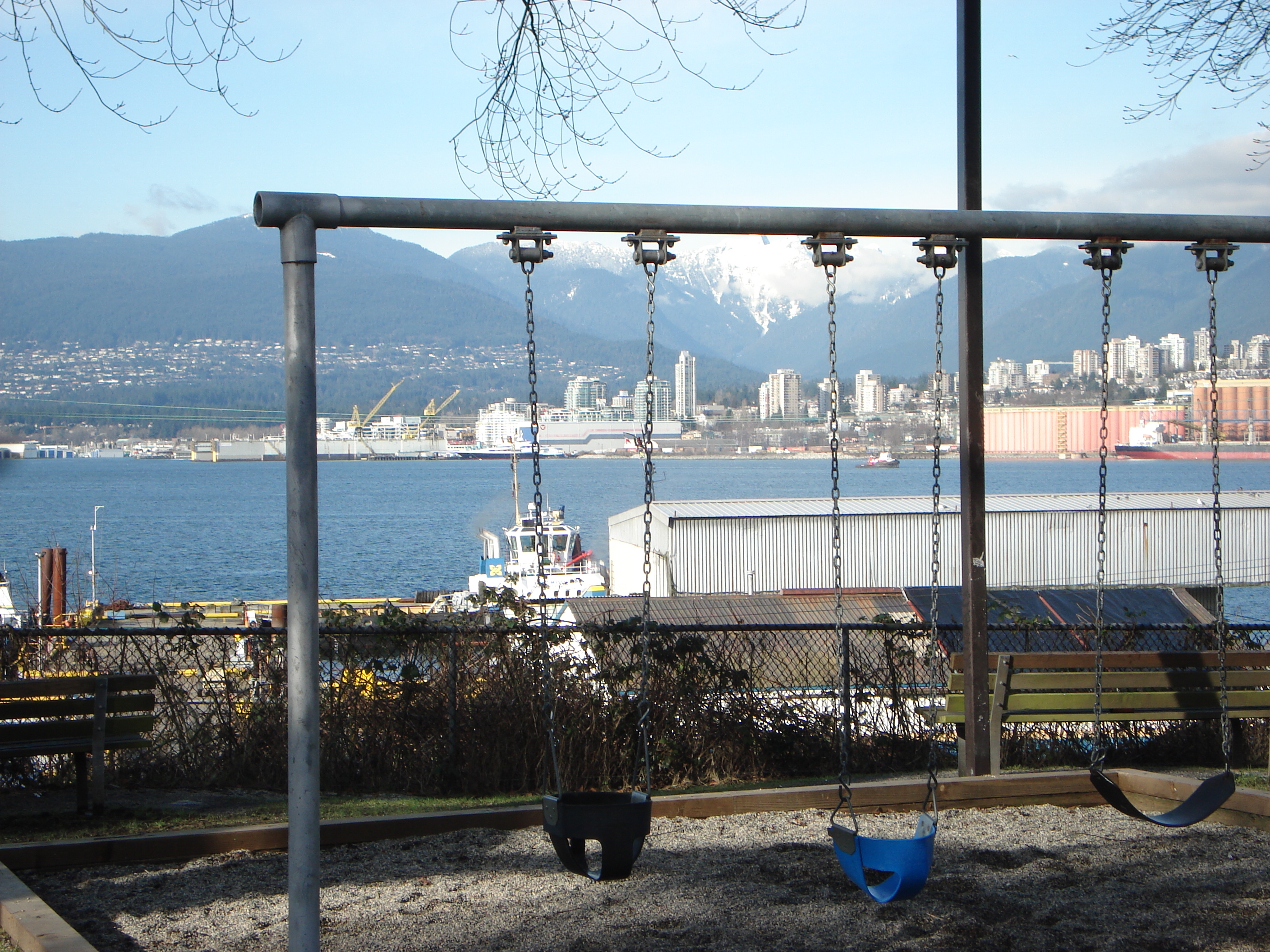
The other night I visited an old friend I hadn’t seen in a little while (no particular reason for this gap in our social calls, just busy summers for the both of us), and after doing that thing where you say “Whelp, time to go” but then you stand and talk in the porch for fifteen more minutes, I stepped out of her house into a warm August evening. I reached the main drag just as my 7 Nanaimo Station bus zipped past the stop on the other side of the street, but the weather was fine and I realized that all was not lost: sure, I could wait half an hour for the bus to come again, or I could take the other bus, the 7 Dunbar, and reach home via a circuitous route that would take me through my old neighbourhood.

I chose the latter, and as I watched the familiar landmarks glide past my window, my little bus trip became a journey (internally at least), and that journey became a story, and that story became about Vancouver, and when I got home I wrote some of it down, and as I did that I discovered the story was more important to me than I had expected, and then it became apparent that I could not write this particular story about Vancouver this week. Probably not next week either. Because I realized that the story I want to write about Vancouver is one that deserves more attention than my mind can give it right now. It deserves more crafting and more subtlety than what I can do in the week between blog posts. At the moment, it exists in my mind purely as potential, with images and lovely turns of phrase gravitating towards it. Careless handling will collapse the whole enterprise, and I don’t want to do that with this one.

So this is not that story. This is a story about the story. Pointless? you ask. No, I answer, because although this is not the story, this is also a story that is important to me. A story about the way that inspiration sometimes finds you. A story about how we leave our mark in every place we go, and how those pieces of ourselves that we sloughed off (thinking we’d grown, thinking we were “past that”)  still loiter in the streets of our old haunts, waiting for a circumstance of municipal transit to carry us back.

It’s a story about realizing the value of something, even if it’s just personal value, and being aware enough to understand that it deserves more than the usual effort, that it requires being patient. It’s a story about how, in a culture in which so much is shared (especially by personal bloggers such as myself), sometimes it is important to keep some things close, if even for a little while, and consider them carefully before shoving them into the world.

It’s a story about how exciting it can feel to have a story you’re itching to write, and how precious and perfect that electric moment before creation can be.

Emily of New Moon vs. Anne of Green Gables

Spoiler alert–Emily wins.

n59419 Sorry Anne fans, but if Anne Shirley is the boisterous poster child for all that is sunny and sentimental about L. M. Montgomery’s  Prince Edward Island, Emily Starr is the quiet and dignified young ambassador for its darker, lonelier, and sadder beauty. Both girls are orphans, both do, eventually, find their “rainbow gold” (critics often argue Anne achieves this only by lowering her expectations), but only one girl truly visits the “depths of despair” in her young womanhood, and for all her melodramatic theatrics, that girl is not Anne Shirley.

[Note – For the purposes of this post I am comparing the three Emily books (Emily of New Moon, Emily Climbs, and Emily’s Quest) with only the first three Anne novels (Anne of Green GablesAnne of Avonlea, and Anne of the Island). There are two reasons for this. Firstly, I couldn’t bring myself to read past the third Anne book. Secondly, by cutting the Anne books off after the third, we are finishing with both heroines at a similar age and marital status, since their girlhood and young adulthood is what I’m interested in anyways.]

anne_of_green_gables1I suppose I can start with the obvious: the writing in the Emily trilogy is, quite simply, better. This isn’t Anne’s fault. After Anne of Green Gables was first published, L. M. Montgomery had 15 years to become a better writer before Emily of New Moon came into existence. One would assume that a writer would become better after 15 years, and Montgomery did–she managed to retain the charming characters and setting that made Anne of Green Gables so beloved, but with Emily the plot as a whole was stronger, the stakes higher, and the narrator’s sense of humour and pathos considerably sharper. Emily Starr inhabits her world, and is constrained by its constraints; she doesn’t simply overrule them the way Anne does.

Obviously, the perceived strengths of each character and their journey depend upon what you, the reader, feel is more important in a story. Despite its relative safety and domesticity, the story of Anne Shirley reads like a fairytale–somehow, despite an early childhood of abuse and neglect, a little girl is able to be infallibly romantic and optimistic, charm every single person she ever meets, win top honours in every academic trial she encounters, and eventually realizes that the man she spent years declining really is the man she wants after all (boring Gilbert from Avonlea was her dashing prince all along! Quelle surpise!). Interestingly enough, despite Emily Starr’s possession of her Grandmother Shipley’s “second sight” (used incredibly sparingly as a plot device), her life and world are simply more human–once an orphan, Emily is misunderstood and treated unfairly by the adults in her life, and teased and resented by her peers. The love she gains (and is able to give in return) is hard-won on both sides, the outcome of conflict and compromise and not simply “charm”. Essentially, if you want the endearing dew-bright fairytale, Anne Shirley is the heroine for you. But if you want a character that’s a little more human (whose failures and disappointments make her triumphs that much sweeter), Emily Starr will deliver.

Still not convinced? If you’re a dyed-in-the-wool devotee of “that Anne-girl” you probably never will be, but just for fun, consider the following:

  • Anne and Emily share a similar character flaw (pride), but Anne’s is literally only skin deep. If you’ve read Anne of Green Gables (or watched the CBC mini series) you will remember the time Anne broke a slate on Gilbert’s head (and refused to forgive him for years) because he called her “Carrots”, or the time she dyed her hair green, or her nose purple (later book). One could say Anne is beset by pride, which can make for an interesting character flaw, but in actuality she merely suffers from pride’s annoying little cousin–vanity. BORING. Emily, though not at all vain, is acutely proud–proud of her late father (who is despised by her new guardians in her extended family), proud of her extended family (despite their sometimes unjust treatment of her), proud of her friends (despite their occasionally spotty reputation), proud of her composure (even to her detriment), and proud of being a writer. These various kinds of pride clash with the desires of her community, her family, her peers, and her heart in ways that are important to Emily’s growth as a character, a woman, and a writer, but they are also integral to the plot. The consequences of Anne’s vanity are as superficial as the flaw itself–hair grows back, forgiveness is granted, love restored. The consequences of Emily’s pride are lasting, and she must learn to live with them.
  • Anne Shirley writes, but Emily Starr is a writer. Sure, Anne scribbles down a few hilariously flowery romances (remember “Averill’s Atonement”?), and eventually pops out a little book about Avonlea, but she is hardly ambitious and seems mostly to write for amusement. Conversely, the first book in the Emily trilogy ends with a realization of her commitment to her craft (described as a “jealous goddess”) despite the pains it will and does give her. As you watch Emily grow as a person you also watch her grow as an artist–the rejection letters sting, the first acceptance is a thrill, and nothing will ever fill the hole in her that writing occupies.  Though obviously Emily the Writer is specifically relevant to me, I wouldn’t require Anne to share that goal if she at least wanted something. But she doesn’t really. I suppose I could rephrase my point in a more general way:
  • Emily has a goal, but Anne does not. It’s true. Anne enjoys scholarship and getting her BA (through hard study rather than intellectual maturation it seems), but has apparently little plans to do anything with it. How convenient for her that she happens to find herself in love with Gilbert Blythe around the same time she finds herself with nothing to do! And it’s not even the feminist in me that grates against this journey–if Anne had always wanted a simple married life then achieving the means to it would be a great end to the third book, but the thing is, she never did. The reader really wants Anne and Gilbert to end up together, but for the most part, Anne herself does not. Having the heroine achieve something she never really wanted because it turns out she has nothing better to do is not my idea of a great story. (For all you naysayers who point out that maybe Anne’s goal was to be loved and have a home, I would say that’s valid, but she achieves that goal in the first book, and the next two novels are just saintly sentimental Anne Shirley spinning her wheels and staving off Gilbert’s puppy-eyed advances.)
  • Anne’s love of Gilbert is simply tacked on to the end of the third novel, while Emily’s feelings for Teddy are a force that significantly shapes her journey. Regarding Anne’s engagement to Gilbert, see above. It’s all just comfort and friendishness, with not a single spark or thrill about it. Though critics often smear Teddy Kent as a “Gilbert Blythe” type, he is no such thing. Teddy Kent is a talented visual artist with emotions and ambitions of his own. His life does not belong to Emily, and he does more with it than dote on her (his creepy mother, the “morbidly jealous” Mrs. Kent, also serves to make Teddy a more risky and thrilling proposition than safe dopey Gilbert Blythe). Apart from Teddy’s superior qualities, his relationship with Emily seems to grow organically and artfully throughout the trilogy, encountering disappointments and misunderstandings along the way. Unlike Anne and Gilbert, Emily and Teddy are NOT a foregone conclusion and the tension this creates is AWESOME. Of Miss Lavender and Mr. Irving (finally wed after a long separation in Anne of Avonlea), Gilbert once says to Anne, “wouldn’t it have been more beautiful still, Anne, if there had been NO separation or misunderstanding . . . if they had come hand in hand all the way through life, with no memories behind them but those which belonged to each other?” No, Gilbert, no it would not, at least not in a book. BORING.
  • Bad things happen to Emily. Nothing really bad of course, or it wouldn’t be an L. M. Montgomery novel, but actual bad things do happen to Emily and she is forced to bear the weight of them. It’s suggested in Anne of Green Gables that Anne’s life before Avonlea is a very unhappy one, but it seems to affect her not at all. She’s sad of course when Matthew dies and Marilla’s eyes fail and when she declines Gilbert for the first time, but it falls from her like water from a duck’s back, and through unrealistically fortunate circumstances (including the death of minor characters we’re not attached to), Anne is able to have everything she wants anyways. Not so with Emily. When it comes to Emily Starr, Montgomery has allowed her heroine to be hurt and afraid in ways Anne never was (see Emily Climbs for a truly macabre episode in which 13-year-old Emily is locked in an empty church with Mad Mr. Morrison, who believes she is his dead wife). When Emily breaks an engagement, she loses a cherished friend forever. When her teacher dies, she loses her best mentor and critic. After high school she remains on New Moon farm while her best friends pursue their careers in the wider world, growing professionally and growing apart from her. And even in the glow of the triumph of her first published novel, she still feels the sting of the loss of her forever unborn actual first book. Montgomery has given Emily permission to be depressed when life hurts, a permission she never granted Anne. Case in point:
  • The broken ankle. When Anne breaks her ankle falling off a ridgepole in Anne of Green Gables, her seven weeks on the sofa are described as merely “tedious”. “It isn’t very pleasant to be laid up;” says Anne, “but there is a bright side to it, Marilla. You find out how many friends you have. Why, even Superintendent Bell came to see me, and he’s really a very fine man.” Then she prattles away for a couple pages about “kindred spirits”. Sigh. Anne Shirley, sometimes I want to slap you right in your silly face. When Emily trips over a sewing basket and falls down the stairs, piercing her foot on the sewing scissors and nearly succumbing to a dangerous infection, her convalescence as depicted in Emily’s Quest is not quite so cheery:

…in the long nights when everything was blotted out by pain she could not face it. Even when there was no pain her nights were often sleepless and very terrible when the wind wailed drearily about the old New Moon eaves or chased flying phantoms of snow over the hills. When she slept she dreamed, and in her dreams she was for ever climbing stairs and could never get to the top of them, lured upward by an odd little whistle[…]that ever retreated as she climbed. It was better to lie awake than have that terrible, recurrent dream. Oh, those bitter nights!

Emily’s world is clearly darker than Anne’s, and for those who don’t like the darkness, I can see why spunky Anne would be a better literary companion. But doesn’t a little darkness make for a better story? Doesn’t a little pain make a character more human? Don’t ambitious goals and formidable obstacles make the reading experience more worthwhile (especially when, true to L. M. Montgomery fashion, everything works out fine in the end)?

I think so. Though Anne Shirley will always have a nostalgic little place in my heart, it is to the world of Emily Starr that I return again and again for comfort and inspiration.

Rachel Lebowitz and Anakana Schofield on taking 10 years to write one book

Last Thursday my fiction professor David Chariandy decided to take us on an impromptu field trip to the Rhizome Cafe to hear Vancouver-to-Halifax transplant Rachel Lebowitz read from Cottonopolis, her new book of  prose and poetry, with a special a guest reading by Vancouver writer Wayde Compton (we missed the first part of his reading but his work was pretty intriguing).

cottonopolisI must confess that I generally don’t like readings, or at least, don’t like the idea of readings. I worry that if I don’t like the work I’ll be depressed and wonder how on earth this person managed to be published, or if I love the work, I’ll be depressed and wonder how on earth I will ever have anything of worth to contribute. Lebowitz and Compton put my feelings in the latter camp of course; however, the evening as a whole was surprisingly encouraging and I think it has to do with actually meeting published writers, instead of just being scared (or jealous) of them.

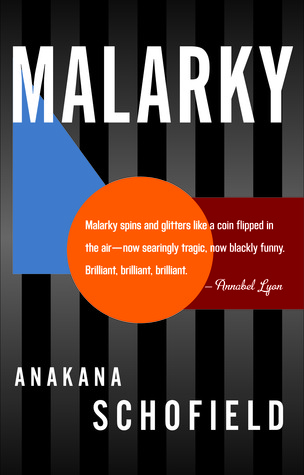
13237125Prof. Chariandy (whose 2007 debut novel Soucouyant was shortlisted for the Governor General’s Award) is never one to miss a learning opportunity and shortly after the reading he was able to commandeer the time and attention of not only Rachel Lebowitz but Ireland-to-Vancouver transplant and author Anakana Schofield as well (Schofield was recently the recipient of the Amazon.ca First Novel award for her book Malarky). Both Lebowitz and Schofield seem to take time very seriously in their respective processes, i.e. both writers worked for years on their respective books. Upon learning that we were an undergraduate writing class, Schofield joked that she and Lebowitz would give us their top ten tips for taking ten years to publish one book, but between the two of them they actually came up with a great list.

So here, in no specific order and paraphrased/remembered only to the best of my abilities, I give you Rachel Lebowitz and Anakana Schofield’s “Top Ten Tips for Taking Ten Years to Publish One Book”:

  • Read, and read widely. If YOU aren’t reading, how can you expect your work to be read by others?
  • Don’t publish work that isn’t good, even if it’s “publishable”.
  • Take time to NOT write. There’s no reason for the constant pressure for writerly output if you’re just spinning your wheels–time spent on your family, your interests, yourself will find its way into your work.  To be a good writer you have to actually LIVE life.
  • Choose your “influences” carefully. Your influences should be artists (from various disciplines) that you believe to be the best of the best. Your influences should inspire you to be better. Your influences should be truly excellent at their craft, rather than writers that write at the level you’re already operating at (i.e. your influences should not be your peers, necessarily, unless your peers are jaw-droppingly good).
  • Don’t condescend to your reader. Writing to the lowest common denominator because you think it will increase your chances of being published does not a good writer make (see point about not publishing work that isn’t good). Assume a readership that is as intelligent as the work you are trying to create.
  • If you find yourself consistently writing around the same locale or idea, that’s fine, so long as you continue to challenge yourself in your writing. As long as you need to write about a certain thing, write about it. Once it’s out of your system, you can write about the next thing that haunts you. To put it another way, there’s no need to write about something outside your scope of knowledge, interest, and experience just for the sake of it. The fact that a subject is “new” for you doesn’t necessarily make it more worthy, unless you have genuine passion and interest around it.

Find those first six tips helpful but need more advice on how to stretch out the writing process to ten full years? Schofield rounded out our top ten with some time-spending techniques:

  • Lose parts of your manuscript all over your apartment.
  • Get a guinea pig.
  • Don’t kill your teenager (presumably keeping both guinea pigs and teenagers alive is more effortful and time consuming than killing them off).
  • Stay off the cheese (I’m not sure if this one is meant to speed you up or slow you down actually. Either/or I guess, depending on how much you like cheese).

Of course my list is no replacement for meeting these warm and talented writers in the flesh but I found their conversation with us so darn nice and useful that I just had to record it for posterity. I apologize profusely if I’ve misrepresented either Lebowitz or Schofield–I did my best to get the gist of a pretty fast-paced conversation, but obviously some things were lost in translation.

I was able to purchase Cottonopolis from Rachel Lebowitz that night (and get it signed too, woot!) and will hopefully be able to get my hands on a copy of Malarky soon. I’m certainly intrigued and appreciative and looking forward to some good reading.

[For more about Rachel Lebowitz’s process, you may want to check out Lebowitz’s 2010 interview with Desk Space. For more of Anakana Schofield’s informative and hilarious musings, visit her website at anakanaschofield.com. Particularly the “About” page and her blog.]

I Never Had My Gatsby/Salinger/Bohemian Moment

People with whom I’ve discussed certain works of English literature have probably heard me say that “I’m just not all that into ‘angry young man’ fiction.” I will often follow up by complaining that there seems to be no similarly canonized literature about angry young women.

While my latter point is true, and remains problematic to me, I realize that labelling F. Scott Fitzgerald’s The Great Gatsby or J.D. Salinger’s The Catcher in the Rye “angry young man” fiction is a bit of a misnomer. The characters aren’t angry, per se, but they are hopelessly lost. And they make terrible decisions, the consequences of which are often more damaging to other people than they are to the decision maker. (Then again, maybe the angry young men aren’t the ones in the books themselves, maybe they’re the ones reading them. But I digress.)

Of course, both The Great Gatsby and The Catcher in the Rye are great books. They really are. You should read both of them at least once in your life, and yet…and yet

There’s a certain cultural thing these books have become part of, erroneously I think, and I just don’t get it. There seems to be a group of young Salinger/Fitzgerald fans (in the age group of my peers, generally) who laud these books as Bibles for the truths they tell about the irresponsible, self-inflicted misery of privileged living (which a lot of angsty Millennials from middle class backgrounds relate to), and yet, paradoxically, seem to use these same novels to excuse their own flakiness and lack of roots or connections to the world and people around them. If you recognize that what makes The Great Gatsby and The Catcher in the Rye so good is also what makes them so sad, I can’t see that you would consider Jay Gatzby, Holden Caulfield, or even Nick Carraway to be role models for living. Unless of course, you actually wanted to be sad. In which case, you’d be well on your way if you emulate these miserable heroes.

But are we really so lucky, really so privileged, that we must purposefully seek out unhappiness and instability in order to feel alive? Have I missed out on a great piece of my generation’s growth by experiencing only the unavoidable misery and instability that came my way naturally? If so, I don’t get it.

Maybe I’m just stuffy as hell. I recently went to see Baz Luhrmann’s film adaptation of The Great Gatsby (Leonardo DiCaprio and Carey Mulligan were great, Tobey Maguire, as usual, was not). Before the previews the cinema was playing advertisements, most of them aimed at millenials like myself (because we buy SO MUCH STUFF), and one of them was Mini Cooper’s NOT NORMAL commercial. Basically, says the coaxing manifesto of the voiceover, normal is safe, but “normal can never be amazing”.  Grey sterile images of office cubicles and dry toast with marmalade make way for beautiful twenty-somethings hula hooping in the dark, making art, and kissing in elevators, all to loud rousing music and the smooth British voiceover man as he champions the “not normal”. And somehow, these beautiful people (who are WAY too cool to have anything “normal” like a job) can afford to drive Mini Coopers.

I have no problem with crazy hula hooping club parties, making out in elevators, or even Mini Coopers, but the message here (“Who would ever want to be normal?”), like the message of most advertisements, is way off. Even sexy Mini-driving DJs eat toast sometimes. Even people who “seize the day” by getting it on in a crowded elevator have jobs, most of those jobs are “normal”. Mini Coopers don’t pay for themselves, and NO ONE gets paid just to be an awesome thrill-seeking hipster. Survival necessitates at least some bending to the normal demands of life (food, shelter, transport). Sure, “normal”, by definition, can never be exceptionally stupendously mind-blowing, but it also won’t be war-torn, diseased-wracked, starving, homeless, or abused. I guess what I’m saying is that I’m okay with normal, and because of this, I am not invited to Mini Cooper’s party, the wild binge-drink/heart-break/art-make that is their version of “not normal”. And I guess that’s too bad.

I always wanted to go to a really amazing party. I really wanted to be part of that “let your hair down” crazy time, I wanted the romance of waking up in my car in a strange place, of stolen kisses and superficial heartache brought on by guitar-strumming boy wonders, summers that last forever, mud in my hair, and the Zombie’s “Time of the Season”. But when I was old enough to go to parties, I was disappointed. I felt like a fool and a phoney, self-consciously swigging whatever beer I could get someone to buy for me (regardless of its taste or temperature), talking too loudly, laughing too loudly, making “fun” this big show we all had a part in. It didn’t look like what I’d imagined, there was a lot of eyeliner and hooded sweatshirts and stupid fights. It didn’t sound like what I’d imagined, most of the music in the mid-2000s was really shitty. It was nothing to make a celebrated subculture out of, and I felt cheated.

I still feel cheated. I wasn’t at Woodstock, I was never part of the Pepsi Generation. I never lived in a house where all our glasses were mason jars and the weed belonged to everyone. I’ve never done anything really debaucherous. I’ve never really REALLY been out of money (because rather than being “not normal” and spending the last of my line of credit on turntables and a Mini Cooper I got a temp job in admin instead). I’ve never felt responsible for nothing. I’ve never sought out misery or insecurity or instability for the sake of it–I’ve always run back to solid ground when I could find it.

I never said, “eff this” and wandered the big wide world aimless and nursing my whiskey soaked blues. I never kept company with careless people (if I could help it). I never hated my family or their values, I never broke a heart if I could help it. I chafed against the system, but I never really rejected it. I loved the long loose dresses, but I never was a bohemian. I’ve never even cried on a fire escape.

And I never held up a battered paperback of Catcher in the Rye that I carried everywhere and said, “This book, man. This BOOK. It’s like the story of my WHOLE LIFE,” and set my eye on a future that was always moving away from, and never coming back to.

Huh. I wonder what it is I missed?

Hive: the New Bees 3 (Chapel Arts, June 11-14)

New Bees 3 BannerThe buzz is back! Following on the heels of the successful New Bees 2, Resounding Scream Theatre‘s Catherine Ballachey and Stephanie Henderson have once again corralled almost a dozen emerging theatre companies into the labyrinth that is the Chapel Arts gallery in East Vancouver. Together, this eclectic hive mind has conspired to bring you Hive: the New Bees 3, running Tuesday, June 11 to Friday, June 14, in nooks and crannies all over Chapel Arts.

Considering New Bees 3 is the sixth Vancouver Hive event (there have been three professional Hives facilitated by the Progress Lab and three events, including this one, produced under the “New Bees” banner), many of you may be veterans of the Hive scene already. In case you’re not, here’s the skinny on what you can expect:

  • The doors open at 7:30 p.m. and shows will run simultaneously, in various spaces, until approximately 10:45 p.m.
  • You can see as many (or as few) shows as you want, in any order you want.
  • Before, after, or between shows, you can drink at the bar and enjoy the ambiance of arts and culture.
  • Due to space restrictions in the different Chapel Arts performance areas (which includes coat rooms and bathrooms), each show has its own limits on the number of audience members it can hold at one time. You’ll need to scope the place out, and, if there’s a particular show or company you know you want to see, it’s a good idea to line up/sign up for that one early.
  • At approximately 11:00 p.m. on Friday (following the final performance), the after party will begin with the Gal Pal DJs. 90s dance hits will be playing. The bar will be open. Party party.

If you’re looking to test the waters of the emerging theatre scene in Vancouver or just test the waters of the Vancouver theatre scene in general, an event like Hive: the New Bees 3 will be a good place to start. Last year, the Georgia Straight’s Colin Thomas called New Bees 2 “an intimate adventure, which is exactly what theatre should be,” and I am sure the companies participating in this year’s theatrical caper will continue in this new tradition.

Hive: the New Bees 3 will feature 11 emerging theatre companies:

Many of these companies participate in New Bees 2 and some are brand new to the event. All of them will be bringing varied and interesting work to their little corner of Chapel Arts. Why don’t you join them?

Hive: the New Bees 3 will run from Tuesday, June 11 to Friday, June 14 at the Chapel Arts gallery (Dunlevy and Cordova). Doors open at 7:30 p.m. Tickets available online through Brown Paper Tickets.

[SHAMELESS PLUG ALERT: I wrote the text of the Troika Collective’s piece this year. Even if I hadn’t I would still be recommending this event. :)]

Drawing it up at the Vancouver Draw Down

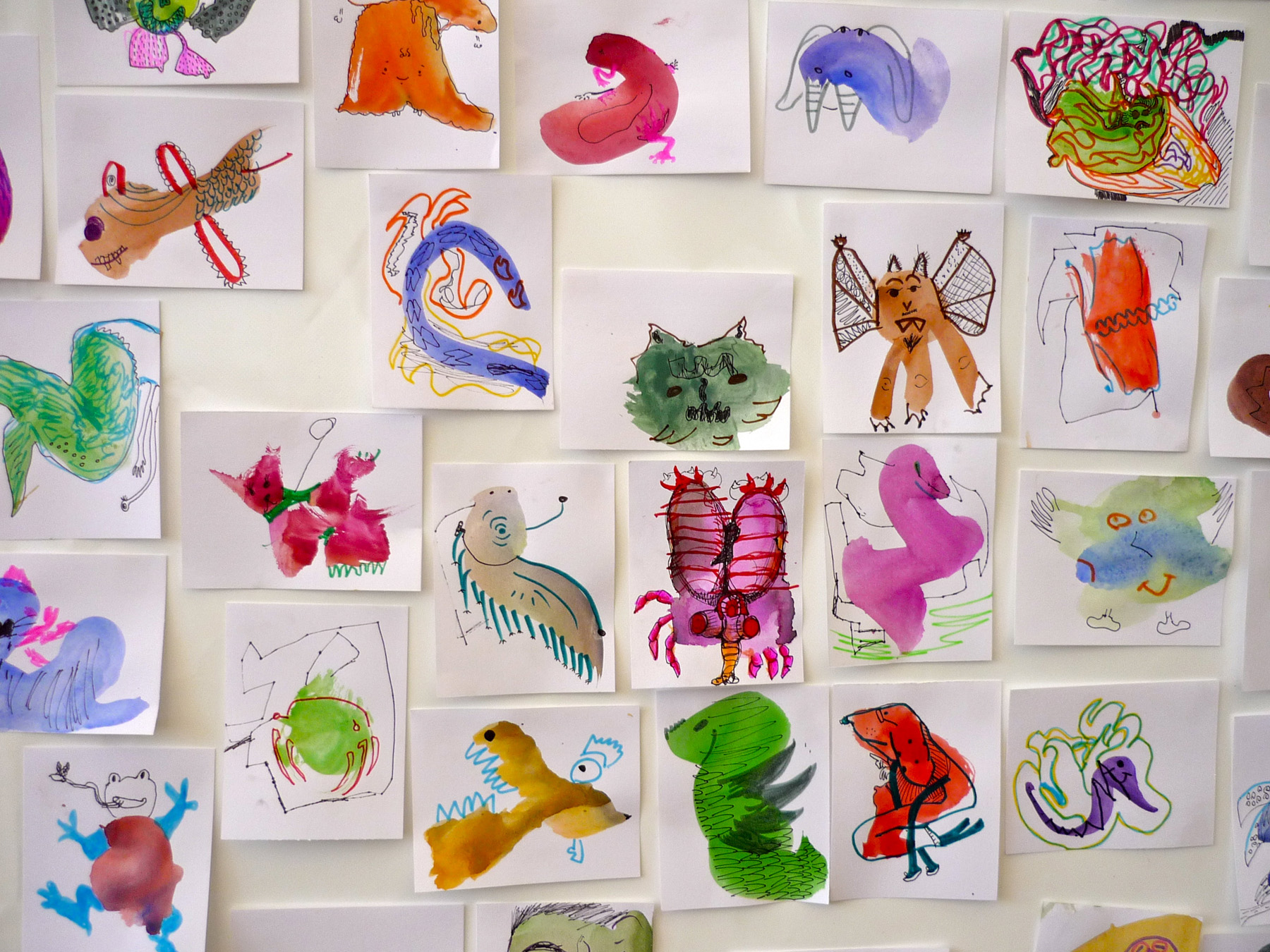
_creaturesvdd If you’re having a hankering to unleash your inner visual artist, or to collaborate with others artistically, or just to get out and learn something new, you’d better mark Saturday, June 15 in your calendar so you can be sure to join the 4th Annual Vancouver Draw Down at one of their 35 FREE drawing workshops, hosted at venues across the city.

According to their website:

“Vancouver Draw Down is a celebration of drawing in everyday life that challenges preconceptions about drawing and works to reconnect EVERYONE with the power and creative pleasure of making marks. […] Projects, developed and led by professional artists, offer the opportunity to explore drawing in person and online. This day-long, city wide celebration focuses on the process, pleasure and diversity of drawing, rather than on skill and technical ability.”

Photo: Melissa Baker

Photo: Melissa Baker

At one point or another, I’m sure we’ve all enjoyed doodling, or crafting, or the simple satisfaction of making something. Sometimes we’ve wanted to hone our skills independently. Sometimes we’ve wanted to create a spirit of community by creating something with other people. With focuses ranging from independent creation, to collaborative work, to surprisingly athletic feats of visual artistry, there should be at least one Draw Down workshop that’ll rock your artsy soul.

[Note that the links I’ve provided above represent only THREE of the 35 Draw Down events running on June 15. Please visit the Vancouver Draw Down website to explore all of the events and find your passion and play. I mean, there’s even a workshop where you colour with GIANT CRAYONS for goodness sakes!]

Photo: Josh Hite

Photo: Josh Hite

RELATED EVENT: ONLINE DAILY DRAWING PROJECT

As a lead-up to the June 15 events, Draw Down is also facilitating a 10-day Online Daily Drawing Project (June 4 – 14). Participation in the Daily Drawing Project is a pretty simple affair: just follow Vancouver Draw Down on Facebook (facebook.com/VancouverDrawDown) or Twitter (@VanDrawDown) and be on the look out for your daily drawing instructions. You can either choose the “Challenging” instructions (15-minute drawings) or the “Just For Fun” instructions (5-minute drawings). You draw, share, and spend the rest of the day basking in artistic glory. Voila.

(I think) I know what a play is!

FairholmeHouse

This is not a play. This is a house.

Sound the trumpets! After five years spent completing a BFA in Theatre Performance and four more years performing in and writing plays, I think I have finally figured out what a play is!

(Kind of.)

A famous question theatre artists are told to ask themselves when they decide to produce, direct, or write a piece of theatre is “Why this play? Why now?”. When writing a play, that question can be extended to also ask, “Why is this story a play? Why is it not a work of fiction, or a poem, or a film script?”

For the most part, I can never quite articulate why this play, why now. I think the point of the question is the struggle to answer it–struggle that informs the work I’m doing and helps to imbue it with urgency and intention. Unless I work on a directly topical piece of theatre, I will never have a completely satisfactory answer to this question, and I am satisfied with that.

But when it came to the question of why any particular story was being written as a play, my answers used to be something along the lines of, “Because I’m writing it as a play” or “Because I have more experience with theatre than with any other genre” or “Because I was asked to write a play.” These are terrible answers. They are nowhere close to satisfactory and I should never have been satisfied with them.

But thank goodness, I’ve figured it out. Sort of. At least for theatre with text. Or at the very least, for the theatre I write. Which is, I suppose, all that matters when I’m writing a piece of theatre. The answer, my friends, is really very simple:

The play that I’m writing is a play because it can’t be anything else.

Mind blowing, isn’t it? Something is something because it could not be anything else. Perhaps you think it shouldn’t have taken a degree and four extra years of experience and part time study on top of that for me to figure this out, but some of us are slow learners. Besides, it’s not as though I haven’t heard other writers say this before, but a lot of writers say a lot of things about their work that are not at all applicable to mine. Until I figured it out myself, in my own work, it just wasn’t true yet.

My process was thus:

I wrote a very short play that was very narrative. In many places, it read like fiction.

I changed certain passages to make them sound more “play-y”. Then I didn’t like that so I changed them back. Then I got feedback from a respected source that I should change the verb tense of these passages to make them more “active” (a better word than “play-y”). I have yet to do this. As of now, the play has remained untouched for three months.

Instead, I made a digital copy of the script and began taking it apart. “There’s a lot of narrative here,” I thought. “Fiction?” I thought, “Why not?” I decided to give it a try; after all, I’m no less trained to write fiction than I am to write plays (which is to say, not trained at all). Since nearly two-thirds of the play read like fiction anyways, I thought turning the script into a short story would be both natural and simple.

Ho HO. Not so.

My strange little play, imperfect though it was, deflated like a wrinkly old balloon the moment I tried to “fiction-ize” it. It was clunky. It was heavy. The character’s lines, instead of resonating my ears, dragged themselves sullenly along the floor of…what?

Of a stage. When I tried to fiction-ize my play, break free of the confines of staging and truly inhabit the setting I’d placed my characters in, I realized the ground the characters walked on was a stage floor, and the air they breathed to speak was the rarefied air of a darkened theatre, and even though I can see my setting in my mind’s eye, clear as day, nothing will ever change this. The story itself is where I put it, in my mind. But the telling? The telling is on the stage.

There are narrative plays (lots of them, actually) and there are very theatrical works of fiction, and the way I was able to figure out which one I was writing was by asking myself this: Do these words need to be said aloud, not just quoted in quotation marks on the page but actually, physically, create sound waves and exist together with no “she said”, “she cried”, etc. to mediate them?

For my fiction-y little play, the answer is yes. The text is meant to be spoken aloud. And not just read aloud, the way poetry is read aloud. The text is meant to be performed, its skeleton fully fleshed out by the intelligence and craft of artists and its voice ringing in the ears of an audience. So what if my play’s not “active”? A good actor can make a whole room with just the sound of their voice.

That’s not to say I won’t be returning to this piece, dusting it off, and doing what I can to “activate” the language without damaging its soul. This play is a play because it can’t be anything else. But whether or not something of mine is a good play, well, that’s a whole other question for me to contend with and I’m afraid I’ll just have to get back to you. It could take years.

It takes a village to raise a storyteller

Near Elmhurst Road, back home in Saskatchewan

Near Elmhurst Road, back home in Saskatchewan

A week or two ago, TC and I were watching one of my favourite films, Big Fish (based on the novel by Daniel Wallace). In a nutshell, the plot revolves around Edward Bloom, a larger than life retired salesman and an incorrigible storyteller. As he lays dying of cancer, his adult son attempts to sort fact from fiction in the often “big fish story” of his father’s life. It’s a beautiful film and you should definitely watch it, but that’s not why I’m writing this post. I’m writing this post because while I was watching, I turned to TC and said, “That reminds me of Fred.”

Fred and Jackie (his wife) are my parents’ neighbours back home on the Prairie. Growing up, our two families spent a lot of time together playing, pot-lucking, camping, and car-pooling. It’s impossible to think about Fred without thinking about his stories. And it’s nearly as impossible to think about the art of storytelling without thinking about Fred. Some people just have the gift.

Do you ever examine your childhood memories and wonder if some events really happened, or whether you just remembered them so often imagined events took on a concrete shape (like a photo album where some of the images are staged but the photo itself is real)? I often can’t tell if one of my older memories is something I just dreamed, or if the dream I’m thinking of is actually a real memory. My family likes to twit me about my “faulty memory”, which I think is unfair. There’s nothing wrong with my memory–it’s quite good actually, and I remember a lot of things other people forget. The problem is, I seem to remember a few things that didn’t happen as well. I’ve noticed this when my high school graduating class shares memories of a classmate that passed away a couple of years ago. I don’t remember all the stories shared. But they so seem real to me, so “yeah, that’s just like him”, and I can picture my friend doing these things so clearly, it’s as if I remember that story too.

And it’s like this with the stories Fred used to tell us. Did my sisters and I, together with Fred and Jackie’s sons, really kick/paddle our way to the middle of Bright Sand Lake in an inner tube, accidentally pop it, and get blown across the lake? Of course not. But I remember our fear when the inner tube sprang a leak. I remember how dark it was when we beached on an unknown shore and peered through the reeds at the lighted windows of a hermit’s cabin (spoiler alert, the hermit helped us get back to our part of the beach and all was well). Did we really get lost in the woods one night, with carnivorous beasts surrounding us, only to be rescued by strange creatures that were almost as scary? No. But I remember the gleaming eyes of the evil Mud Bunnies, and the otherworldly shrieks of the Dukakis (spelling?) as they swung through the trees. I probably remember things about Fred’s stories that were never there in the first place.

But that’s how stories work, I think. You tell them, and some things get added, and some things fall away. Even the stories Fred has told us about his real life take on a different quality from the things other people tell me about their lives. I suppose that’s the danger of being a good storyteller–you make your experiences sparkle in a way other people’s don’t, making them suspicious. Surely, it can’t all really be true, can it? Is there some art there, shaping the experience, giving it arc and pace and climax, making it just a bit eerier or a bit funnier than it would be if someone else was telling the story? Of course there is. Storytelling is an art, even if you’re just telling your own story. And I don’t mind a bit.

Aside from my obvious pleasure in the fact that I featured prominently in several fictitious childhood adventures, you may wonder what all this has to do with me today, now. The point is that stories shape us, they shape how we speak, how we think, and how we remember. Narrative is so ingrained in human beings that we even create it where there isn’t any–did you know our dreams are only about 2 seconds long, and are just unrelated fleeting images/sounds? It’s true (I learned this in Psychology class). But we’re so attached to sense and narrative that when we remember our little 2-second dreams, our brain actually weaves them all together to form a story (albeit a very strange one, usually).

When thinking about my realization that I wanted to create stories, i.e., to write, I usually think about the stories that captured my imagination. Fairy tales. The dramatic games of “pretend” we played as kids. YA fiction. The 1984 film The NeverEnding Story. The Oresteia. The ballad of Tam Lin. And so on.

But what about the storytellers in my midst? Like my parents, reading to us and singing to us and telling us stories at bed time and doing their best to give answers to questions we were too young to understand? What about Fred, passing fireside nights with fantastical stories about his kids and their friends? What about my peers at school, and the elaborate fibs they told to impress each other? Aren’t their contributions of style and voice and creativity and commitment equal to (if not greater than) the contributions of the stories themselves? I think so.

I think too, about my friend Lisa, who lived just a bit farther down the road from Fred and Jackie. I was in junior high when she was finishing high school and she was the only one out of the kids in my neighbourhood who was writing, really writing, and caring enough to get feedback and develop her work (she and my older sister also heavily influenced my Our Lady Peace fandom but let’s not get into that, besides, Clumsy was a great album). Nowadays, Lisa is a writer (for a living!) and is working on a novel.

I think too, about the short-lived TV series “Jim Henson’s The Storyteller and especially about one episode taped onto an old VHS that we used to watch when I was small, and that I absorbed so unconsciously that when I thought about it later I couldn’t remember if it had been real (it was the story of Fearnot, and yes, it was real, I found it on Netflix). It wasn’t the folktales John Hurt’s Storyteller character told that were  necessarily special–it was the WAY they were told, the way the world of of the story bled into the fireside world where the Storyteller told his dog (who was a Jim Henson muppet) his tales, and the way that same Storyteller and his fireside bled into the tales themselves.

I think too, about beautifully-written books like Dianne Warren’s Cool Water that are exciting pieces of literature not because of WHAT the story is, but HOW it is shared with us (the language and the subtlety and the love). Or about a writer like David Sedaris, who makes the unusual parts of his life seem rather mundane and turns the mundane into something extraordinary.

It’s the artistry that captures me, the dedication to craft and to story. It’s the respect for a good story, and the acknowledgment of the importance of the teller, that inspires me. Every time I write, the stories I’ve read, heard, and seen find their way into my work. In the same way, I know that while it was my parents that raised and supported person I am, the storytellers around me (whether it was Fred my neighbour or John Hurt the actor) definitely chipped in to raise the storyteller I’m aspiring to be.