Walking With My Keys in My Hand

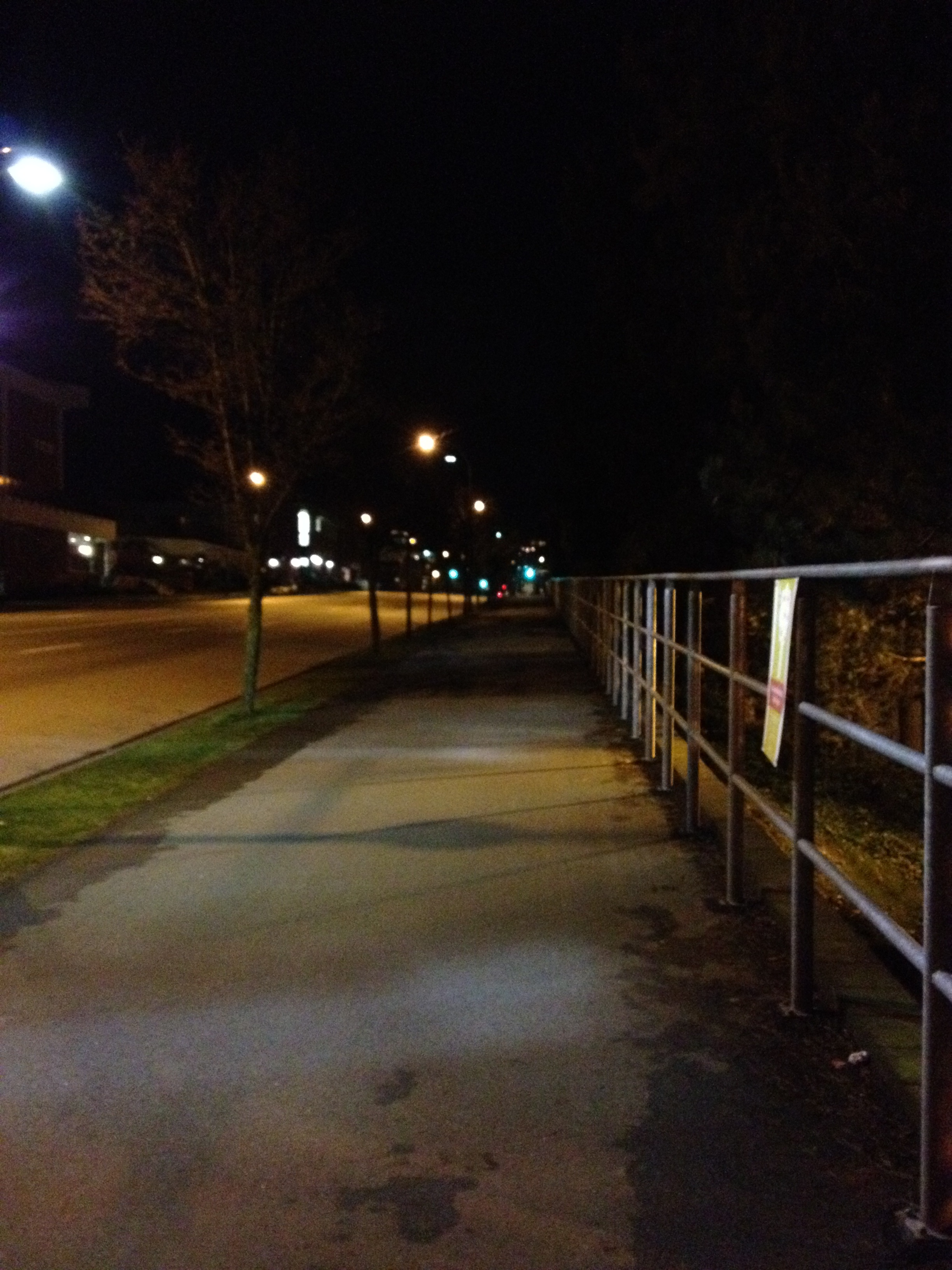
nightstreetLet me begin by saying that I understand the smallness, the near insignificance of my experience compared to the horrifying experiences of many other women in Canada, and worldwide. But here goes.

If you’re a woman who lives, or has ever lived, in a city, then you’ll know what I’m talking about when I say that when I walk alone at night, I usually walk “with my keys in my hand”. I’m not just holding them because digging them out of my bag when I get to my front door is annoying. I am carrying my keys in a particular way: the lanyard is wrapped tightly around my hand and the points of three different keys poke out between my knuckles. If you’re a woman who lives in the city, you’ll know why I do this, and why you’ve likely done it yourself.

Because you’re scared that someone will attack  you, and you need your first punch to cause as much pain as it possibly can. Most of us, thankfully, will not be attacked while walking home at night, but still. You are scared, and you walk with your keys in your hand.

I don’t live my life in perpetual fear. I like Vancouver and I love East Van in particular. But it doesn’t take so very much to compel me to put my keys in my hand. A dark street. The lateness of the hour. A vacant lot.

A couple of years ago, when I lived alone at my last apartment, I was heading home late on the number 16 bus. There are usually strange characters on this bus and I’ve had (or overheard) some pretty strange conversations. The conversations are usually funny and I forget them as soon as they’re over. But sometimes, I just get a feeling. A feeling that the attention directed at me is no longer safe for me. That night was such a night. A young man sat next to me on the bus and started to talk to me. Which is fine. It’s a free country. But there was an intimate tone in his questions that was too personal, that wanted to know too much about me. And it was late, and I was tired, and I had been drinking, all things that weaken me and make me feel more vulnerable. When I pulled the bell and excused myself at my stop, the guy said, “Oh, is this where you live? We should hang out.” I said, “No” and got off the bus. I tucked my keys between my knuckles and ran all the way home.

Of course, I made it home safely and never saw that person again. Reading this anecdote, you might not understand why such a seemingly harmless interaction would frighten me so much. But somehow, it’s been ingrained in me that a woman’s survival depends on reading tone, and trusting her intuition. Nine times out of ten, the person who seems inappropriate and threatening to her is merely inappropriate. But the tenth–there’s a good chance that tenth could be a Threat. And if she’s unlucky, that Threat could be an Attacker. Problem is, we have no way of knowing who to protect ourselves from, so we have to act on our red flags, whenever we see them. I don’t know where I learned these lessons. I grew up in the country and never had this issue. I can’t remember my mom or any other authority figures teaching me these skills. But when I moved to the city, there they were, waiting for me to need them.

So when I’m walking alone at night, I walk with my keys in my hand. I eye every stranger I pass. I eye cars too, to make sure they aren’t slowing down or stopping beside me. When my friends and I part ways on a cab or in the bus one of us asks the other to “text me when you get home”. Do I feel like I’m too paranoid? Do I feel a bit crazy? Do I feel like I’m overreacting?

Sometimes. To be honest, I know that my little precautions would likely do very little to help me if someone did want to attack me. But I’ve got to do something. Because if I didn’t, and something happened to me, I know people would ask questions, not of my attacker, but of my actions: Why was she walking alone? Why did she talk to strangers? Why didn’t she do more to protect herself? The truth is, I would ask myself those questions too: How silly could I have been to think nothing bad would happen to me?

When I was in my first year of university, I took a political philosophy course, and my conception of myself as a female in society exploded. For the first time I actually entertained the idea that I might be oppressed. Not by any purposeful forces, not by any men in my life who were trying to keep me down. But by the simple fact that I had to make different choices from my male peers. I had to have a “buddy system” for walking home from bars. I had to be careful who I spoke to. I had to make sure I didn’t get so drunk that I didn’t have my wits about me (unlike my classmates of the male sex). And, of course, I learned to walk with my keys in my hand. Nothing has hurt me so far, or even greatly inconvenienced me, but it isn’t fair, is it?

Obviously, my anxiety is manageable, and until the onus stops being on me to prevent my own potential assault, it’s just the way I’ll feel sometimes. But I am at the most harmless end of a huge spectrum of threat and violence that spans through muggings and rapes, all the way to the vicious beating and gang rape that left a Delhi woman dead in December. And I want off before I move any further along it.

This International Women’s Day, that is my wish. Take us off. Take us all off the spectrum. This request is from someone who exists on the best possible part of it she could possibly be located on, so I can’t imagine what it’s like to go any further. Actually, I can, a little. Just enough to scare me. Just enough to make me walk with my keys in my hand. And it’s stupid, and I’m ashamed of myself, and I really don’t know why.
What’s in a (Last) Name?

I recently read a Big Think article by the controversial (pseudo) academic Satoshi Kanazawa, entitled Why Children Must Inherit Their Last Names from Their Father, Not Their Mother. I should have known better. Kanazawa’s reasoning was, of course, ridiculous (I mean, this is the guy who published an article supposedly explaining the “truth” about “why black women are considered less attractive than other women”. I’m paraphrasing but not much. Please. Gag me with a spoon). I should not have given that idiocy (and thinly veiled misogyny) another thought and, at first, I didn’t.

But seeing as how I’ll be a married woman in not so very long, I have been thinking about this issue a lot lately. First and foremost, with my own name. My last name, Kresowaty, is long(ish). It’s Ukrainian. The only situation in which people meeting me for the first time have ever pronounced it correctly, or read it aloud without confusion or panic, was when I lived in Poland (and then uber correctly, pronouncing the “w” as a “v”, which in Canada I don’t bother to do). But despite suffering through years of mispronunciations (or having people address me simply as “Miss” rather than attempt my surname), I like my last name. I feel my last name very strongly to the core of my being. I want every good thing I do in my life to have the name “Kresowaty” appear on it. And I don’t think that will change.

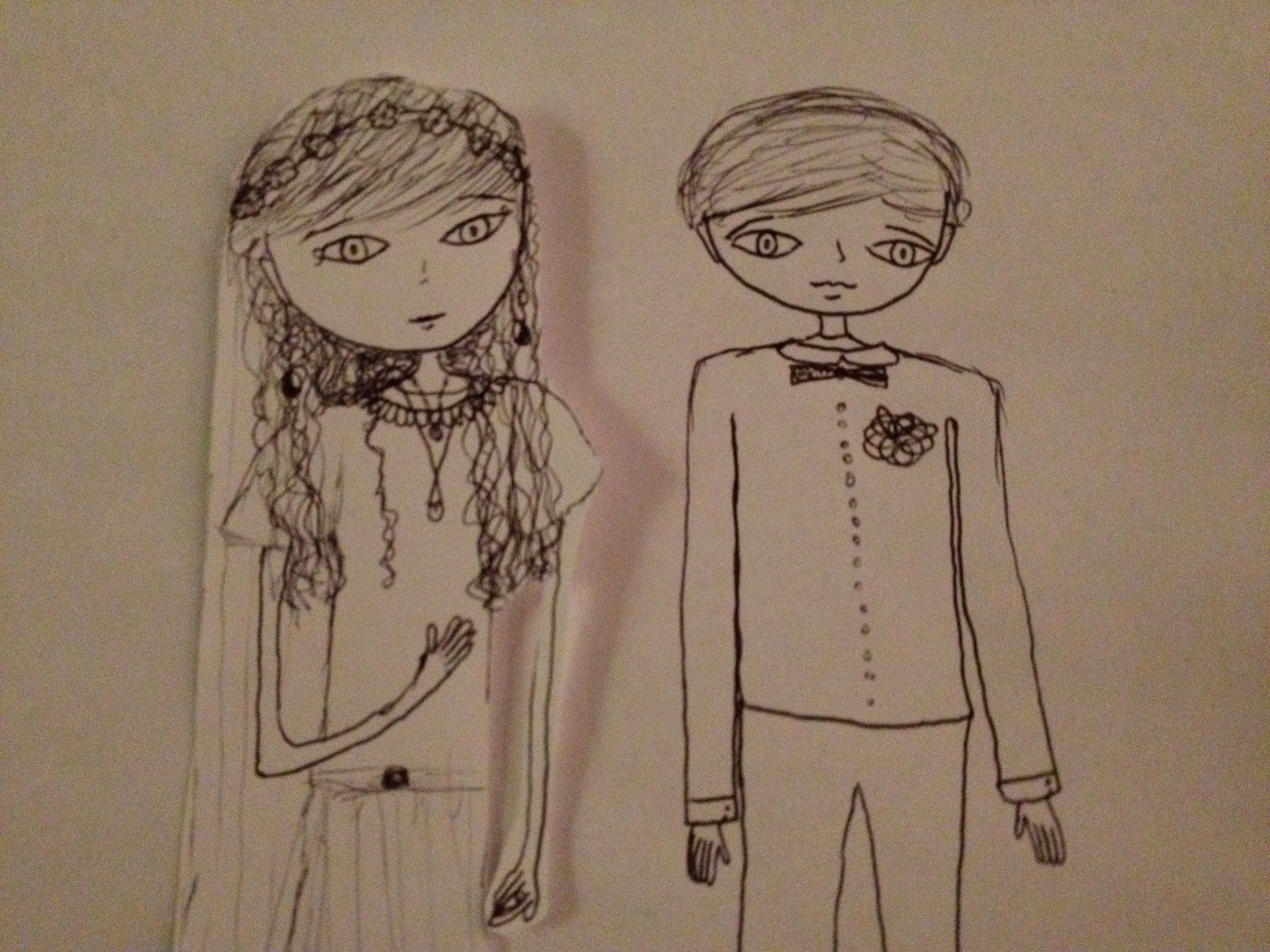
Illustration by TC's little cousin, who was 9. I like my drop earrings.

Illustration by TC’s little cousin, who was 9. I like my drop earrings and double necklaces.

I remember reading a blog post several years ago by a woman who explained why she kept her maiden name, rather than take on the last name of her husband and children. I was very surprised by the vitriolic comments her post received. People called her a “feminist c–t”. People told her she was a terrible mother, psychologically damaging her children by sending the message that she does not love or respect their father, or truly consider herself to be part of their family.

Bullshit. My mother has used her own surname, Zilans, both personally and professionally all her life. Her marriage to my father nearly thirty years ago did not change that, and I never felt for a second that she didn’t love us or didn’t want to be part of our family. Still, when I was a kid I once asked my mom why she never changed her name. She said, “Why would I?” That’s all the reason I’ll ever need.

That’s not to say that I don’t respect the choice of women who want to go the “traditional” route and take their husband’s name after their wedding. Knowing how I feel about my own name (and my mother’s) I was surprised when some of my contemporaries changed, or told me they were planning to change, their names. But when I think about it, it’s a lovely choice to make. Some people feel true to themselves when they have the name they were born with. Some people will feel more true to themselves by marking this milestone in their life by changing their last name. And it’s a choice I respect.

But the choice of whether or not to change your surname should remain just that–a choice. This means that while I support a woman who wants to take on her husband’s name, I also equally support any man who wants to take on his wife’s. Why not? A choice is a choice. In contemporary Canadian society, a woman is not the property of, nor subservient to, her husband. So if he wants her name, why the heck not? Or if they both wanted to change their last name to “von Sparkleson”, why the heck not? The argument that such arrangements are “untraditional” holds no water when you consider that Canadian law now recognizes marriages between couples of the same gender. What heteronormative “tradition” is to be honoured in these marriages, marriages which are fully sanctioned and recognized by Canadian law? How about whatever they want? And if gay couples can do whatever they want with their names, why can’t I?

And now back to the question of children. While my mother broke from Western tradition by keeping her last name, my parents still went the traditional route by making my sisters and me “Kresowaty’s”. I don’t dispute their choice–as I said, I feel so much a Kresowaty I can’t imagine being anything else. It’s worth noting, however, that in the hospital the first name I ever bore was “Baby Girl Zilans”, marked on my bassinet because my parents took their time naming me and the hospital needed to call me SOMETHING. So if I could survive those days in the hospital with my mother’s name rather than my father’s and not suffer from some non-traditional naming identity crisis, it’s entirely plausible I could have been a Zilans (yet another formidable Eastern European name) all my life and been perfectly happy.

But it feels different, doesn’t it? Keeping one’s “maiden” name after marriage is generally considered acceptable nowadays but boy oh boy, tell a person you think that your future children should bear YOUR name (since you’re the one doing all the pushing and shoving to get that baby born after all) rather than their father’s, and watch their confusion. Watch the cogs of “That’s not normal!” and “That’s just not how we do things!” turn in their head. It’s an interesting experience. And it’s not just men that seem to feel this way, it’s, well, mostly everyone it seems. Even my own parents seem to have accepted that their line of “Kresowaty’s” ends with their daughters and don’t really see why a couple would bother with the hassle of going against the grain by using the mother’s name, or, as suggested by super genius Marilyn vos Savant (IQ of 228, people) giving maternal surnames to daughters and paternal surnames to sons.

I actually don’t really care if any future sons don’t bear my name, maybe because in my mind I would identify them, by virtue of their gender, with their father. But if I have daughters, I want to have “Kresowaty girls”. I was a Kresowaty girl (now a Kresowaty woman, I suppose). My sisters were Kresowaty girls. And we were awesome girls, who grew up to be awesome people. So if it ain’t broke…..

But it’s not normal. It’s not traditional. It’s not done. And according to the aforementioned controversial Kanazawa, it would cause paternal uncertainty, and a father would be less likely to invest in his kids if they didn’t bear his name, hurting the children and society in general.

Bullshit. Kanazawa’s argument is based around the evils of cuckoldry, and it’s a bunch of bullshit. As he points out, like (good) human fathers, the fathers of many bird species invest heavily in the offspring of their mate, and unfortunately for those poor birds, they have no way of knowing if the eggs are really theirs or not, meaning they are potentially investing their energy in somebody else’s sperm. You know who doesn’t give a hoot? Me. You know who else doesn’t give a hoot? The birds. They take care of their mate and her eggs, they further the species (which was probably strengthened by the mother making some discerning choices between biological mate and social mate) and they all live to flap and crap another day. So much for the birds.

As far as humans go, if you think a name is any proof that a child is yours, you’re an idiot. Either you trust your partner or you don’t. And if you don’t, why ask a name to do what birth certificates, adoption certificates, and blood tests can do so much better? So much for names as proof of paternity (besides, this argument assumes a family to be a biological, nuclear one, completely ignoring the single parent, blended, and adoptive families that also contribute to our society’s fabric).

It’s not that I don’t like TC’s surname, or don’t think it could or should be bestowed upon our future children. It’s that I resent, with all my might, that no one thinks I should have a choice in the matter. One of the reasons I am marrying TC is because I have never in my life felt more that I am in a true partnership of equals. This equality will not end after the wedding, and it will not end when I give birth. If I thought it would, I wouldn’t be getting married (and quite frankly, if TC was not the man he is, I doubt a stubbornly independent soul like me would interest him much anyhow). And I know many equally intelligent people in many similarly equal partnerships. So why, after nine months of pukey swelly pregnancy, and hours of painful labour (or, conversely, after the months/years of bureaucratic hurdles that precede an adoption), does everyone think it’s completely normal for the agency of the female member of the partnership to be stripped in this situation?

I guess it’s normal because it’s done. But that doesn’t make it logical, or rational, or correct. It’s simply a preference. And if passing on the father’s name to the children is what the couple prefers, that’s great. But what if it’s not?

When I talk to people about my feelings on this issue, invariably I am asked, “Can’t you just use a hyphenated or double last name?”. The answer is no. I can’t. For one thing, when a person has a double or hyphenated last name, the first name (usually the mother’s) often gets treated as merely a second middle name and is dropped from normal use. So it’s not a satisfactory solution for me. Secondly, what if my hyphenated kid married another hyphenated kid, and they both wanted to keep their names, and their kid ended up with not one but FOUR last names? Ridiculous. And finally, my last name has four syllables. TC’s has three. Some people have seven-syllable last names, that’s the name they have to pass on to their kid, and it’s not their fault. But I really wouldn’t feel kind giving a seven-syllable surname to a child on purpose.

I’ve been told that giving sons one surname and daughters another would be very confusing for other people trying to identify my family. And that’s probably right. But names don’t make a family. Blood doesn’t even make a family. Love, and shared experiences, and sacrifices make a family.

Which is why, when the time comes, despite all this rantin’ and ravin’, I may sacrifice my last name after all (as far as the kids go). And I will love my family no matter what they’re called–I just wish the situation were different. I wish that TC and I could make this choice on our own, and that what society considers to be “traditional” and “expected” had nothing to do with it. Because with those huge pressures at play, how can we possibly make a choice that reflects how we really feel? How can we even identify how we really feel? We can’t. I’m not even sure if my feelings now reflect my real wishes, or are just a reaction to a structure I find outdated and unfair.

And I guess what I truly, desperately want, more than a name, is the opportunity to make a private decision with my husband about our children’s last names. But in the structure we live in, still old-fashioned in so many ways, we will never, never have that.

To a Happy New Year (one that’s worth fighting for)

My past two New Years posts have been a little…flippant. At the end of 2010 it was because 2010 had been so personally sad for me. At the end of 2011 it was because the year had been so personally awesome. But this year–this year 2012 that has just passed–requires, I think, some honest reflection.

For me personally, 2012 was good. Had the world actually ended on December 21, I would have had little to complain about. The year 2012 was intellectually fulfilling: I did more writing than I’ve done in a long time, and the fact that I was taking classes allowed me to get incredibly constructive feedback. The year 2012 was artistically fulfilling: I watched my talented friends perform my play Libation Bearers (the Flame), and it was everything I could have asked for. As far as adventures go, nothing could have topped our visit to the Galapagos Islands this autumn. And as for my heart, I became engaged to the man I love, and throughout this past year and all years I have received love and support from my family and friends. 2012 was kind to me.

But the year 2012 was not kind to everyone. November and December, especially, took a darker turn. My hometown lost another young man to suicide. A much loved and respected colleague at work succumbed to cancer. Other colleagues have been dealing with serious illness, either battling it themselves or watching a loved one suffer. Aaron Johnson, the director and founder of the Vancouver Circus School (where I have trained in aerial silks for the past five years) fell into a coma and passed away this autumn (this is the man who taught me to do a headstand at the age of 23). And just as the year was drawing to a close, a member of my father’s family was taken suddenly. An aunt, a mother, a wife, a grandmother, a sister–all these things in one person, and all these things to miss.

On a wider scope, I have felt the weight of this particular autumn. A cosmic force did not end the world on December 21, but it’s becoming obvious humanity is more than capable of bringing about its downfall. Bill C45 reduced the number of protected waterways in Canada on an unprecedented scale. The “Idle No More” movement has been met in many parts of the country with ignorance, racism, or, in the case of our own Prime Minister, a complete lack of recognition for the responsibilities the government has for the well-being of ALL Canadians (not just the ones that vote Conservative). It has been announced that the Victoria hearings into the proposed Enbridge Pipeline (which would pump bitumen from Alberta to BC’s coast, to be loaded onto tankers and shipped through extremely dangerous and environmentally significant waterways) will no longer be public, despite the potentially disastrous impact it would have on the environment, livelihoods, and citizens of BC.

In the United States, the deaths of the innocent children and schoolteachers in the Sandy Hook massacre shocked and sickened us, and still hateful groups like the Westboro Baptist Church and the NRA have chosen to use this tragedy as a platform towards their own ends.

In India, a young woman died after being brutally beaten and gang raped, exposing a (dare I say global) culture that accepts that women, 50% of the population, are not safe, and that very little is being done to foster underlying societal attitudes that would keep them safe.

It all sounds very bleak. But I say “Happy New Year”. Why? Because, as the saying goes, “Out with the old, in with the new.”

Out with a government, a culture, a country, that turns its back on its obligations to its First Nations people. Out with a government that ignores its people, is afraid of its people, and does whatever it can to turn its citizens against each other. Out with short-sighted economic policy that fails to recognize that a completely gutted environment will yield nothing but loss–to our health, our culture, and our economy. Out with a government that banks on our ignorance and complacence. The tools are in our hands (I’m typing on one right now). We can inform ourselves and we can act. We have to live with this particular government until at least the next election, but we don’t have to make it comfortable for them.

Out with outdated stigmas and ineffective support for people with mental illness. Out with waiting for yet another tragedy to finally decide that attitudes need to change, that asking for help is not weakness, and that anyone reaching out for mental health assistance should find it readily available.

Out with being too afraid of gun lobbyists to finally just make it harder for someone to obtain a dangerous weapon whose reason for existence is killing people.

Out with accepting that women should just be content with feeling unsafe. That their safety is the price they pay for daring to participate in public life, or for deciding to act, travel, work, etc. independently.

And, for me (and hopefully for you), out, OUT with being too paralyzed by the shades of grey in the world, the plethora of information, the never ending bad news, or the fear of offending someone, to actually take a stand and believe in something, and be willing to fight for something.

I am a feminist. I am pro-choice. I am against the Enbridge Pipeline. I support marriage equality. I am a member of the federal New Democratic Party. I support Canada’s First Nations and the Idle No More movement. I am committed to learning more about Canada’s environmental and treaty laws. I am committed to telling people what I believe. I will donate my money (when I can), I will sign a petition, I will blog, I will read the news, I will share the news, I will march when I can march, I will yell when I can yell. I will continue to love my family and my friends and my fiance and my country deeply because they are the point of the fight.

And so I wish you a Happy New Year because we don’t have a choice. Either we fight for a happy 2013 or we lose ourselves to indifference, violence, hatred, and fear. Tonight, I hope you are having a wonderful (and safe) time with people you care about. Eat, drink, and be merry. Tomorrow, and each day after, get up and fight. Happiness, like all truly good things, is worth fighting for.

It’s December 6, and casual misogyny abounds

Green-AppleThis morning Canadians on Facebook and Twitter have been calling on us to remember the 14 female engineering students whose lives were taken by a gunman on December 6, 1989, and to pledge that violence against women will stop.

I was particularly taken with this address made by NDP MP Megan Leslie in 2008 and shared on Twitter today. Leslie said, “We live in a culture of casual misogyny…And we don’t do enough to fight it.”

This year, like any year, I would agree with Megan Leslie. But this year in particular, I have been provided (via an argument on Facebook no less, if you want to really talk “casual”) with an example of casual misogyny in action which has proven, beyond a doubt, that we need more than ever, to oppose violence against women, and first and foremost, to vehemently oppose, wherever they arise, the misogynistic attitudes that lead to gender-based violence in the first place.

The argument started with an opinion piece called The war on men, written by Suzanne Venker and published on FoxNews.com. Venker opines that women these days are having a hard time finding a marriageable man these days, and it’s feminism’s fault:

Women aren’t women anymore…

Now the men have nowhere to go…

Men want to love women, not compete with them. They want to provide for and protect their families – it’s in their DNA. But modern women won’t let them…

Fortunately, there is good news: women have the power to turn everything around. All they have to do is surrender to their nature – their femininity – and let men surrender to theirs.

If they do, marriageable men will come out of the woodwork.

Pretty nauseating stuff. Almost laughably bad, and I was laughing at it. I was laughing at this horrible piece of “journalism” because I didn’t know a single person who actually thought the article had any truth or merit.

Until last weekend when I found myself in a Facebook argument I couldn’t ignore because this man’s opinions were so disturbing to me. A friend had posted the article and we were all having a nice time poking fun at its flaws when for some reason a guy up and decided that this was the day he was going to reveal his true feelings about feminism at last. At first, pretty small potatoes. This guy said that he had met too many “liberal transient single women with zero goals” who problematize masculinity to say feminism was without its problems. I have also met such women, but as was immediately pointed out, perhaps the issue was not the women’s feminism itself but perhaps other aspects of their personality (or, as my friend suggested, “a lack of critical thinking”).

Sounds good to me. But no. The guy then told me that “the line of of thinking” in feminism is not the belief that everyone should have equal value in society, but that feminists believe that society itself is invalid because it is patriarchical. To which I replied:

“As a feminist, I think I know what my own line of thinking is thank you. And I think it’s a bit much to say “THE line of thinking” is or isn’t anything. At its base, it’s about being an equally valued member of society no matter your gender, and this is the line of thinking I hear most often from the feminists in my life. After that, the idea of feminism becomes complicated and I believe personal, affected by where and when I live, historically and geographically. Just as I assume your own beliefs and values surrounding gender, femininity and masculinity are. If YOU personally believe that society is invalid because it’s patriarchal, that’s fine. Either way, you don’t really have the right to paint your particular idea of feminism on me or any other feminist. I’ve been a feminist for as long as I’ve been socially conscious. I’m more than capable of knowing what my line of thinking is.

The issue for me wasn’t really what this guy thought about feminism, it was that he, not I (a woman and a feminist) knew what THE line of thinking in feminism was. Some feminists may very well have this belief about society and patriarchy, but this is not an absolute. Many people joined in at this point to agree that “isms” are flexible and personal, and that there is a whole spectrum of feminism to which a person and their line of thinking can belong. In fact, my friend who posted the article in the first place even stepped in and tried to smooth things over by clarifying that it was the stupid article, not masculinity, that was under attack, and she was sorry if the guy had felt differently.

To which he replied with a bunch of mumbo jumbo no doubt picked up during a philosophy class, about spectrums and how they are “very clearly finite” complete with a mathematical example. Other people tried to shut down this crazy train but this guy was intent to keep on chugging:

“i replied in this manner because i sensed the feeling behind the sheepish bashing of crude right-wing news is coming from a place of pain and darkness. the punches are too easy… are you just externalizing your pain?. so its like hey u kno what? there’s a ton of pain and obscurity and distancing and dissociating within the feminist movement. Inside. if we confront that pain well be 10x stronger in creating the world we want.”

Again, there’s a tiny kernel of truth there. Yes, a lot of women (like a lot of men) experience pain and darkness in their lives. Many of them at the hands of men or at the hands of a gender-biased society. It’s one of the reasons people (both men and women) might become feminists in the first place. But it seems to me that this guy, while pretending he is part of the “we” that needs to “confront the pain” (while so obviously demonstrating he is not on the same team), is experiencing some pain of his own around the idea of feminism that he needs to deal with. Why else would he be trying to prove he is not misogynistic by calling women “sheepish” and essentially saying they just need to deal with their baggage?

And this point I just couldn’t ignore the conversation anymore and had to step back in:

“Here’s the thing. When _____  first shared this article, we were laughing at the stupidity of it, making jokes like “good thing you’re a great cook” and having a fun time with a poor piece of journalism. The butt of the joke was always the ARTICLE (which was, incidentally, written by a woman), never men themselves. Somewhere along the way things went way off the tracks. I’ve no doubt we’ve all met a feminist or two we didn’t like. I have. But was the problem their feminism or that maybe they just weren’t very nice people? Keep in mind, for example, that _____, a wonderful intelligent person I respect and admire, is a feminist (I make this assumption based on the 20+ years of conversations we’ve had). I assume we’re all friends of _____’s or we wouldn’t be on her Facebook wall. Does anyone truly believe their friend _____ blames her problems on men or indulges in “sheepish bashing”? Or enjoys how crazy this has gotten? If you are her friend, you know she doesn’t. Don’t let bad experiences with a “feminist” or two in the past colour your opinions of the kick ass feminist who shared this post in the first place. For my part, I’m out now before things start to get more nuts, though it’s been an interesting conversation.”

And foolish as I am I truly thought that might be it. I tried to be diplomatic. I didn’t single this guy out. I didn’t use his name or try to make the attacks personal, though I just wanted to scream, “Listen to yourself, you f**king misogynist!”. I thought, surely no rational twenty-something educated Canadian man would want to both insult his friend and appear misogynistic by continuing his kamikaze mission of crazy talk. But he DID:

ok, two last things and this can all roll under the bridge forver if u like ……
i. The handful of women i’m thinking of are lovely intelligent gorgeous human beings, consciously feminist. i personally find them adorable and fun. i see a part of their being is a terrible sadness. a fundamental radical source of negativity seems to be the undercurrent of their choices, shaping a life to be flighty transient and obscure. negating something very primary about the universe: wielding energy over objects is control. so going thru life rejecting this immutability of using masc. power-over, whilst simultaneously relying on others doing it for survival. Weird adolescence without end. seeing giant industry and going NOpe not real ZOOOOOOOoooom.

ii. (my cultural view) by being unable to accept power-over in any form, relationships suffer since the natural dance & ebb and flow of (u>me + me>u = meu) is stifled into oblivion. any decent man versed in feminist thought undeniably recognizes Woman possesses of her Being her own kind of creative power and nonrational wisdom distinct from his, but from which he may borrow. In union, let man go out face the world with his devices (fights for what’s his) and let woman freedom to apply & refine her creation, her genesis at home, in the private realm; or if she decides to leave it, it is her complete choice and not obligation for survival. (you decide what these entities are, ‘Woman’ ‘man’ maybe they are aspecst of your own self, yet this motif comes up again and again). If this basic concept of ‘home’ isn’t satisfied then it is replaced with a series of ugly public conventions, a myriad way of contending with REEEELING against the flow of dominion of men over nature.

I don’t respect this as multiculturalism. It’s simply degradation of the feminine in the name of misdirected freedom. good luck

I just. I just don’t know. I just don’t know what the hell this guy is talking about. I mean, he uses disclaimers like “you decide what these entities are ‘Woman’, ‘Man'”, etc. but hold the phone… “adorable”? The feminists he knows are adorable but have a terrible sadness (and this sadness is somehow feminism’s fault)? And women possess their own kind of “nonrational” wisdom? And that as a woman I am free to express myself in my home and in the private realm? (Or leave my home, if I choose, but don’t worry, he’s told me I’m not “obligated” to do so.)

I have never read anything more patronizing in my life. Like capitalizing the word “Being” just for us feminists (because you can’t be a feminist without also being New Age, apparently). Like admitting to our  “nonrational wisdom” but declaring “power-over” (whatever that is) to be a distinctly and irrevocably masculine power. Like kindly admitting women’s dominion over their homes and private lives, allowing them to enter public life, but assuring women they are not obligated to (assuming, I suppose, because their masculine counterpart is already out there, makin’ the bacon). The whole thing was like getting a huge “F U” wrapped in an ugly bow.

To really really give this clown the benefit of the doubt and say he’s using the words “Man” and “Woman” in symbolic rather than literal terms, I still find his argument sexist: to infer that the power which is public and shapes the world must always be a masculine power, and that the feminine power is wielded in the private realm. I don’t buy it. If I were to divvy up my own yin and yang, I would say it is actually my more stereotypically feminine qualities (my sociability, my rapport, my organization and attention to detail) that allow me to be very good at my job, to support myself, and to get what I want in my public life.

I did read and reread this guy’s comments, wondering if they truly are as sexist as I felt they were. And they are. I am also aware this kind of not-so-thinly veiled “philosophical” misogyny is not the same as committing violent acts against women, and that this guy probably has no idea, in his heart of hearts, that what he was saying makes him appear incredibly incredibly sexist.

Which is why it scares me so much. Just like when someone says, “I’m not racist, but…” before making a gross racial stereotype, a person who claims not to be sexist but simply rational (unlike, apparently, “nonrational” women) is the worst kind of sexist. It is hard to change their minds because they believe they are realists, rationalists, and it is feminists or people who agree with feminism that are crazy and out of touch. And it was all so casual, the way this person just lay these ideas out there as if he was having a drunken philosophical argument with a roommate with no real-world implications. As if all that matters is winning the argument, rather than the repercussions those arguments (as widely held beliefs) have on women, real women, in real life. As if there aren’t people out there, people less in control of their impulses, who come across these so-called “rational” arguments against feminism and use them to justify discrimination and violence.

The misogynists I have had the misfortune to encounter in my life (and not all through the screen of Facebook, unfortunately) all seemed to labour under the misconception that there is a finite amount of success/happiness in the world, and that women wanting to achieve success and happiness means that they want to take this success and happiness away from men. So I want to make something very VERY clear:

When I say I am a feminist, I am saying that I believe all people, regardless of gender, should have equal rights, equal worth, and equal regard in the eyes of the law, society, employment, and any institution or organization they are a part of.

When I, more specifically as a woman, say I am a feminist, I am saying that I believe I have the right to equal opportunity to go out into the world and try to get what I want. I don’t want to take something belonging to a man away from him. But if I want something out of my life, I believe I should have just as much opportunity to try for it as any man has had to achieve his dreams. Dude, I don’t want your dreams. I want mine. And I don’t want the biggest thing standing in my way to be the fact that I am a woman.

When I say I am a feminist, I am saying that I believe that gender-based violence is a hate crime. I am saying that the man who shot and killed fourteen women at the Montreal Ecole Polytechnique 23 years ago because he felt they did not belong in a place of higher education, committed a hate crime, and as Megan Leslie calls it, an act of “gender terrorism” designed to keep women out of traditionally male spheres of life.

And I am saying that gender-based hate crimes begin with attitudes. Begin, as Leslie says, with “casual misogyny”. Begin with the idea that feminism is a threat to men and to masculinity. Begin with the belief that women in the public sphere give men “nowhere to go.” Begin with the idea that there is something tragic, flawed, or simply unnatural about pursuing something outside of traditional gender roles. Begin with the idea that women and feminists are a fringe group, not representative of a large number of people possessing intelligence, practicality, and reason. Begin with the idea that it okay to tell me, a rational intelligent adult, what my “line of thinking” is, as if my deeply held beliefs are up for debate.

No gun kept further generations of Canadian women from going to university. Does anyone really think their high-flung philosophical misogynistic rhetoric is going to shake me?

But it does make me sad. Because it proves that we have so, so very far to go.

Why I am Pro-Choice (a response to Motion 312)

Today I feel the need to state, unequivocally, that I am pro-choice.

For the past few months I have been watching US institutions’ “War on Women” unfold with a mix of horror, disbelief, anger, and smugness. Horror that people like Todd Akin, who are in positions of power (power that allows them to shape public policy), are so ill-informed and so ill-willed towards women that they can make a comment stating that pregnancy cannot occur if a rape is “legitimate”. Disbelief that a Congressional panel on reproductive rights that did not include a single female panelist could possibly be convened or considered credible in a supposedly first world country. Anger that this is considered an acceptable topic for negotiation in the first place–a person’s rights over their own body do not suddenly become fluid or something which must be negotiated with the government just because that person happens to be a woman. Finally, smugness because I thought that at least I am safe from this idiocy up here in Canada.

Silly girl. Of course I’m not safe. Enter Conservative MP Stephen Woodworth and Motion 312 to show me why. In a nutshell, Mr. Woodworth would like to reopen the abortion debate, under the guise of convening a House of Commons committee to “study” Subsection 223(1) of the Criminal Code of Canada, which states that a fetus achieves personhood (and therefore human rights) only upon exiting its mother’s body.

The language used in Woodworth’s M-312 is incredibly problematic. Specifically, I am concerned with the third question Woodworth would like his proposed committee to examine: “what are the legal impact and consequences of Subsection 223(1) on the fundamental human rights of a child before the moment of complete birth?”

The problem with this language is that it is misleading. Woodworth claims he wants merely to “study” Subsection 223(1) and ask questions of it, but by framing his question by referring to a fetus as a “child” with “fundamental human rights”, he is not asking a question. He is making the claim that a fetus is a child with human rights.

Whether you agree with this claim or not, to present a motion under the guise of “examining” or “questioning” a legal definition when it is actually an attempt to impose your own personal moral views onto this legal definition is underhanded. Mr. Woodworth, if you want to try to keep women from having abortions because you believe unborn fetuses should possess rights as persons under the law, just say so, right in your motion. Don’t pretend to ask a question while simultaneously stating what you believe to be the answer.

[Side note: Joyce Arthur, Executive Director of the Abortion Rights Coalition of Canada, wrote an excellent series of counter-arguments against M-312. These counter-arguments include a more in-depth analysis of Woodworth’s misleading use of language, and his misinterpretation of the Section of the Criminal Code he wishes to examine. I recommend reading them.]

According to CBC News, both Prime Minister Harper and Conservative whip Gordon O’Connor have denounced M-312 as an attempt to reopen the abortion debate and do not believe it should proceed. It is predicted this motion will not get far. So why am I upset?

I am upset because even with Canada’s long tradition of (technically) secular politics, even though women have been recognized as persons under the law since 1929, even though women make up half the population, an elected official in the Canadian Government still feels that it is appropriate for him to use his position of power to impose his own personal morality on Canadian women through legal channels. I am upset because as much as Harper said he does not want to reopen the abortion debate, the fact that this motion has been made in the first place (and Harper doesn’t let just any old motion from his party see the light of day, he doesn’t work that way) effectively reopens the abortion debate. I am upset because M-312 has found itself some public support (in the usual, predominantly religious, places) and I am worried that even if this particular motion isn’t able to proceed, the Conservatives will decide there is enough leverage to officially reopen the abortion debate in the future.

M-312 as a Parliamentary motion is simply NOT appropriate. Not because Stephen Woodworth is not entitled to his moral beliefs (he is). Not because these are not questions  women will be examining with their doctors and within their own consciences (they likely do). This motion is inappropriate because Stephen Woodworth does not have the right to use the power of law to inflict his moral beliefs on women’s medical decisions or their bodies.

Some people think that being pro-choice means believing that everyone should be having abortions all the time, or that being pro-choice means being anti-children. That’s simply not the case. I love children and I will love to have children of my own someday. Being pro-children can exist harmoniously with being pro-choice. I respect the gravity of what having children means enough that I understand why a woman who becomes pregnant might choose not to do so.

I know there are situations that feel like grey areas. Woodworth claims that declaring life to begin at complete birth is an arbitrary line. But it’s the most concrete line we’ve got. Any legal definition of life that was drawn at any point before complete birth would be much more arbitrary (zygote? fetus?) and would be much more likely to infringe on the rights of women to use contraceptives, for example, or to engage in any activity which may endanger their physical body (examples of this can be found in the US–in the state of Indiana a woman was charged for feticide after a failed suicide attempt, even though attempted suicide is not a crime in Indiana). Besides, late-term abortions, which at this time Woodworth seems most anxious to prevent with M-312, are incredibly rare in Canada and most doctors would perform them only in the case of extreme danger to the life of the mother. A woman going through these tragic circumstances should not have to be fighting a legal battle as well.

I am pro-choice because I believe that abortion should not be criminalized. I am pro-choice because I believe that a person’s body belongs to them alone. I am pro-choice because I believe any government intervention in the medical and moral choices of a pregnant woman is inherently discriminatory; it strips a woman of her personhood and violates her human rights. I am pro-choice because I know that women are capable of making informed medical decisions for themselves. I am pro-choice because I can’t possibly know or imagine the various scenarios (emotional, medical, financial, or otherwise) which may cause a woman to choose an abortion, and I do not know what I would choose if I were in her place. I am pro-choice because I trust a woman to make the right decision for her.

And I am pro-choice because I trust myself. I trust my moral compass. I trust that I will never take reproductive decisions lightly, whatever decisions I might have to make. I trust my intelligence and my capability to be sole sovereign over my body.

I do not trust MP Stephen Woodworth with any power to make decisions about my body, or any person’s body, and I do not believe he, or any politician or lobby group, has the right to do so.

One Year Later, Jack’s Still My Hero

One year ago today, my hero Jack Layton lost his battle with cancer and left his New Democratic Party of Canada, recently elected to the Official Opposition, without a leader. He left Canadians from coast-to-coast without a mustached knight in orange armor to champion their values in Parliament. He also left us with a remarkable sense of optimism and purpose, and his now familiar parting words to Canadians:

My friends, love is better than anger. Hope is better than fear. Optimism is better than despair. So let us be loving, hopeful and optimistic. And we’ll change the world.

Nathan Phillips Square, Toronto, August 2011 Photo: Sonja Kresowaty

Layton’s message of hope and optimism has been printed on posters and in papers, chalked onto sidewalks, and blogged and tweeted throughout cyberspace. These are the words of a dying man passing the torch to the people he spent his life working and fighting to represent. And these are words to live by.

On this day last year, I wrote a blog post entitled,
…And we’ll change the world. (My tribute to my hero)“. My heart was broken and I keenly felt the loss of the person who had shown Canadians a different and better way to engage with Canadian politics and each other. Was Layton a dreamer? Probably. It’s easier to wax optimistic when you realize that your fight is almost over. But I’m a dreamer too. Based on last May’s federal election results, a large percentage of Canadians are dreamers. And Jack taught us that being a dreamer is fine, as long as you can also be a fighter, a hard worker, and a good person.

And you need to have patience. When Layton told Canadians that we would change the world, he didn’t mean tomorrow. He didn’t mean in one year from that day. Jack Layton’s story is not one of resting on success–in his 8 years as leader of the federal NDP, he never was our Prime Minister, and he did not unseat the Conservative government. What he left us with is a legacy of perseverance, in which the process is just as important as the product.

Layton did not become a respected and beloved public figure overnight. Prior to becoming the leader of the NDP, he spent almost 20 years in municipal politics in Toronto. Growing the NDP and its voter base over the 8 years Layton was at the helm required intelligence, commitment, and hard work, coupled with a public persona which by turns needed to be both affable and firm, witty and civil. It took Layton and his party time to get this right, and it took Canadians time to realize that the NDP could be a viable alternative to the governments we’re used to.

“The house that Jack built” isn’t finished, and it isn’t one that Layton built himself. In his political life, Layton and the NDP benefited from caucus members, individual MPs, staffers, and countless volunteers, donors, and voters. In his personal life, Jack Layton found love and support in his partner, MP Olivia Chow, and in his family.

Is it daunting to be passed the torch by a man whose life and death in Canadian politics has raised him to almost mythical status? Absolutely. Sacrifices will always need to be made by anyone who wants to fight for a cause. But a struggle towards a better Canada need not be alone, and it need not be miserable. Engaged people all over the country are becoming invested in Canada’s future, even through something as simple as voting or signing a petition. Personal sacrifices will be required from anyone who wants to actually work in politics, but the work doesn’t need to be devoid of love, humour, or joy. In fact, if Layton hadn’t looked like he was having so much fun on the campaign trail, I doubt he would have reached so many people.

One year after Layton’s death, I am still afraid of the power of Harper’s Conservatives. I’m afraid of pipelines and oil tankers in BC. I’m afraid of the impact an anti-expert, anti-science, and anti-research culture in Ottawa is having on policy decisions. I’m afraid of the US’s “war on women”, because any supposedly “first world” country that doesn’t respect women or their bodies spells bad news for us all. Jack Layton is gone and he can’t fight my fears for me.

But as Layton himself wrote, “[our] cause is much bigger than any one leader.” My fears make me hopeful because of the people all over the country who are rising up to combat them. Canada will never be some hippie socialist utopia where nothing bad ever happens. But if we engage in a process of work, intelligence, and above all, compassion, we will get so much farther, and become so much better, than the mediocrity and inequality we labour under now.

So where’s the product of Jack Layton’s life? I don’t know. It may never have arrived. But I have seen the process of Layton’s political life in the NDP, the work over years to achieve the ground the party now stands on. If Layton’s life, cut short in the middle of such an exciting time, is any example, it may well be that the process is really all we have.

[To see how other Canadians are remembering Jack Layton, you may want to check out DearJack.ca.]

Why feminism and my apron can be friends

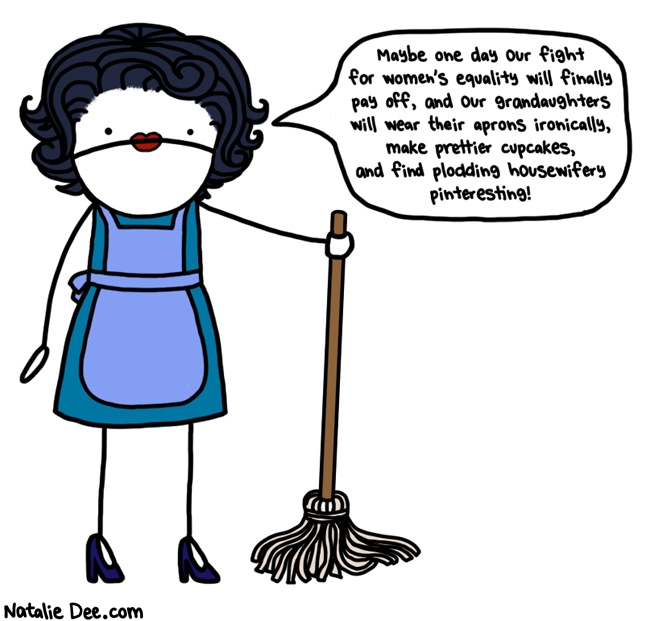
www.nataleedee.com

“We are living the dream grandma” http://www.nataliedee.com

Once upon a time, I came upon this web comic on one of my favourite “let’s waste some time with funny things” website, NatalieDee.com. And I laughed and laughed and laughed. Ha ha, I thought, I’ve seen those ladies whose lives are so pretty and ladylike and are all so perfectly just-so. Do they really think having a choice between cute stripes and cute polka dots on their way-too-pricey for kitchen use, too-precious-even-for-Zooey-Deschanel, vintage-esque oven mitts makes them liberated? How charming! I felt pretty damn smug for a while and snickered and snickered judgementally.

Then my sister (who isn’t the kind of woman being described in the comic at all but is a clever and independent lady who didn’t want me to get too smug) reminded me that a liberated woman should be able to choose to do whatever the hell she wants to, even if it’s spend all day on Pinterest looking at pretty things, regardless of whether I personally think Pinterest is just a shopping list with pictures or not (don’t hate, all you Pinterest fans, I know there are very good ways to use the site, it’s just not my bag). I also had to admit to myself that I love cupcakes, and also, that my adorable apron has chickens on it (but I wear it sincerely, to keep my clothes clean, without a trace of irony).

So it seems that I live in a glass house, but I throw stones anyways. What else is new in this weird world of post-feminism feminism? I know I am feminist, in that I believe in wage equality and reproductive rights and that I do not believe in glass ceilings or the idea that “there are some things men are just better at”, but that’s kind of where it stops. Besides recognizing my full personhood (physically, mentally, morally, legally), I don’t really know how to express my feminism.

And now I wonder, do I have to? Is there something I’m supposed to be doing to stand up and be counted (besides politically–I already vote, sign petitions, all that good stuff). Should I stop wearing makeup because it’s just The Man’s way of telling me I’m not beautiful enough without it? Should I have gone into Math and Science in university instead of theatre and English because females are incredibly underrepresented in those areas of study and overrepresented in mine? Am I supposed to take the fact that I’m a smart lady as an indication that I’m wasting my life if I become anything less than a CEO?

I think the answer to all those questions is No. If I’m truly the master/mistress of my own destiny, my gender (or other people’s perception of it) should have very little do with my choices. And yet, the people who have made me feel, at different points in my life, that the answers to those questions should be Yes are WOMEN. Women in my personal life, women on the media, female bloggers–name any group of intelligent feminist women and you will find those who feel the answers to these questions should be Yes.

And maybe for them, they should be. But deciding how to express yourself and being confident in your choices does not mean you get to decide how another woman should express herself or become self-actualized. Another thing I’ve noticed about these questions is that they relate much less to me than they do to what a man is doing in comparison to me (not wearing makeup, studying Math, being a CEO, etc.).

I’m not sure about much in the way of how feminism is doing these days but I’m sure of one thing: masculinity is not going to be the benchmark of my success as a woman. I am not a man, so why measure myself with their yardstick? Why leave the control of my self-esteem in their hands?

Eff that. That said, this is ME saying “eff that” for myself, not for other women. If you are a lady who wants to not wear make-up, or wants to study Math, or be a CEO, more power to you. In fact:

For any woman who does not wear make-up: That’s great. It probably saves you time and money. I don’t wear much make-up but I do like to feel a little fancy sometimes, and there’s nothing wrong with that. Technically, there’d be nothing wrong with me piling on the stuff and going to work everyday looking like Boy George as long as I was happy.

For any woman who studies Math or Science: Coolio. I hope you build a bridge or cure something. I’m terrible at both of those subjects (mostly Math) so I would not have added anything to your field of study. I also love theatre, writing, and books and that’s what I’m involved in. So, y’know, I think we’ve both been learning things we like.

For all you female CEOs, Supreme Court Justices, and other Captains of Industry and Influencers of High Finance and Society: You rock. You are inspirational to women who share your goals, and I appreciate being represented in certain political and legal spheres. Personally, I just want to live on an island in the sea with the people I love and write things and be happy. I’ll use your motivation to reach your goals as inspiration to meet mine, without having to follow your path.

And that’s what it’s all about. Maybe. Natalie Dee will draw her very funny comics. I’ll keep laughing at them and wearing my apron (when I cook, obviously) and wondering what the heck Pinterest is all about. Somewhere out there, some woman will keep on rockin’ her job as a CEO. Little girls will play with cars, or Barbies, or mud, or whatever they want. And that’s what it’s all about?

Well, no, of COURSE that’s not what it’s all about. When I read the news it’s glaringly obvious that we have a LONG LONG way to go. Watching Rachel Maddow being patronized on Meet the Press made me sick. We’ve got a long goddamned way to go.

But you know what won’t get us there any faster? Judging other women for petty choices that have nothing to do with anything, like how they dress themselves or their hobbies or what they like to do.

So please be a feminist. Be a feminist any way you like. And I will do the same. Because the enemy is not my apron. It’s an attitude.

My Reply to the BC NDP’s Sucky Survey

It should come as no surprise to anyone that has read any of my political blog posts that I am a card-carrying member of the federal NDP. I joined before Christmas because I wanted to be able to cast my vote for the new Leader of the Opposition (such fun!).

What was a surprise to me (though not a necessarily unpleasant one), was that membership in the federal NDP automatically made me a member of the BC NDP as well. That is why I was the recent recipient of a disappointing mail-out called the “BC NDP Pre-Election Opinion Survey”.

Now, I love surveys. Love them. I love sharing my opinion (again, no surprise). I have not been very involved in BC politics and I was excited at the prospect of my opinion helping shape the direction the party would be taking in the next provincial election.

Much to my dismay, this “survey” proved to be little more than a request for donations, and a collection of questions so leading and so obvious you’d have to be a Nazi to answer any differently than the party expects you to. Since this survey was sent only to BC NDP members, I suspect Nazis were not given the opportunity to respond.

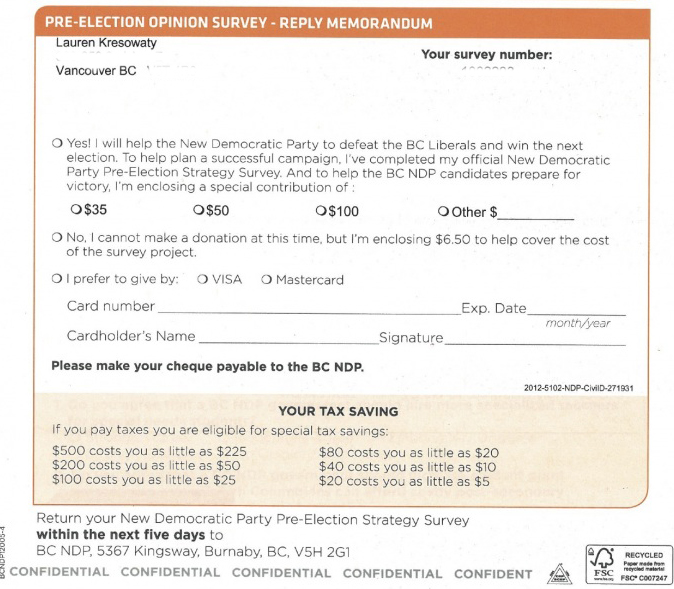
An example of the in-depth research this survey is doing.

Of course it’s important to ask questions about housing, persons with disabilities, the economy, education, etc., but the way these questions are phrased simply asks questions we all know the answer to. I think I can safely say all British Columbians (no matter which party they support) would agree that people with disabilities should be provided some assistance and security and that well-paying jobs are a priority for the province. What the survey failed to ask was how we felt about how the BC NDP proposes to do this. How is good housing for adults with disabilities to be secured? How will apprenticeship programs be expanded and well-paying jobs created? Who will pay for these initiatives?

A more useful survey would be one in which respondents were asked to rank the issues/iniatives which were most important to them (in the economy, education, health care, etc.), and were then asked what they would be willing to see their provincial government do to make these initiatives happen. Would we be willing to see income tax increases? Corporate tax increases? Would we be able to stomach cuts in certain areas? If so, which?

A criticism of the BC NDP that I have heard repeated several times since moving to BC is that although they are against whatever the BC Liberals do, they themselves do not seem to have a plan and do not seem to have any solid alternatives to offer. You can’t simply decry cuts to this and that without any alternative plans for balancing the budget. Although I will likely give the BC NDP the benefit of the doubt and vote for them in the next provincial election, I can’t blame British Columbians for having little confidence in the party, especially when its own members are receiving stupid surveys like this one.

After ripping open my survey envelope in delightful anticipation of participating in the political process and having my hopes immediately dashed, what I found most galling is that the confidential survey finishes off with a money grab.

Soo confidential! With my name and address on it and everything!

I’m used to being asked for donations so that didn’t bother me much, but I couldn’t believe that my “No” option for donating was enclosing $6.50 to pay for the privilege of answering this absolutely useless survey. If the survey questions had been decided on as the product of intense research and thought I would have likely been happy to support the initiative. I do not feel like I need to pay $6.50 for what is essentially junk mail.

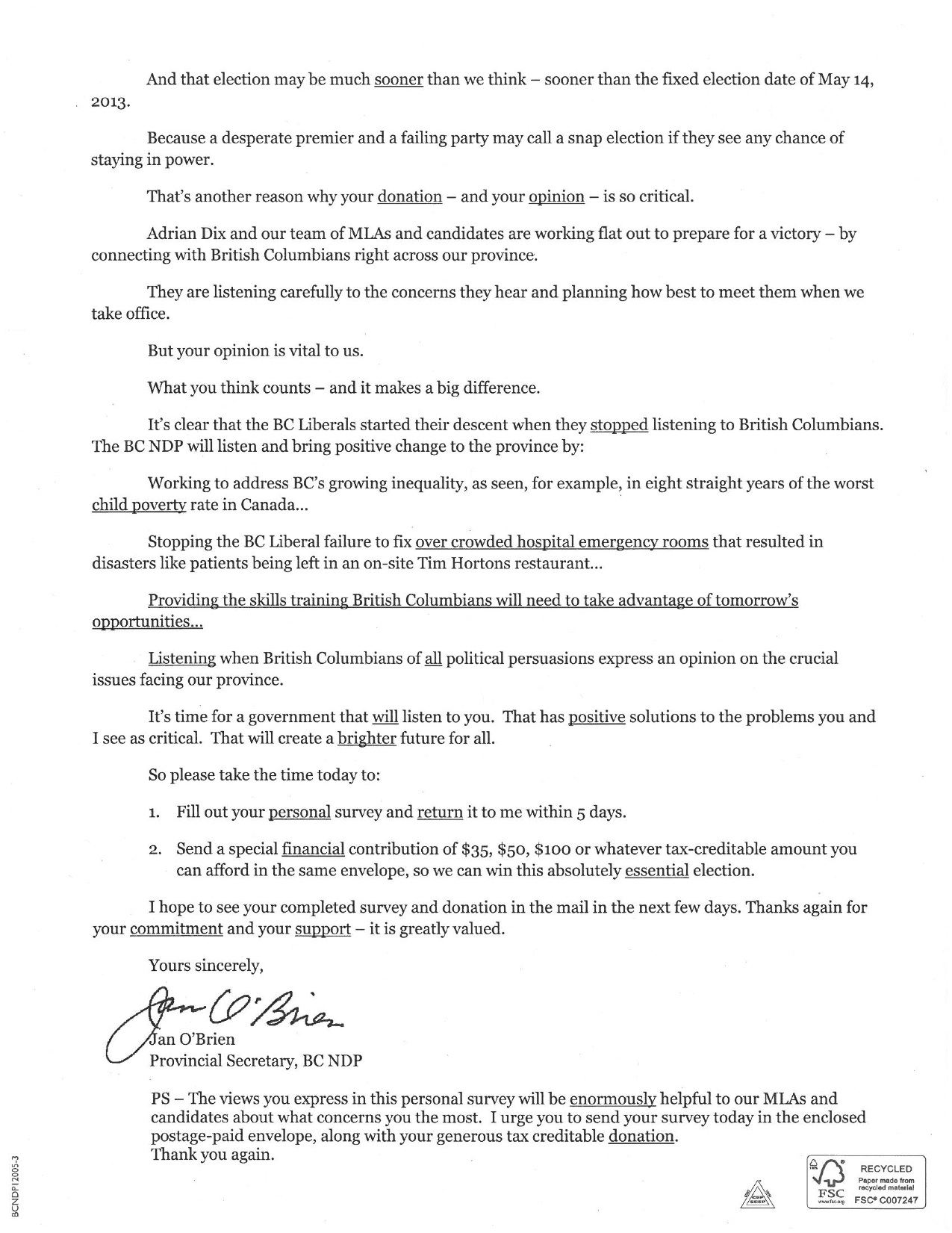
While I’m in the process of bashing the provincial party I will likely vote for, I’d also like the point out that the letter I received with the survey was stupid too. As you can see, the letter uses underlining to great effect. Good god. I’m not in elementary school anymore. I don’t require underlining to tell me which words are important. Remember that this is a letter to the BC NDP’s own members, not someone completely unfamiliar with the party. If I was so stupid that underlining key words would sway me, I wouldn’t be voting NDP (the Liberals and Conservatives have better soundbites and use more repetition). Eugh.

You may ask why, if I am an NDP-supporter, I would write a post criticizing and poking fun at the BC NDP. The answer is because I want to vote for them, and I want to vote for a party that doesn’t underestimate my intelligence. I want the BC NDP to step it up. Ill-conceived donation drives like this one (masquerading as surveys) do not increase my confidence in the party.

C’mon BC NDP. If you can’t give me solutions right now, at least show me that you’re making an honest and genuine effort to come up with some. Until you do, your sucky missives are going straight in the recycling.

Everything Is Not Okay In the Communities That Raised Me

I planned this week to write a funny blog post about politics and ghosts.

Instead, before I could get started, my mother broke the news that a young man from St. Walburg, one of the communities I consider “my neck of the woods” (my childhood home in rural Saskatchewan is equidistant from the towns of St. Walburg, where my mother taught, and Turtleford, where I went to school) and his wife and son had lost their lives, allegedly in a more upsetting and shocking way I would ever have thought possible.

For information about this tragedy, I have turned to the Saskatoon Star Pheonix and CBC Saskatchewan, which have given me some facts, I guess, though I resent the splashy way in which these horrible events are being presented, and the audacity of the reporters who would be so callous as to contact family members for comment at a time like this.

When I saw the photos of the family I recognized him right away. When I was in high school I thought he was cute. My mom taught him in grade 3. I competed in the Meadow Lake Music Festival with his sister. There is nothing in my thoughts or memories of this young man or his close-knit family to suggest such a horrible thing was possible.

But the horribly impossible has become horribly possible. I am in shock, I guess, I can hardly believe it (I certainly don’t want to). When I think about what the families of these young people must be going through (which, at the moment, is all the time), I feel sick to my stomach. To say I am experiencing grief would be an insult to the families and friends of this young couple and their son, because their grief is beyond imagining now.

Instead, I am casting around myself, trying to understand something that can’t be understood, that maybe isn’t any of my business to try to understand right now. For the second time in the past year and a half, a young man my age, from my tiny rural area, has lost his life in an inconceivably desperate act (although in these most recent events the deaths of his wife and son have exponentially heaped horror on the tragedy). Both of these young men were good-looking, good-humoured, gentlemanly young men with supportive families and close friends. They also both worked in Fort McMurray, an oil town gaining a reputation for suicide, violence, and desperate acts among its workers. It’s fairly common knowledge that working and living conditions in Fort Mac are extremely dire in terms of mental and emotional health.

This is unacceptable to me. Nothing is worth this loss of health and life and this senseless devastation of families. Not oil, not money, nothing. How many other families in other provinces, Alberta or Newfoundland or Manitoba, etc., see young men go up to Fort Mac, only to have them return mentally and emotionally strained to the point of breaking (or not to return at all, the victim of a suicide or murder)? This is not acceptable to me. It is not acceptable for anyone.

And yet the conditions that help contribute to these tragedies are accepted. The oil life is no picnic no matter where you are (which is why I also know several young men who’ve become addicts or alcoholics while working on the patch) and this has become an accepted part of life in the Prairies. I’m frustrated by this. I’m horrified, I’m angry, and I’m completely heartsick.

I can’t write a funny or clever post today. I’ve been thrust into a world that is harder, meaner, more senseless and more dangerous than the world of the communities I grew up in. And my communities have been thrust into this world too.

Where I’m from, people look out for one another. We are good people. Our parents worked hard all their adult lives to provide a good life for us. We are not unfamiliar with the harshness of cold winters or summer drought. We are not unfamiliar with the cruel indifference of fate as it intersects with farm life (though I must admit that as the child of teachers I was insulated from the worst of this). The communities that raised me know how to accept the good luck with the bad. But this is not a case of luck. I do not accept this. And I am utterly sick at heart.

[I am categorizing this post under “Politics” because ultimately, any push to improve the working conditions in Fort Mac will come down to the will of regulators and lawmakers, as long as there is public support for positive changes.]

Brief Encounters: Strangers, Drugs and the DTES

Living where I do, I pass through Vancouver’s Downtown East Side (DTES) almost every day, either transferring buses on my way to work in the morning or passing through to Gastown on the bus for dinner or a show on the weekend. For anyone not familiar with the DTES, it is a place unlike any other in Vancouver (or Canada). This part of the city sees a high rate of drug addiction, mental illness, and homelessness. It is also alive, buzzing, colourful. In other parts of the city, it is the distressed and marginalized who become invisible to the world. In the DTES, it is me, with my lack of involvement with life and work in this area, who becomes invisible–an observer, and occasionally, a listener.

With the arrival of spring (and the warmer weather), I have had the opportunity to see and interact with more people in my brief journeys through their landscape. Some of these encounters have stuck with me, snapshots tacked on the mirror. I can’t condemn or judge. I have no solutions to offer. I can only tell.

ONE.

It is evening and TC and I are riding the bus. We have a reservation at Jule’s in celebration of my birthday. I’m sitting gingerly, careful not to wrinkle or dirty my dress. I’m playing with my necklace, a birthday gift. A man in his thirties makes his way towards the back of the bus (and us), swaying dangerously as the bus moves. He sits down across from us and makes a funny comment about his difficulty getting to his seat. TC and I laugh. The man begins a conversation with us. I assume he is drunk, but he has a nice smile and nice teeth. We are not at all bothered by him. The man tells TC that his “wife” (i.e. me) “has a good sense of humour.” TC agrees and I cover my left hand with my right so the man will not see that I have no ring and be embarrassed by his mistake.

The man tells us that he is going to Main St. to take drugs. He says he has a wife and three children. His wife does not know that he’s using crack–she doesn’t know he has ever been using drugs. He says, “I know it’s supposed to be bad to lie, but sometimes, you have to. To protect people. I know I’ll have to tell her sometime though.” I think to myself, this man is an addict, the way I would think, this man is a hippie, or this man is a Canucks fan. Just a marker for a stranger.

He tells us he has only been using drugs for two weeks. I’m surprised but I believe him (I imagine that long-term crack use would damage his very nice teeth). He has only been using for two weeks but already it has claimed his Friday evening and probably several days and evenings since. He is angry that he ever took crack in the first place, and blames a friend for getting him into it. But he gets off the bus at Main Street, and tells us he just wants to get back that feeling.

When I tell my co-worker this story, she asks if either TC or I attempted to convince this man not to use drugs that evening. I say no. We didn’t. He wished us a good night and we said thank you. And that’s all that happened.

TWO.

I am returning home from running errands at 2:00 p.m. I switch buses at Main and Hastings. To my left, I am joined by a Young Man who seems more like a boy–he could be my age at most but I’m not sure he’s even 20. He’s wearing a white undershirt and his skin is pocked and scarred. He is otherwise a good-looking young man, with a wiry build that suggests energy and activity, but today he is so tired he cannot lift his head from the hands resting in his lap.

To my right sits a man in a ponytail and clinical scrubs. He seems a little wired and very sociable. He remarks loudly to the fellow beside him that he was on his way home from work but has been called in to return to cover the rest of the day. He is asked what he does. The Man in Scrubs replies that he works at a methadone clinic.

At this the Young Man riding beside me raises his head. He turns and asks (over me) about which methadone clinic he should go to. He has a referral for one, but he’s not sure if it’s the one he should visit. The Man in Scrubs tells him kindly (and cheerfully) that it is best for him to go to the clinic he’s been referred to, that it’s close by, and not to worry, he will be taken care of there. The Young Man looks tired, and sad.

As the bus nears my stop and I leave my seat, I hear the Young Man tell the Man in Scrubs that he has relapsed today. The Man tells him not to beat himself up about it, it has happened, and to just keep going. I get off the bus and I wonder what the Young Man was like before he began a methadone program. I wonder about his energy (did he have more before, or less?). I wonder how old he is.

THREE.

It is 7:30 a.m. and I am waiting at Main and Hastings for the bus that will take me to work. I’m looking up periodically, always afraid that a bird will shit on me (crows constantly congregate on the electrical wires at Main and Hastings, and pigeons live under the awning of the Rickshaw Theatre; seagulls, of course, are everywhere). Two men near me have a small argument, and one of them walks away.

The other approaches me and says hello. He tells me that he wants me to see something and holds out a stub for a federal government cheque. He tells me to look at the amount. The cheque had been for $326.

He says, “I helped ten people buy dope yesterday because I had this [the cheque]. How much of that do you think I have left today?”

I say, I don’t know. I can feel my features making a sad face and I say, Is it gone?

The man holds up a toonie. “This is all I have left,” he says. And then, “I’m not telling you this because I’m asking for money. I just wanted to show somebody because I’m ashamed of myself. I needed someone to see what I did.”

I nod as my bus pulls up. He tells me to have a good day. I think I say, You too. I hope I say it.

———————————————————————————–

These stories are true, to the best of my memory. These stories all happened in the past three weeks. I’m sharing them not because I have anything to say about them, but because they made an impression on me, and because I want to.

I don’t know about drugs or addiction. I haven’t seen it in my immediate life. I hear and read good things about harm reduction and recovery programs available through places like Insite and the Union Gospel Mission in Vancouver. But I don’t know anything. Stories brushed against me, and I just wanted to tell them.