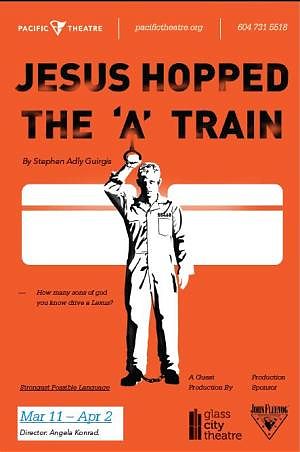
One Electric Ride: “Jesus Hopped the ‘A’ Train”

Glass City Theatre‘s production of “Jesus Hopped the ‘A’ Train” at Pacific Theatre is not for the faint of heart. It is not for those of us whose enjoyment and appreciation of a show requires a happy ending. It is not for those of us who are comfortable in our assessment of the way the world and people work and do not want to be challenged. It is for those of us who are interested in a solid, uncompromising script, difficult themes, and unapologetic performances.

The play, written by Stephen Adly Guirgis and directed by Angela Konrad, takes place on Rikers Island, New York, where two men, one a convicted serial killer, the other on trial for a murder he doesn’t think was a crime, spend their days in solitary confinement. For one hour each day they are brought outside to  separate cages to spend some time in the fresh air. Sometimes friends, sometimes enemies, the meat of this play can be found in the conversation and complicated relationship that builds between these two prisoners during their time together at Rikers. This particular production also boasts a simple, effective, and altogether stunning set and lighting design by Itai Erdal.

Not having been raised in a religious household, I occasionally find myself nervous when I attend performances at Pacific Theatre. I sometimes worry that perhaps the spiritual mandate of the company (which operates on the property of the Holy Trinity Anglican Church) will result in productions that exclude a non-religious viewer (like myself) or otherwise prevent my enjoyment of the work. So far this has not happened. Yes, religion is a central theme of the play. Lucius, the convicted serial killer, believes he has found God and tries to convince Angel, who is still pleading innocent for the murder of a cult leader, to do the same.

This plot could have easily alienated a viewer like me, but it did not. The strength of the script lies in its forever altering lines between black and white, right and wrong. Upon first appearance,  Lucius is presented as a sympathetic character, even though we know he has murdered eight people. Angel is also presented as sympathetic, a victim of circumstances. And yet, as much as we begin to like these men, as much as one has found God and the other’s lawyer insists that he is innocent, the fact we must always contend with is that both have taken human life. Is there ever a good and moral reason to do so? Is an unspeakably horrible upbringing an excuse to cause so much pain to victims and their families? Can you ever reach a place, after you have done something wrong, where you can make it right and be forgiven, whether it be by God, or by society, or by yourself? Even if a jury were to find you innocent, if you have broken your own personal laws of right and wrong, what then?

While the entire cast is strong, Carl Kennedy (Lucius) and Robert Olguin (Angel) are electric together. There is such an overwhelming energy onstage it verges constantly on either giddiness or violence. The script can be very funny. And there is violence. But it is not the characters’ actions that are violent (they are prisoners), it is their words and their lives that are violent. I found myself on teetering on the edge of tears during the second act (I was not the only one), not because the acting or directing was “milking” a reaction out of me but because I simply couldn’t bear the strain of watching the struggle to make right out of something so horribly horribly wrong.

The play is a struggle.  The characters struggle. Heroes, villains–everyone is both. “Jesus Hopped the ‘A’ Train” shows us a world where nothing is completely saved, and yet, nothing is completely lost either. Much like ours. A constant struggle to find the right. What is the answer? I don’t know. Struggle struggle struggle.

I appreciate leaving the theatre with more questions than I had when I walked in. I appreciate the occasional challenge to my own moral compass, and the opportunity to put myself in the shoes of a person whose eyes I will hopefully never see through.

“Jesus Hopped the ‘A’ Train” runs until April 2 at Pacific Theatre. Tickets can be obtained at the Pacific Theatre Box Office through visiting their website or calling 604-731-5518.

Final notes: I received a comp ticket from the good-hearted Lois Dawson,  all-around Super Vancouver Theatre Woman and author of the theatre blog Lois Backstage. She gave me a comp because she’s awesome. I was not asked by Pacific Theatre or Glass City Theatre to write a review of this production.

SFU Woodwards presents “The Alice” and “Black Box 2011”

Let me begin by saying that I will not be reviewing shows at my alma mater, the School for Contemporary Arts at SFU. I will, however, shamelessly plug them on the internet before I watch them.

A lot of changes have occurred since I began at SFU in 2005. My first SFU acting instructor, Marc Diamond, sadly passed away that fall while writing his Alice play. I’ve graduated with my BFA (and lost some of my enthusiasm to the need to not be poor, sadly) and SFU Contemporary Arts has moved from the leaky-roofed old facilities on Burnaby Mountain and into the shiny new Woodwards complex on Hastings Street. Cosmetically, the new SFU theatre spaces are unrecognizable compared to the old SFU Mainstage and its hillbilly little cousin, Studio II.

In spite of the new facilities and the new faces gracing SFU’s stages today, Marc’s Alice play, and his beloved partner Penelope Stella’s commitment to realizing it onstage, has remained. Until March 5, “The Alice: A play by Marc Diamond” is being presented in the Fei and Milton Wong Experimental Theatre as SFU’s Spring 2011 Theatre Mainstage production.

(Sources from the inside have reported that during rehearsals the running time for “The Alice” was approximately four hours so be prepared to lengthen your attention span.)

Tickets to “The Alice” are very affordable at $10 for Students/Seniors and $15 General Admission. Please note that there are no performances on February 27 or 28.

In addition to its Mainstage production, SFU Theatre is also presenting its 2011 Black Box season this spring. Blackbox is an SFU theatre course in which an ensemble of students create, rehearse, and produce a new show every few weeks of the spring semester. It is an exercise in creativity, experimentation, and sheer endurance. Generally, when I see a season of SFU’s Black Box, I see things that disturb me, make me laugh, inspire me, and sometimes just make me go, “Huh.”

SFU’s Black Box season is the perfect taster for those new to SFU Theatre. The performances are short, free, and go well with whatever else you’ve got planned that evening (drinks afterwords at one of several nearby Gastown pubs, for example). Show 2 of Black Box 2011 is based on the theme of “Community” and runs Friday, February 25 at 7:00 and 9:00, and Saturday, February 26 at 7:00 and 9:00 in SFU Woodward’s Studio T.

If you can’t make it this time round, don’t worry, there will be more shows this season.

SFU’s School for the Contemporary Arts has been hidden for far too long atop Burnaby Mountain. They have made the effort to move downtown and join the Vancouver artistic community. If you are curious about the innovative work being created and performed by tomorrow’s contemporary artists, may I humbly suggest that you visit their brand spanking new campus and see what all the fuss is about.

PuSh 2011: “Peter Panties” at the Cultch

I’ve been a Peter Pan devotee all my life. I’ve seen the musical, own the Disney film as well as a live-action one, I cry every time I read the book. It makes sense, therefore, that I was very jazzed to be wrapping up my 2011 PuSh Festival experience with “Peter Panties” at the Cultch on Saturday. “Peter Panties”, written by Niall McNeil with Marcus Youssef, is a Neworld Theatre and Leaky Heaven Circus co-production, directed by Steven Hill and Lois Anderson, with original music by the fabulous Veda Hille. It will be performed on the Cultch’s Historic Theatre stage until February 13.

Before the show I ran into Marcus Youssef in the lobby. I’d met him very briefly last spring after “Ali & Ali 7” so I reintroduced myself and expressed my enthusiasm for attending a Peter Pan-based play. Youssef was glad I was excited but warned me that “Peter Panties” would be an almost unrecognizable version of the story.

I appreciate the warning but I think Youssef is wrong. No, J.M. Barrie’s classic tale of the boy who refuses to grow up does not traditionally include rock ballads, CSI investigations, or Macbeth. But any die-hard Peter Pan fans in the audience would immediately recognize all the important landmarks of the story: the nursery window, Mr. Darling’s job at the bank, Skull rock, Tinkerbell’s jealousy, Hook’s abduction of Wendy, the crushingly sweet moment before innocence is lost. These landmarks may not be “in order”, they may be expanded and exploded, but they are all there. Like the Never Land, anyone who truly understands and loves the story of Peter Pan can find it in McNeil’s version.

The playwright, Niall McNeil, has Down’s Syndrome. This fact is not hidden nor overly advertised. Video footage of McNeil and Youssef’s writing process (shown at various moments in the piece) reveals a deep commitment to expressing McNeil’s version of the play. Nothing I saw or heard that evening seemed cleaned up  or doctored in any way. And the result is totally unpredictable but very funny and always beautiful.

Watching the piece feels like watching children at play. Certain scenes seem distracted. Certain scenes are confusing. Characters move from snippets of this and that, certain lines sound like something a child overheard at the table or on TV. Like a children’s game, the characters are moved by their own strange logic, unfathomable to observers but incredibly important to those in the game. It’s funny for us but deadly deadly serious for them.

The piece puts the “panties” in “Peter Panties” by  moving beyond the simple idea of the boy who won’t grow up to the notion of the way children think about sexuality. They are curious about it, and Peter and Wendy (played by James Long and Sasa Brown) demonstrate a very clean but inventive way to make a family, but sex is not understood in this play, or seen. To understand sex Peter would have to grow up. And in “Peter Panties” it’s not simply that he won’t, it seems he can’t.

Given the constant exploration of the tension that exists in the middle ground between childhood and being an adult,  “Peter Panties” is more true to the original and beloved tale than people realize, or perhaps more than they’re willing to admit. As a worshiper of the J.M. Barrie text, I have no problem adding “Peter Panties” to the shrine.

Props also go to the Bank Dogs and Veda Hille. If there are copies of the “Peter Panties” soundtrack out there I’d love to get my hands on one…any song that dismisses the idea of growing up with the line “F— that, NO MUSTACHE” is my kind of music.

To read more about “Peter Panties”, I recommend checking out Plank Magazine‘s review by Maryse Zeidler as well as Colin Thomas’s review in the Georgia Straight.

If my stellar blogging has managed to convince you to see the show, “Peter Panties” runs at the Cultch until February 13. Tickets can be purchased online from the Cultch or by telephone through the Cultch’s box office at 604-251-1363.

PuSh 2011 – “Floating” at the Arts Club Revue Stage

On Thursday I decided to put the “international” in the PuSh International Performing Art Festival and take in Welshman Hugh Hughes‘ fantastical theatrical event, “Floating“. “Floating” is produced by Hoipolloi, created and performed by Hugh Hughes and Sioned Rowlands, and presented at the Arts Club New Revue Stage January 20 – February 5.

Using slides, flashcards, flip charts, video, magazines, and other helpful props and pieces of furniture, Hughes and Rowlands tell the not-so-true story of Hughes’s homeland, the Isle of Anglesey, breaking away from the Welsh mainland and going adrift in the Atlantic. The set itself consists mainly of the aforementioned props and visual aides, creating an effect not unlike the way a very large supply closet in a community centre might look.

I believe a hoity-toity description of the night I had would be “meta-theatrical”, in that I never once forgot myself. I did not transcend. I was not “swept away in the magic”. Hughes stressed time and again (using a laminated sign he kept in his pocket) the importance of making a connection with us, and the importance of our decision to come to his show. I suppose it would be hard to truly connect to an audience, as individual people, as members of a group, if our emotions were usurped, if we were stolen away to other lands the way I often am at the cinema or at a different kind of show. Hughes and Rowlands talked to us, gave us props to hold and to pass around, noticed what was happening in the audience (and remarked upon it) and never once forgot we were there, or resided in a stage world that did not include us.

We were included to such an extent that after I was not chosen as the lucky audience member to get to use the “clicker box” to keep track of the story’s episodes, I was invited, in the middle of the show, to help Rowlands clean up the water that had been splashed onstage. I thought I was just being humoured because I’d missed out on holding the clicker box so I said (stupidly), “For real?” and Rowlands replied, “Well, if you come up here it will be real.” So I did. The opportunity to be that much more involved with the show was too good to pass up. I took a towel and helped mop up the stage. When I was done I gave a self-conscious little bow, hopped back down to my seat, and the story continued. It pretty much made my night.

The show is clunky, inviting, funny, generous and enchanting (in a very unmagical, “I can see the strings you’re pulling” sort of way). Yes, the story is a fantasy. Yes, the open structure and the acknowledgment of the audience is good-humoured and gracious and made us all feel warm and fuzzy. I got the sense however that lurking underneath this mythologized episode of Hughes’ life is something very true, and incredibly sad, if only we could stop laughing long enough to realize it.

The "harness of oranges"

While I enjoyed the show, and I enjoy the Arts Club as a venue, I do not feel that “Floating” was best served by being presented at the Arts Club Revue Stage. “Floating” is an incredibly intimate and incredibly open piece. The friendly and flexible nature of Hughes and Rowlands is what makes it work. It is not glossy. There are no thousand dollar set pieces or period costuming. I would have loved to see this show in an elementary school basement, or somebody’s garage, or in my living room. I feel this would have been more appropriate to the spirit of the piece, and actually would have enabled me to reach an even higher level of engagement.

There are certain things one expects when they pay $40 to see a show, and certain things one expects when they see a show at the Arts Club. One expects that money has been spent on high-tech effects (like in the Electric Company’s “Tear the Curtain!”), or on a celebrity appearance (like Eric McCormack’s role in “Glengarry Glen Ross”). These productions are impressive and worth every penny but they are distanced from the audience. Another world is being created “onstage” and we are “in our seats” and that is that.

“Floating” asks us to break down that fourth wall and be with Hughes and Rowlands, at heart if not physically, and it is hard to do that when you’re sitting in a structured audience space, feeling a little miffed that you paid $40 for a seat with sight-line issues. On Thursday I also found myself in an audience who did not seem to be, based on the lobby conversation I overheard, “kindred spirits” in terms of the art they enjoy (compared to what I find engaging) and I felt that some of the laughter during “Floating” was patronizing amusement (“Tee hee, what a funny Welshman. What IS he doing?”) rather than actual pleasure. This barred me from the sad truth that I felt was in the piece somewhere, that I wanted so desperately to find, and I believe this kept the audience from being able to make the true connection Hughes tries to emphasize with his work.

I also think that the audience that would be most appreciative of a special piece like “Floating” are those who are turned off by “fancy” theatre and special effects and just want to be in a room with a performance. This type of audience is the least likely to realize that there is a show they should see at the Arts Club, and probably less likely to be able to afford a $40 ticket.

I am not trying to denigrate the Arts Club (or its subscribing audience) in any way. I have seen very good work on the Arts Club stages (“The Black Rider”, “Tear the Curtain!”, “The 39 Steps” to name a few). But these are special treats for me. I choose each show carefully and have always been rewarded by high-tech wizardry, elaborate sets, great music and/or almost impossible physicality. I understand where the extra money goes (to put it in perspective I seldom pay more than $20 for a ticket to anything at any other venue–there were meant to be $25 tickets for this show but those were no longer available when I bought mine). I attend Arts Club productions I am very interested in when I can afford it and I have never been sorry. I am afraid, however, that the choice of venue (and the ticket price that goes with it) for this particular show will keep away the audience that would have appreciated it most of all.

Which is one of the reasons I felt it was important to write this review. For those of you who don’t frequent Arts Club productions, now is the time. Do not be put off by the fancy lobby or the ticket price. Go see “Floating”. It’s the type of art I’ve always wanted to make. It’s the type of art you should see at least once. You have until February 5.

PuSh Fest 2011: Neworld Theatre’s “PodPlays”

The setting is Vancouver. The characters are the voices in your ear, and you, alone with your thoughts and your city. You and your fellow audience member(s) are made both identifiably together, and incredibly separate, by the headphones you’re wearing and the mp3 players in your hands.

You’re attending “PodPlays – The Quartet”, an aural theatrical experience offered by Neworld Theatre as part of this year’s PuSh International Performing Arts Festival. The 70-minute walking tour of Vancouver is accompanied by the voices and music you hear as you listen to the the PodPlay score on an mp3 player. The helpful Neworld representatives will give you a map before you head out but you’ll hardly need it since the PodPlay track will tell you where to go and when.

I was able to attend a preview of PodPlays on Sunday, January 16. It did not rain on me.

The show itself consists of four separate pieces, thematically bound together by Vancouver itself. I enjoyed some pieces more than others, though I think this had more to do with my subjective preference for certain themes and styles than any difference in the “goodness” of the pieces. One story in particular did arrest me, stop my breath for a moment, and make me fight back tears as it pulled me through Gastown, guided by those bodiless voices. The whole 70 min of walking really came down to a few exquisitely painful or beautiful moments like that one.

I have been living in the Lower Mainland since 2005, and in Vancouver proper since last spring. Podplays showed me parts of Vancouver I had never seen before, and even things I have seen hundreds of times over became new– illuminated and imbued with meaning by the stories in my ears. It helped that the sun was just breaking through after a rain: everything was wet and glistened like it had just been made (and all for me!) and the grey old world, just for 70 min, was unbearably bright. I fell in love with Vancouver all over again.

More than just being directed to passively listen to the pieces as presented and follow the PodPlay directions, I felt the show was an invitation to indulge in my own thoughts and memories of Vancouver. An invitation to remember, for the rest of the time that I live here (and any time I visit should I ever choose to leave), that every piece of Vancouver that I have ever walked in has its story: the people who’ve walked here before, the buildings that used to be here before the ones that are here now, the forest that stood before that, and my story, only five year’s worth but no less important to me than any other.

I’m sure not everyone will have the same experience I did, though rain or shine you’ll certainly have an experience. The best way to find out what it will be for you is to go.

Go to PodPlays!

PodPlays run Fridays, Saturdays, and Sundays, noon – 4 p.m., January 21 to February 6. To book tickets call 604-602-0007 or e-mail podplays@neworldtheatre.com.

Neworld’s website has a description of each of the four pieces and more information about the show. I invite you to click here.

Things to remember if you are going to see PodPlays:

Call ahead to book a departure time. You may use your own mp3 player and headphones but if you do you will need to be e-mailed the sound file. If you want to use Neworld’s mp3 players and headphones, make sure they are available for the departure time you want.

PodPlays involves 70-minutes of walking, including stairs. If you have any concerns regarding this, I recommend contacting Neworld. Most of this walking takes place outside so check the weather forecast and bring an umbrella (unless you’re one of those hard core Vancouverites who don’t believe in umbrellas).

Full disclosure: I was able to see a preview of PodPlays because I will be volunteering as a route monitor for this Sunday’s performances. I was not asked or paid to blog about PodPlays, and I’m pretty sure no one at Neworld even knows that I have a blog.

If you do see “PodPlays – The Quartet” I’d love to hear from you. Leave a comment about which pieces you enjoyed the most (and why) or drop me a line at twitter.com/niftynotcool.

“Christmas on the Air” – The internet giveth and I giveth back

This year, Christmas came early courtesy of Twitter. On Saturday, Sabrina of Twenty-Something Theatre (@theatre_20) tweeted that she had a +1 for Midnight Theatre Collective’s “Christmas on the Air” at Pacific Theatre she was hoping to make use of. Not having met Sabrina in the flesh yet, I wasn’t sure she’d want to give a ticket up to me but I decided to message her on Twitter anyways and see if she still had the ticket to give away. She did, and even though she’d never met me, she saved it at the box office for me and I got to see some delightful Christmas theatre. (I met her at the show, by the by. She’s very friendly and cool in addition to being generous with her +1’s).

Since the connective power of the internet (coupled with Sabrina’s niceness) got me my free ticket to “Christmas on the Air”, it only seemed right that when Raul from Hummingbird604 (@hummingbird604) tweeted that he wouldn’t mind having someone guest post for him, I offered up the “Christmas on the Air” review I was going to post here for his site. I had the good fortune to meet Raul this spring at the Global Agents Gala through a mutual friend and he has been nothing but kind and supportive during my adventures in this brave new world of Twitter and blogs.

(Incidentally, if you’re considering getting in the holiday spirit by donating to a worthy organization, Global Agents is a very effective Vancouver-based non-profit committed to eradicating global poverty. That’s why they’re in my “Nifty AND Cool” links.)

Before you think I was being altruistic by offering up my review, I should point out that Raul is a Vancouver Blogger Extraordinaire and that my post will get far more exposure through Hummingbird604 than it ever would from Nifty Not Cool. I am  tickled that Raul agreed to post my review. If you want to read about my evening at “Christmas on the Air” on Hummingbird604, click here.