PuSh 2011 – “Floating” at the Arts Club Revue Stage

On Thursday I decided to put the “international” in the PuSh International Performing Art Festival and take in Welshman Hugh Hughes‘ fantastical theatrical event, “Floating“. “Floating” is produced by Hoipolloi, created and performed by Hugh Hughes and Sioned Rowlands, and presented at the Arts Club New Revue Stage January 20 – February 5.

Using slides, flashcards, flip charts, video, magazines, and other helpful props and pieces of furniture, Hughes and Rowlands tell the not-so-true story of Hughes’s homeland, the Isle of Anglesey, breaking away from the Welsh mainland and going adrift in the Atlantic. The set itself consists mainly of the aforementioned props and visual aides, creating an effect not unlike the way a very large supply closet in a community centre might look.

I believe a hoity-toity description of the night I had would be “meta-theatrical”, in that I never once forgot myself. I did not transcend. I was not “swept away in the magic”. Hughes stressed time and again (using a laminated sign he kept in his pocket) the importance of making a connection with us, and the importance of our decision to come to his show. I suppose it would be hard to truly connect to an audience, as individual people, as members of a group, if our emotions were usurped, if we were stolen away to other lands the way I often am at the cinema or at a different kind of show. Hughes and Rowlands talked to us, gave us props to hold and to pass around, noticed what was happening in the audience (and remarked upon it) and never once forgot we were there, or resided in a stage world that did not include us.

We were included to such an extent that after I was not chosen as the lucky audience member to get to use the “clicker box” to keep track of the story’s episodes, I was invited, in the middle of the show, to help Rowlands clean up the water that had been splashed onstage. I thought I was just being humoured because I’d missed out on holding the clicker box so I said (stupidly), “For real?” and Rowlands replied, “Well, if you come up here it will be real.” So I did. The opportunity to be that much more involved with the show was too good to pass up. I took a towel and helped mop up the stage. When I was done I gave a self-conscious little bow, hopped back down to my seat, and the story continued. It pretty much made my night.

The show is clunky, inviting, funny, generous and enchanting (in a very unmagical, “I can see the strings you’re pulling” sort of way). Yes, the story is a fantasy. Yes, the open structure and the acknowledgment of the audience is good-humoured and gracious and made us all feel warm and fuzzy. I got the sense however that lurking underneath this mythologized episode of Hughes’ life is something very true, and incredibly sad, if only we could stop laughing long enough to realize it.

The "harness of oranges"

While I enjoyed the show, and I enjoy the Arts Club as a venue, I do not feel that “Floating” was best served by being presented at the Arts Club Revue Stage. “Floating” is an incredibly intimate and incredibly open piece. The friendly and flexible nature of Hughes and Rowlands is what makes it work. It is not glossy. There are no thousand dollar set pieces or period costuming. I would have loved to see this show in an elementary school basement, or somebody’s garage, or in my living room. I feel this would have been more appropriate to the spirit of the piece, and actually would have enabled me to reach an even higher level of engagement.

There are certain things one expects when they pay $40 to see a show, and certain things one expects when they see a show at the Arts Club. One expects that money has been spent on high-tech effects (like in the Electric Company’s “Tear the Curtain!”), or on a celebrity appearance (like Eric McCormack’s role in “Glengarry Glen Ross”). These productions are impressive and worth every penny but they are distanced from the audience. Another world is being created “onstage” and we are “in our seats” and that is that.

“Floating” asks us to break down that fourth wall and be with Hughes and Rowlands, at heart if not physically, and it is hard to do that when you’re sitting in a structured audience space, feeling a little miffed that you paid $40 for a seat with sight-line issues. On Thursday I also found myself in an audience who did not seem to be, based on the lobby conversation I overheard, “kindred spirits” in terms of the art they enjoy (compared to what I find engaging) and I felt that some of the laughter during “Floating” was patronizing amusement (“Tee hee, what a funny Welshman. What IS he doing?”) rather than actual pleasure. This barred me from the sad truth that I felt was in the piece somewhere, that I wanted so desperately to find, and I believe this kept the audience from being able to make the true connection Hughes tries to emphasize with his work.

I also think that the audience that would be most appreciative of a special piece like “Floating” are those who are turned off by “fancy” theatre and special effects and just want to be in a room with a performance. This type of audience is the least likely to realize that there is a show they should see at the Arts Club, and probably less likely to be able to afford a $40 ticket.

I am not trying to denigrate the Arts Club (or its subscribing audience) in any way. I have seen very good work on the Arts Club stages (“The Black Rider”, “Tear the Curtain!”, “The 39 Steps” to name a few). But these are special treats for me. I choose each show carefully and have always been rewarded by high-tech wizardry, elaborate sets, great music and/or almost impossible physicality. I understand where the extra money goes (to put it in perspective I seldom pay more than $20 for a ticket to anything at any other venue–there were meant to be $25 tickets for this show but those were no longer available when I bought mine). I attend Arts Club productions I am very interested in when I can afford it and I have never been sorry. I am afraid, however, that the choice of venue (and the ticket price that goes with it) for this particular show will keep away the audience that would have appreciated it most of all.

Which is one of the reasons I felt it was important to write this review. For those of you who don’t frequent Arts Club productions, now is the time. Do not be put off by the fancy lobby or the ticket price. Go see “Floating”. It’s the type of art I’ve always wanted to make. It’s the type of art you should see at least once. You have until February 5.


“Skin” at the Vancouver South African Film Festival

On Saturday, my friend (and social media spirit guide) Raul Pacheco-Vega invited me to be his “+1” at the opening gala of the first-ever Vancouver South African Film Festival (VSAFF), and Vancouver’s first screening of the South African film “Skin“, directed by Anthony Fabian.

Obviously, I said yes (Thank you Raul!). When I arrived it seemed I would require a media pass to get in without a ticket (Raul had his own media pass) so the helpful VSAFF staff gave me one to use. The first one said “Colin” which I thought was great but it was nevertheless changed for the more gender appropriate “Basya”. Basya is a nifty name.

Attending the opening night of anything is always very exciting because it usually gives you the opportunity to learn more about the event. The more I learned about the VSAFF the more inspired I was. The VSAFF is a completely volunteer-driven event. All proceeds of the VSAFF went to the Canadian non-profit organization, Education Without Borders. EwB is an organization dedicated to providing educational opportunities, resources, and facilities in poorer communities of the world, primarily in South Africa. Not one VSAFF organizer or volunteer received a salary or stipend of any kind for the tremendous work they put into this two-day festival.

I enjoyed the film “Skin” in that it moved me, never bored me, and had unexpected moments of humour. For the most part the film is a struggle. “Skin” tells the true story of Sandra Laing, a daughter of white Afrikaners, who distinctly appears to be black. Her parents’ fight to have her classified as a white person (so that she will have access to the education, facilities, and rights the rest of her family enjoys), and Sandra’s own fight to be reclassified as black after having children with a black man (an illegal act for a white woman) is both tragic and riveting.

Aside from the beautiful cinematography and an amazing performance by the award-winning (and Oscar nominated) Sophie Okonedo (who plays Sandra), what struck me most about the film was how arbitrary apartheid society appeared. I knew about apartheid of course, the way I know about genocide in Rwanda and the war in former Yugoslavia but other than condemning it in my mind as an unjust thing I never really thought about it. Certainly it never occurred to me to describe it as “arbitrary”. But it was.

Sandra Laing is one person. The same person, from the beginning of her life right through to the end of the film. And yet, the way she was treated, and the world she could inhabit, depended entirely on whether she was considered to be a black person because she looked black, or a white person because her parents were white. What she could learn, where she could live, who she could love, all of this was determined by skin. Okonedo portrayed Sandra Laing with an almost unbearable shyness, as a person acutely uncomfortable in her own body, which, of course, you might be if you belonged not to one world or another but lived in the dangerous and lonely ground between.

With such an arbitrary and unjust system governing the lives of South African people, it is no wonder that so many of the characters in “Skin” developed strains of hardness, ignorance, and violence. Sandra herself, while always a sympathetic character, was forced to become hard and strong under the weight of the sorrow in her life. No character in the film was wholly good or wholly bad. Instead of hating Sandra’s father for his increasing pigheadedness and cruelty, I felt sorry for him and hated instead a situation that would force a loving father to become a slave to his pride and an enemy to his daughter. I respect a film that, while all about the differences between “black” and “white”, chose to reside in shades of grey rather than pass judgment on its characters.

I am delighted to report that the VSAFF had a full house for its opening night, and that there was wine, food, and Amarula a-plenty in the lobby for its guests. I believe the organizers were pleasantly surprised by the support from their community (according to their website, the VSAFF raised $14 000 for EwB!). I sincerely hope this festival returns next year. Not only do I relish chances to be exposed to art and culture outside the North American mainstream, but the enthusiasm of the organizers and their selfless mission of awareness and education was inspiring to witness.

PuSh Fest 2011: Neworld Theatre’s “PodPlays”

The setting is Vancouver. The characters are the voices in your ear, and you, alone with your thoughts and your city. You and your fellow audience member(s) are made both identifiably together, and incredibly separate, by the headphones you’re wearing and the mp3 players in your hands.

You’re attending “PodPlays – The Quartet”, an aural theatrical experience offered by Neworld Theatre as part of this year’s PuSh International Performing Arts Festival. The 70-minute walking tour of Vancouver is accompanied by the voices and music you hear as you listen to the the PodPlay score on an mp3 player. The helpful Neworld representatives will give you a map before you head out but you’ll hardly need it since the PodPlay track will tell you where to go and when.

I was able to attend a preview of PodPlays on Sunday, January 16. It did not rain on me.

The show itself consists of four separate pieces, thematically bound together by Vancouver itself. I enjoyed some pieces more than others, though I think this had more to do with my subjective preference for certain themes and styles than any difference in the “goodness” of the pieces. One story in particular did arrest me, stop my breath for a moment, and make me fight back tears as it pulled me through Gastown, guided by those bodiless voices. The whole 70 min of walking really came down to a few exquisitely painful or beautiful moments like that one.

I have been living in the Lower Mainland since 2005, and in Vancouver proper since last spring. Podplays showed me parts of Vancouver I had never seen before, and even things I have seen hundreds of times over became new– illuminated and imbued with meaning by the stories in my ears. It helped that the sun was just breaking through after a rain: everything was wet and glistened like it had just been made (and all for me!) and the grey old world, just for 70 min, was unbearably bright. I fell in love with Vancouver all over again.

More than just being directed to passively listen to the pieces as presented and follow the PodPlay directions, I felt the show was an invitation to indulge in my own thoughts and memories of Vancouver. An invitation to remember, for the rest of the time that I live here (and any time I visit should I ever choose to leave), that every piece of Vancouver that I have ever walked in has its story: the people who’ve walked here before, the buildings that used to be here before the ones that are here now, the forest that stood before that, and my story, only five year’s worth but no less important to me than any other.

I’m sure not everyone will have the same experience I did, though rain or shine you’ll certainly have an experience. The best way to find out what it will be for you is to go.

Go to PodPlays!

PodPlays run Fridays, Saturdays, and Sundays, noon – 4 p.m., January 21 to February 6. To book tickets call 604-602-0007 or e-mail podplays@neworldtheatre.com.

Neworld’s website has a description of each of the four pieces and more information about the show. I invite you to click here.

Things to remember if you are going to see PodPlays:

Call ahead to book a departure time. You may use your own mp3 player and headphones but if you do you will need to be e-mailed the sound file. If you want to use Neworld’s mp3 players and headphones, make sure they are available for the departure time you want.

PodPlays involves 70-minutes of walking, including stairs. If you have any concerns regarding this, I recommend contacting Neworld. Most of this walking takes place outside so check the weather forecast and bring an umbrella (unless you’re one of those hard core Vancouverites who don’t believe in umbrellas).

Full disclosure: I was able to see a preview of PodPlays because I will be volunteering as a route monitor for this Sunday’s performances. I was not asked or paid to blog about PodPlays, and I’m pretty sure no one at Neworld even knows that I have a blog.

If you do see “PodPlays – The Quartet” I’d love to hear from you. Leave a comment about which pieces you enjoyed the most (and why) or drop me a line at twitter.com/niftynotcool.

PuSh Festival Opening Gala (Part 2)

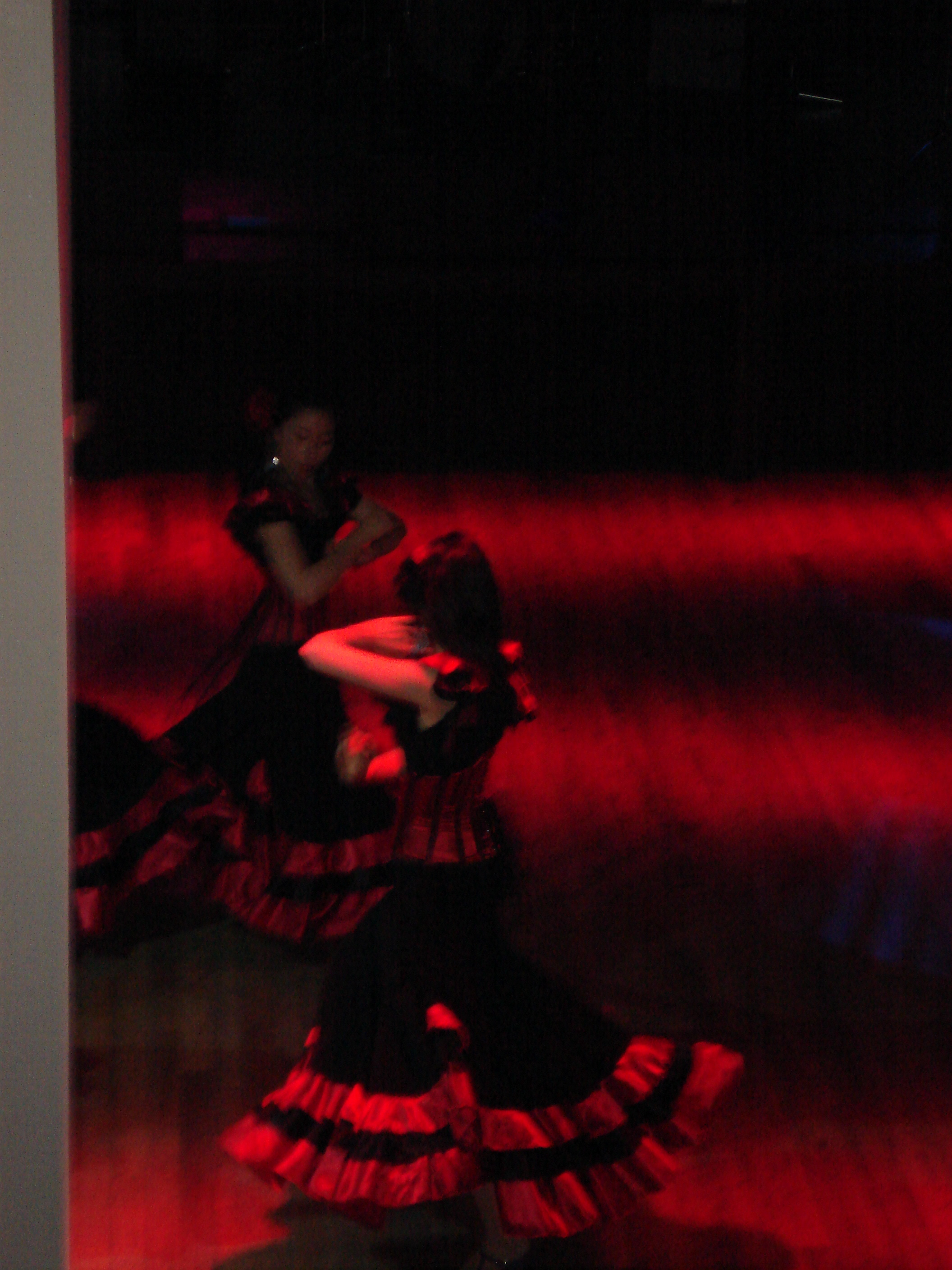
Unfortunately can't remember the name of this troupe!

Sorry PuSh fans, I am no longer live-blogging from the PuSh Gala. Unfortunately, the wireless in Club Five Sixty went out so, seeing as I am a little behind the times and sans smart phone, I could neither blog nor tweet.

I took some beautiful photos with Lois in the booths downstairs, took in Theatre Replacemcent’s “Weetube” which is always a Vancouver favourite, and lugged my laptop and tired little self home because I work early tomorrow.

As I left, I believe the band “The Zolas” were setting up, small theatre performances were under way in the lounge, and I’m sure the party hadn’t even peaked yet. I also saw Gregor Robertson near the photo booths tonight but I was too shy to say hello. Maybe next time.

If you want to follow the gala and other PuSh Festival events on Twitter, the hashtags that I believe were most commonly in use tonight were #PuSh2011 and #PuShFest. You can also follow the folks at the PuSh Festival itself at twitter.com/PuShFestival.

2011 PuSh Festival Opening Gala (Part 1)

Through some kind of combination of Twitter, dumb luck, and the awesomeness of Zaira Petruf, the Outreach Coordinator for the PuSh International Performing Arts Festival in Vancouver, I am typing in the VIP lounge of the oh-so-cool Club Five Sixty at the 2011 PuSh Opening Gala.

I am here tonight as one of the bloggers for the event: live-blogging, tweeting, interneting all over the place. My apologies to those who have e-mail-subscribed to NiftyNotCool, I’m going to be posting several times tonight. I’m also drinking wine. Sorry.

First up, the club. Club Five Sixty is MASSIVE. And groovy. Never seen a place like it. The whole basement is a bathroom. And a bar. And a coat-check. There is a massive main floor. There is a VIP lounge upstairs. There are labyrinth-like hallways. This place is full of theatre artists and theatre lovers and bucket-loads of nifty AND cool people.

Gregor Robertson: Mayor Extraordinaire

A big highlight for me so far was watching Vancouver mayor Gregor Robertson make his opening remarks. I knew he was a nice-looking fellow but he is even better looking in person. He also seems to be very supportive of arts and culture in Vancouver in general. I appreciate a politician who is. I wish this attitude could carry more into the Provincial and Federal levels.

I have also run into major Vancouver bloggers Raul (Hummingbird604) and Rebecca (Miss604). Theatre blogger Lois (Lois Backstage) is typing next to me. I’ve also seen people I recognize from Neworld Theatre, Theatre Replacement, and Leaky Heaven Circus. I feel so VIP’ed.

I regret I must leave you all for a moment to partake in those crazy basement facilities. I’ll be back before you know it. xoxo

Conservatives & Liberals: Just stop it, both of you.

Like kittens? You'll love Harper's politics.

Today’s rant about being sick and tired of hearing about Canadian politics may come as a surprise to people who read my December 2 post, berating my generation for their lack of political participation and poor voter turn-out. I do still sincerely believe that citizens my age have a duty to be informed and involved. But democracy is a two-way street. Politicians who want our support need to give us something to vote for. Stephen Harper, the leader of the Canadian government, and Michael Ignatieff, the leader of the official opposition, are just not doing it for me right now.

I am tired of reading about whether or not Canadians will be subjected to a federal election this year (wasn’t that the question last year, and the year before that, and the year before that?). I am tired of the government being so arrogant (or perhaps so hopeful) as to make the claim, as they often seem to do, that “Canadians don’t want an election.”  I am tired of the opposition being so unimaginative and so impotent that the only weapon they seem to want to deploy is the threat of an election, only to withdraw that threat as soon as anyone starts to think they might really be serious.

I am tired of Stephen Harper’s sweaters and musical stylings. I am tired of Michael Ignatieff’s plaid shirts and cross-country burger flipping. Why are they doing this? Why aren’t they running the country? What the heck is going on?

That's actually pretty good. Quebec City, July 2010 Photo: Jacques Boissinot/Canadian Press

My January 17, 2011 Maclean’s came today, and with it a tidy little opinion piece by columnist Paul Wells entitled “How Stephen Harper Will Survive 2011.” Even before I read the article there was little doubt in my mind that Stephen Harper will survive 2011 just fine, though whether he’ll do anything with the power he’s still managing to cling to, anything that serves Canada more than it serves his party, is another matter. According to Wells, Harper is in a position of “relative strength” and “has a good shot at avoiding an election and, if he cannot avoid it, a good shot at winning it.” Let’s get this straight: Harper doesn’t want to win an election, he wants to avoid one, but if avoiding doesn’t work, it’s okay, he’ll win it. Harper also seems to be a fan of saying that the opposition is a fan of an election. Which seems silly, because if there was an election, Harper would win it, right?

I’m confused.

Speaking of confusion, I am not exactly receiving a boat-load of clarity from the opposition either. Iggy’s bus tour and the fact that he’s a really smart guy (albeit a bit of a cold fish in front of the camera) notwithstanding, I don’t know much about what Michael Ignatieff wants to do for my country. He likes to complain about the Conservatives, that’s for sure, but any bozo can complain. I’m complaining right now. Ignatieff’s job is to be more effective than that, and the Liberals’ only claim to fame at the moment is that they do not agree with the government. Except when they do, of course.

Just for fun, here’s a little snippet of Twitter conversation I caught on January 7, 2011 between Paul Wells and Andrew Coyne (also of Maclean’s Magazine):

InklessPW Paul Wells

“Planes and prisons” vs “families” and other good stuff: the Liberal ballot question as framed by Brison today and Goodale 2 weeks ago

acoyne acoyne

Interesting, since Libs also for planes & prisons RT @InklessPW “Planes & prisons” vs “families” & other good stuff: Liberal ballot question

acoyne acoyne
ie They’re still going to buy the planes, and they voted for the crime bills that necessitate more prisons RT @InklessPW

.

Again I’m confused. Both parties want some new planes? Both parties are on board with laws that would necessitate more prisons?  I’ll take Coyne’s word on this one, even if it is just a Twitter conversation, even if Twitter isn’t always a good “source”, since he’s a much more knowledgeable person than I.  I know 140-character limits tend to over-simplify issues a bit but it’s the very idea that bothers me. Planes and prisons for both Conservatives and Liberals? Talk about arriving at the party in the same dress and now having to figure out who “wears it better.”

This one's for my scrapbook.

If both the government and its closest rival agree on planes and prisons, and stimulus spending, and all the other big and small issues that the two parties have made gutless compromises on since 2008 (some necessary, some not), all that’s left for each side to do is accessorize that same old dress and try to convince us that the other gal looks trashy.

Which means that instead of being asked to consider which party better represents my values and beliefs regarding war, justice, education, and the economy (not to mention health care and the environment), I am being asked, by BOTH sides, to care about who is more cuddly, who likes “ordinary Canadians” more and terrorists less. To care about whether Iggy is “just visiting” or whether he’s here to stay, to care about whether Harper has something sinister up his sleeve or whether he’s doing what he truly believes is best for Canada. In short, I’m being asked to care about “politics”.

I don’t mean, “caring about politics” in terms of being informed, and of voting for the MP you think will best address your concerns. The “politics” I’m being asked to care about is mostly spin, hype, polls (whose conclusions my beliefs are never on the winning side of), a coalition of “Socialists” and “Separatists” that never really happened (and likely never will), and an election that isn’t happening yet, but that we don’t know for sure isn’t going to happen. This is the kind of crap that always seems to float to the top of the murky federal politics pool. I suppose I could stick my head in there and try to see if I can find any useful information but it’s not an appealing prospect.

Clap if you believe he can win an election. Photo: Sean Kilpatrick/ Canadian Press

This constant stream of exaggeration, hyperbole, and trivial detail seems to come from both sides. And it belittles me as a citizen. It makes me feel as though my part of the political process is about being led to the ballot box by half-truths and handshakes. It makes me feel as though nobody in Parliament thinks we’re smart enough to think about the actual issues that affect our lives and to vote that way. The fact that I haven’t seen either side touch health care with a ten-foot pole recently even though, at some point, we’re really going to have to, is not inspiring. It seems that while both sides certainly believe they have the right to govern, they don’t really have the guts to, and, to add insult to injury, they don’t think we’ll notice.

For goodness sakes, enough already. Conservatives, Liberals, just stop it. That new, nasty, media-sexy, but actually totally irrelevant barb you’re ready to let fly at the other party? That photo of you cuddling a cute kitten/baby/constituent you’re waiting to release? Just don’t. I don’t care. Go to your rooms. Think about what you’ve done. Think about what you’re going to do. I don’t want to hear a single word from either of you until you have something constructive to say.

Got the Blues Real Good: The Case for Being Sad (Sometimes)

From Edward Gorey's "Gashlycrumb Tinies"

Something that has really been getting my goat lately is the increasingly prevalent notion that we shouldn’t ever be sad, that sadness is somehow not a natural and normal state for people to be in sometimes. Whether it’s groups pushing for “the blues” to be classified as some kind of medical disorder (that we can therefore buy pharmaceuticals to correct, hooray!), to Always commercials instructing me to “have a happy period”, it seems like nowadays it is just not okay to feel what you feel about something if that feeling is crappy. Which it sometimes will be. Because life is sometimes super crappy.

Being sad sucks. I know. It’s truly awful. If I could keep the things that make me and the people I love sad from happening, I would. But if something does happen to make me sad, I don’t really have any choice but to roll with the punches and resign myself to being sad for awhile.

This is hard to do. I not-so-long-ago experienced an episode of Being Sad (i.e. my “Pit of Crankypants Behaviour”, first-ever post). I hated feeling that way to the point of being physically ill. I wanted to crawl out of my skin. I thought, “If only there was something I could do, some pill I could take, to make me not feel this, to make me not mind the things that are going on in my life.” But drinking or drugging myself happy was not the road I wanted to go down.

Perishing of fits - more Edward Gorey

To clarify: nothing truly horrible happened to me (no abuse, no death), but I wasn’t enjoying myself or having a hilarious time. My Sad was real and it hurt. But even though I didn’t want to wallow, I decided not to ignore my Big Bad Blues.

I’m not judging people who want to go on an all-out bender and pretend to have a fabulous time, or who give themselves Daily Affirmations that “everything is fine” when their heart is broken or they’ve lost their job. I get it. I’ve done it. I just don’t think it would help me in the long run. Sure, when I’m flying high I’ll be feeling fine but when I sober up the Sad will be there waiting for me and the more I Daily Affirm away my feelings the longer I’ll put off having to deal with the reality of the thing that made me sad in the first place. If I don’t deal with my shit now, accept it and move on, I know it will come back and bite me in the ass later.

Which brings me to my Case for Being Sad: my belief is that regular, run-of-the-mill Being Sad is not only an inescapable part of being alive, it is also incredibly useful. Though I have hated every single moment of every single time I have been “capital S” Sad, I can’t deny that I have made some great changes in my life because of them. In the past these changes have included: not accepting anything less than the excellent treatment I deserve from a partner, eating like a responsible adult, knuckling down in uni, learning that I can fall in love more than once, not taking things for granted, and trying new things like aerial silks (3 years on the silks and still going strong!).

My recent time in the Pit of Gloom and Crankypants Behaviour has given me an opportunity to continue to build on these foundations. I know more about myself now, some of it great, some of it not so great. One of the things I’ve realized is that I am fearful. I used to think that my static behaviour was laziness but it turns out that I am simply afraid of a lot of things: I am afraid of big change (though I am also afraid to get stuck in a rut), I am afraid of the unpredictability that life brings, I am afraid to be in social situations where I don’t know anyone, I am afraid of failure.

"The Blue Guitar" - Picasso

And what am I really afraid of? Well, of being sad I guess. A change that didn’t work out would make me sad. A social situation where no one liked me would make me sad. Failure would make me sad. So I lived in fear of all these things, and guess what? I got sad anyways. At this point, there is nothing else to be afraid of. So I’m blogging even though I might fail miserably and be the Worst Blogger To Ever Make Herself Look Stupid. I’m volunteering as a mentor even though making commitments that change my life’s routine is scary. I’m making travel plans. I have attended events, and will continue attending events, where I don’t know anybody because I might have fun, and hell, most people are nice if you take the trouble to meet them.

Before my latest Sad, I hadn’t realized how little I had made my life, and how afraid I was of things. Until the Blues hit me and I really needed my friends, I didn’t realize how very amazing and supportive they are. I hadn’t realized what was positive about the way I was living my life, and what was not.

Is it hard to look at myself so closely? Yeah. It is. And it’s embarrassing to talk about it in a blog. But now that I’ve started making these changes and heading in this fearless new direction, I don’t want to stop. I don’t want to be sad, no one does, but I don’t want to live my life in fear of being sad. I’ve been sad, I’m still here. I thought I couldn’t bear it, and then it turned out that I could.

If you are unlucky and the Big Bad Blues come your way, be gentle but honest with yourself. Cry your tears, go out with your best drinking buddies, throw yourself into work or school for awhile. Affirm yourself if you need some affirmation. Fight it if you have to. Just don’t deny the crappiness. Look it in the face. Learn something. Deal with your shit. Move on.

You may as well. Because whether you like it or not, no full life is lived without some “capital S” Sadness. Why not meet it head on, live with it, see what you discover? There are all kinds of bravery in the world. I think acknowledging the inevitable Sadness and refusing to live in fear of encountering it is very brave indeed.