Book Review: Joseph Boyden’s “Three Day Road”

In a quick and dirty nutshell, Joseph Boyden‘s Three Day Road tells the story of Xavier Bird, a young Oji-Cree man from the bush near Moose Factory, Ontario. Together with his best friend Elijah, he travels far from home with the South Ontario Rifles and becomes an accomplished sniper. Afterwords, his spirit and body broken, Xavier returns to his aunt Niska, who paddles him deep into the bush towards the home of his childhood. Experiences in the trenches of the First World War are interspersed with memories of Niska’s coming of age as a diviner and healer for the few remaining “bush Indians” who continue to resist the pull of the white towns and the rum, exploitation, and prejudice that came with them.

A striking theme in this novel is the shock of Niska’s spiritual and natural world colliding with that of white Ontario–with its religion, RCMP, and residential schools. Through Boyden’s telling, it is obvious that the systems imposed on the First Nations of Canada were grossly out of touch with the practical and natural realities of life in this country. A familiar theme, yes, but its representation in Three Day Road took my breath away with its absurdity and immediacy.

In another quick and dirty nutshell, I liked this book. I liked Xavier, a quiet young man whose inner jealousies, comforts, fears, and joys play across the mind and heart we are privy to, but remain hidden from the soldiers in his company. I liked his Aunt Niska, a wise woman whose strength comes not necessarily from taught knowledge but from careful and close observation, a firm sense of self, and an ability to do, under any circumstances, what must be done. I loved the descriptions of the bush Niska and Xavier call their home, I loved its almost otherworldly beauty. I loved that this beauty is here, in Canada, though in smaller and smaller spaces now. I hated the war and the futility and brutality of trench life and the various suicidal “pushes” the soldiers were ordered to participate in, but then, who wouldn’t? I was taken by the sensuality of the book–physical, natural, spiritual.

I liked this book. What’s not to like? I suppose that Three Day Road is long, so if you don’t like long books, you may not like it, and it’s heavy, so if you don’t like literature that takes a more serious tone, you may not like it. But if you allow yourself to be pulled in by the beauty of the telling and the emotional threads of the story you will find yourself whizzing through the novel, dodging bullets and yearning for a comforting voice in the din and a warm fire in the rainy night.

If you like Canadian literature and/or history, or literature by and about the First Nations people of Canada, or action scenes and technical descriptions of early 20th-century warfare, or sensual descriptions of intimacy and the natural world, Three Day Road is a book you will like.

Or perhaps “like” is the wrong word. You will respect this novel, you will be pulled by it, you will be struck by it. You will start a long journey and reach the end sooner than you think. And like me, you will recommend this book to others.

One Year Later, Jack’s Still My Hero

One year ago today, my hero Jack Layton lost his battle with cancer and left his New Democratic Party of Canada, recently elected to the Official Opposition, without a leader. He left Canadians from coast-to-coast without a mustached knight in orange armor to champion their values in Parliament. He also left us with a remarkable sense of optimism and purpose, and his now familiar parting words to Canadians:

My friends, love is better than anger. Hope is better than fear. Optimism is better than despair. So let us be loving, hopeful and optimistic. And we’ll change the world.

Nathan Phillips Square, Toronto, August 2011 Photo: Sonja Kresowaty

Layton’s message of hope and optimism has been printed on posters and in papers, chalked onto sidewalks, and blogged and tweeted throughout cyberspace. These are the words of a dying man passing the torch to the people he spent his life working and fighting to represent. And these are words to live by.

On this day last year, I wrote a blog post entitled,
…And we’ll change the world. (My tribute to my hero)“. My heart was broken and I keenly felt the loss of the person who had shown Canadians a different and better way to engage with Canadian politics and each other. Was Layton a dreamer? Probably. It’s easier to wax optimistic when you realize that your fight is almost over. But I’m a dreamer too. Based on last May’s federal election results, a large percentage of Canadians are dreamers. And Jack taught us that being a dreamer is fine, as long as you can also be a fighter, a hard worker, and a good person.

And you need to have patience. When Layton told Canadians that we would change the world, he didn’t mean tomorrow. He didn’t mean in one year from that day. Jack Layton’s story is not one of resting on success–in his 8 years as leader of the federal NDP, he never was our Prime Minister, and he did not unseat the Conservative government. What he left us with is a legacy of perseverance, in which the process is just as important as the product.

Layton did not become a respected and beloved public figure overnight. Prior to becoming the leader of the NDP, he spent almost 20 years in municipal politics in Toronto. Growing the NDP and its voter base over the 8 years Layton was at the helm required intelligence, commitment, and hard work, coupled with a public persona which by turns needed to be both affable and firm, witty and civil. It took Layton and his party time to get this right, and it took Canadians time to realize that the NDP could be a viable alternative to the governments we’re used to.

“The house that Jack built” isn’t finished, and it isn’t one that Layton built himself. In his political life, Layton and the NDP benefited from caucus members, individual MPs, staffers, and countless volunteers, donors, and voters. In his personal life, Jack Layton found love and support in his partner, MP Olivia Chow, and in his family.

Is it daunting to be passed the torch by a man whose life and death in Canadian politics has raised him to almost mythical status? Absolutely. Sacrifices will always need to be made by anyone who wants to fight for a cause. But a struggle towards a better Canada need not be alone, and it need not be miserable. Engaged people all over the country are becoming invested in Canada’s future, even through something as simple as voting or signing a petition. Personal sacrifices will be required from anyone who wants to actually work in politics, but the work doesn’t need to be devoid of love, humour, or joy. In fact, if Layton hadn’t looked like he was having so much fun on the campaign trail, I doubt he would have reached so many people.

One year after Layton’s death, I am still afraid of the power of Harper’s Conservatives. I’m afraid of pipelines and oil tankers in BC. I’m afraid of the impact an anti-expert, anti-science, and anti-research culture in Ottawa is having on policy decisions. I’m afraid of the US’s “war on women”, because any supposedly “first world” country that doesn’t respect women or their bodies spells bad news for us all. Jack Layton is gone and he can’t fight my fears for me.

But as Layton himself wrote, “[our] cause is much bigger than any one leader.” My fears make me hopeful because of the people all over the country who are rising up to combat them. Canada will never be some hippie socialist utopia where nothing bad ever happens. But if we engage in a process of work, intelligence, and above all, compassion, we will get so much farther, and become so much better, than the mediocrity and inequality we labour under now.

So where’s the product of Jack Layton’s life? I don’t know. It may never have arrived. But I have seen the process of Layton’s political life in the NDP, the work over years to achieve the ground the party now stands on. If Layton’s life, cut short in the middle of such an exciting time, is any example, it may well be that the process is really all we have.

[To see how other Canadians are remembering Jack Layton, you may want to check out DearJack.ca.]

Adventures in BC: The Chief and Nat Bailey Stadium

Summer is upon us, and with the summer comes the opportunity to explore the “supernatural” province that we live in. If you don’t have much time (or money), what better way to enjoy beautiful BC than to enjoy the natural and cultural gems existing close to home?

Part I:

In which NiftyNotCool and her TC hike the Chief

One warm BC Day, on a whim (and after getting pumped up by watching the classic 80s film Labyrinth), TC and I borrowed his brother’s car and headed towards Squamish to hike the Chief. (For those who don’t know, the Chief is a granite cliff/mountain that you can hike to the top of. Pretty spectacular.)

After a short and scenic drive along the Sea-to-Sky highway, we arrived at the Shannon Falls Provincial Park so we could check out the pretty falls before beginning our hike to the summit of the Chief’s First Peak, which is technically part of the Stawamus Chief Provincial Park (beginning your journey at Shannon Falls adds negligible time and effort to the overall hike AND involves a waterfall! Score!).

After hearing I’d been up the Chief, one of my coworkers asked if the hike was “reasonable”. This really depends on your version of reasonable. If a reasonable hike to you is over in an hour and a half and can be done in tennis shoes or sandals, then no, the Chief is by no means a reasonable hike. If, however, climbing up (just up, not ever sideways, just up) for almost two hours, sweating like a beast as you clamber over rocks and tree roots, climbing the occasional iron ladder or needing to hold chains to avoid slipping down a granite rock face and then getting rained on and absolutely filthy on your (equally tricky) descent sounds like a reasonable hike to you, then the Chief just might be your idea of a pleasant afternoon.

Sweating and getting muddy aside, TC and I had a great time. Standing more than 600 metres above sea level on a granite peak, feeling the wind and rain whip our faces and knowing there is nowhere to go from here but down was an absolutely exhilarating feeling, worth the sweaty clamber up and slippery descent. TC and I shared a kiss on the summit and headed on our way. My legs were shaking by the time we got back to Shannon Falls but we were both smiling from ear to ear. The entire hike to and from the First Peak took us just under 3.5 hours and we felt sore and exhausted and fantastic.

Part II

In which NiftyNotCool and her friend Colleen watch the Vancouver Canadians beat the Yakima Bears 2-1 at the Nat Bailey Stadium

On Tuesday my friend (and baseball fanatic) Colleen was in town and this is why I ended up spending my Tuesday evening cheering and rhythmically clapping for the Vancouver Canadians at the splendid Nat Bailey Stadium (at 4601 Ontario Street, which is, by the way, easily accessible by transit).

According to Colleen, whose baseball-related facts I always trust, Nat Bailey Stadium is one of few beautiful outdoor baseball stadiums in Canada (and 7th largest) and should be considered a gem of Vancouver. I’m not going to argue with that. It really is an awesome venue and we had great seats for only $16 a pop.

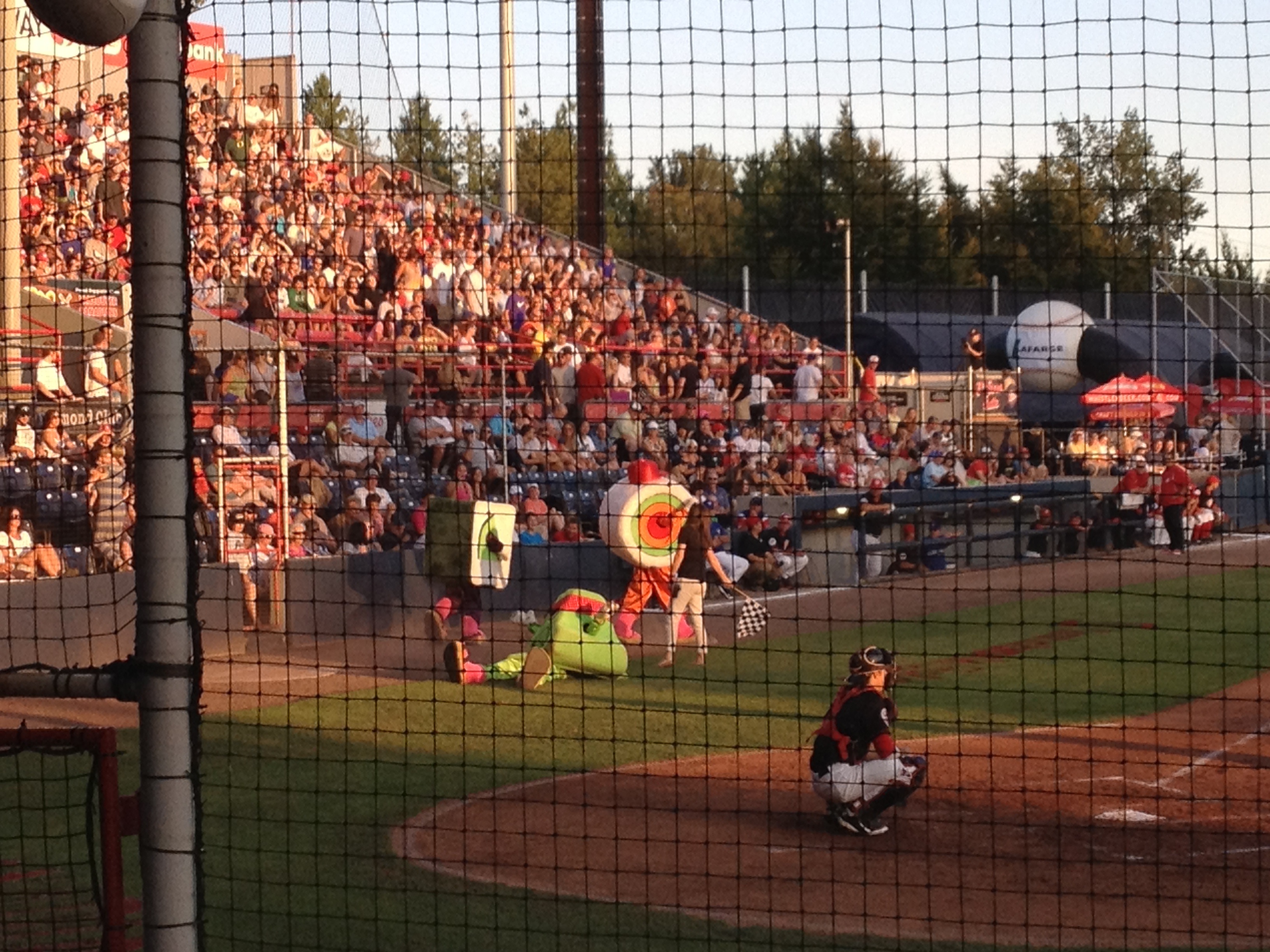
And then, for some reason, sushi raced.

It had been a long time since I’d watched baseball but the rules are pretty simple and the innings are pretty quick. Between innings, the stadium took care to entertain the crowd with various small events: a smart car taking a spin around the diamond, a “sushi race”, dance routines by the ground crew, everyone doing the bird dance in the stands, and finally, everyone singing “Take Me Out to the Ball Game”. I had a beer and a hot dog and reveled in nostalgia and the warm evening.

I really couldn’t have asked for more, except maybe for a win for the Vancouver Canadians. And then, at the bottom of the 9th, they made it happen! What a day. And what a stadium! Nat Bailey is a great place to kick back, shoot the shit, and watch some ball.

—————————

So what are you waiting for? Whether you prefer drinking a beer in the stands or scaling a peak, our warm weather and sunny skies won’t last forever. Get the heck outside you lazy bum, and have a summertime adventure.

Strip Down and Be Counted: Wreck Beach Skinny Dip 2012

The annual Wreck Beach Skinny Dip was held this year on Saturday, August 4. The Wreck Beach Preservation Society (WBPS) really picked a great day this for it (after a bit of a false start July 21, a Saturday which began quite cloudy). The air was warm, the sand was hot, the sun was bright, and the water was…well, the water was cold. As usual.

Besides being a little more crowded, the Skinny Dip is, for the most part, just another beautiful day at the beach. TC and I ate Skittles and apples, drank plenty of water, and I started in on a paperback of Kevin Wilson’s excellent but problematic novel, The Family Fang (many people compare this story to the Wes Anderson film, The Royal Tenenbaums, but I disagree with the comparison because the Tenenbaums love each other, and I am not sure that the Fang parents love their children, at least not beyond what their kids can do for their artistic careers. But my opinion on that is maybe for another time).

The only real difference between the Skinny Dip day and any other Wreck Beach day for me is, of course, the part where I go swimming totally in the buff with a lot of people. This year, I was one of 595 people posing for a big (nude) group photo and being counted by a notary public. According to the WBPS, a donor named Roger Proctor, CEO of Genex Capital, agreed to donate $5 to the Society for every registered naked bather in the water (we had to sign up beforehand to be part of the official “Dip” in order to be counted).

I guess participating in the Skinny Dip is a way to financially support the WBPS (through their donor), but for me, it’s a way to support Wreck Beach and everything I love about it by participating in some “naturist” swimming. I don’t mind sharing the beach with “textiles” (i.e. clothed people), or anyone who is being respectful, but that said, I do think respect is a key part of enjoying Wreck Beach and ensuring everyone else enjoys it too:

  • Respect for the environment: Wreck Beach does not have any garbage receptacles. This is not because you are supposed to throw your garbage in the bushes or into the sand. This is because you are supposed to take all of your garbage away from the beach with you. If everyone takes responsibility for their own garbage, no one will need to take responsibility for everyone’s.
  • Respect for privacy. Obviously, at a clothing-optional beach, taking photographs (except with permission of the subject) is not okay.
  • Respect for personal space and comfort. Visiting a clothing-optional beach is not an invitation to be hit on, gawked at, photographed, ridiculed or in any other way sexualized or objectified. Like any other beach, people go to Wreck to swim and sunbathe, not to pose for Playboy or be harassed.
  • Respect for each other. This one is pretty obvious. Be polite, share the space, don’t mess with things belonging to other people, and look out for each other. The “regulars” at Wreck Beach are always happy to come to your aid if you feel unsafe or harassed in any way.

Generally speaking, most people at Wreck stick to the principles outlined above, which is one of the many reasons this famous naturist beach has remained so beautiful, unique, and inviting. It’s one of Vancouver’s hidden gems and I hope it never changes.

We’re Not In Green Gables Anymore: Canada’s Revolutionary Reads

When I think about iconic Canadian literature, I think about Anne of Green Gables skipping in raptures over the red roads of PEI, the heartbreaking irony of Sinclair Ross’ Painted Door or A Field of Wheat, and maybe, if I’m in a more “contemporary” mood, I’ll think of Margaret Atwood and her much-lauded Cleverness. I don’t think of the word “revolution” when thinking of Can Lit any more than I would think of the words “outer space”. Sure, some Canadian out there is writing about it, I thought to myself, but they can’t be all that good or I would know about it.

Or maybe I’d have to take a class entitled Canadian Literature after 1920 (this year the course theme was “Revolution(s)”) and surprise myself immensely by enjoying it. Which is what I did. Considering three of the books we studied were Canada Reads winners, it seems I am not the only Canadian reader to discover a taste for revolutionary literature.

Readers of Canada (and beyond), allow me to present to you, in the order in which I read them, the books of the Summer 2012 semester of Canadian Literature after 1920:

    • In the Skin of a Lion– Michael Ondaatje (winner of Canada Reads 2002)This one is pretty obvious, and Michael Ondaatje certainly isn’t an unknown quantity to Canadian readers. This was my first encounter with him though, and I wrote my final paper about the book (a high-falutin’ affair entitled “Not Just ‘Men From Nowhere’: Narrative Inclusion as Revolutionary Act in Michael Ondaatje’s In the Skin of a Lion“). The book is big on beautiful language and lyricism, and big on telling stories, but light on the the proletarian rhetoric someone might expect from a book that deals primarily with the conditions of the (mainly immigrant) blue-collar workers who built key features of modern-day Toronto (which is alright by me). As expected, considering its author, In the Skin of a Lion is a fine book. A damn fine book, y’know?
    • Next Episode– Hubert Aquin (winner of Canada Reads 2003) This book gave me some difficulty. When you read it, it seems to be about a revolutionary imprisoned in a Montreal psychiatric facility trying to write a spy novel, set in Switzerland, about a revolutionary spy, but actually it’s about the political climate of 1960s Quebec. Get it? I didn’t, but according to my dad, who read the book in French back when he was a student, if you had been following Quebec politics at the time, you would get it. Give this book a whirl if you’re feeling brave and patient.
    • Louis Riel: A Comic Strip Biography– Chester Brown Considering the story of Louis Riel (and his involvement in the Red River Rebellion and the 1885 Northwest Rebellion) is told entirely by Brown in minimalist black and white comic-strip format (like the kind you would see in a newspaper), Chester Brown’s achievement is impressive. By Brown’s own admission, a lot of facts have been omitted or altered in his telling (since it’s pretty hard to fit major historical events in a comic), but his departures from historical fact are exhaustively cataloged in his notes at the back of the book, along with research information. If you don’t know much about Louis Riel, you’ll actually learn something from this comic-strip depiction.
    • Kanehsatake: 270 Years of Resistancea film by Alanis Obomsawin Kanehsatake is not a book, obviously, it is a documentary about the 1990 Oka Crisis. I was so struck by this film I am really quite speechless (and wordless) about it. Watching it will give you a very different, rather uncomfortable view of Canada and the way our rights as citizens are (dis)respected.
    • In Another Place, Not Here– Dionne Brand This book is a stylistically difficult, deliciously unsatisfying read. The underdogs do not “get theirs” in the end and the villains (when they can be defined) do not learn, or lose, anything. But the language (including Caribbean dialect in the voice of Elizete) is poetic and sensual with the ripe and sweating heat of Grenada pulsing against the empty greyness of Toronto. The plot centres around two people in a lesbian relationship but In Another Place, Not Here is not a novel about being gay. It is a novel about heat, and passion, and unfairness, with a final image that tears your heart right from your chest and just leaves it lying on the floor. It’s a book you can’t help but respect.
  • Something Fierce: Memoirs of a Revolutionary Daughter– Carmen Aguirre (winner of Canada Reads 2012) Despite its often heavy content, stylistically, this book is probably the easiest and fastest read. It is also the funniest. A natural storyteller, Chilean exile and Vancouver theatre artist Carmen Aguirre shares with the reader her (previously unshared) memories of growing up a daughter of the Chilean resistance movement. At the age of 11, Carmen’s mother and stepfather remove Carmen and her sister from the safety of their exile in Vancouver and return to South America to aid Chile’s resistance against the dictatorship of Pinochet. First kisses and doing the hustle are juxtaposed against bullets in the street and the all-important facade the family had to keep up at all times to ensure their safety from arrest and torture. At 18, Carmen officially joins the resistance as a fighter in her own right. This is a book not about gunning down baddies or blowing up buildings but about the physical danger and psychological and emotional toll underground resistance takes on ordinary people who are willing to risk all for a greater cause. The book created a bit of a controversy on the Canada Reads panel when panelist Anne-France Goldwater referred to Aguirre as “a bloody terrorist” and mused that she can’t understand “how we let her into Canada” (you can read more about Goldwater’s comments on the Globe and Mail website). Personally, I was quite taken with the book, and don’t see why anyone needed to use the “T-word”.

We’ve only got another month of summer. Get into your hammock or down to the beach and sink your teeth into some revolutionary reads. You might look at your country, or at least its literature, in a different way.

That time I went to a summer camp in Ukraine

Illustration by Sonja Kresowaty

When I was 10, I went to a summer camp in Ukraine.

I don’t mean that my parents shipped me off and told me to have fun with macrame and Ukrainians and that they’d see me in a few weeks. My whole family had been living in Latvia (the home of my mother’s predecessors) for the previous year, and after the school year and the Jāņi (Midsummer) celebrations were done, we hopped an overnight train to Ukraine, my parents rented a “microbus” van (complete with driver) and we drove into the Carpathians to visit the homeland (on my father’s side–where did you think “Kresowaty” came from?).

I didn’t quite realize this at the time, but by the end of our year in Latvia, we weren’t exactly rolling in money with which to tour another Eastern European country. This, I imagine, is why it seemed like a good idea to spend a few days staying in a cabin in a children’s summer camp, sleeping on the cheap and eating camp dinners with the kids. And for all intents and purposes, it was a good idea, since it worked out just fine.

The camp was pretty and the woman who ran it was very accommodating. After realizing that we spoke English, the children staying there treated us like celebrities, crowding around us to get a look (which was a bit scary for my sisters and me at first but wasn’t mean). Our cabin was large and bright compared to some of the hotels we had recently stayed in (or the hay-covered floor we had slept on after the Jāņi festivities).

As for the camp’s facilities, I remember only that I had to eat mashed potatoes (even though I hated them) because that was what was being served, and that the “bathrooms” at the camp were cement cubicles with small holes in the floor. My aim (as a child of 10 who was used to sit-down toilets) was not so great, so whenever I could I took advantage of the WC provided by the Great Outdoors. I can’t remember if we were ever able to shower while we were there, or whether we bathed in a river or something instead (there was a beautiful little waterfall nearby where we could jump off the rock into the pool below).

But no matter. My parents revealed to me this year that they’re pretty sure that a lot of the kids at the camp were from the Chernobyl contamination zone, spending a summer away from the ever-present danger of radiation (the disaster had only occurred about a decade ago at that point). That freaked me out a bit because I’ve read that to spend time living with a Chernobylite is essentially to spend time with a nuclear reactor (human bodies hold radiation just like everything else), but it also made their kindness all the more touching.

Despite my sisters and my shyness, the other kids (girls especially) were friendly and inclusive and those who could speak a bit of English seemed excited to try it out on us. An older girl took charge of us at the camp’s “Disco” night, asking us what music we liked (I told her Ace of Base) and making sure the teasing boys behaved themselves. On our last day at the camp, some of the girls presented us with little gifts they had bought from the ladies who sometimes set up little booths there.

I want to point out that these kids had nothing. Ukraine was a very poor country following the collapse of the USSR only five or so years before (running water only available some parts of the day, hot water hardly at all) and I think these girls were even poorer than that. I can’t remember how my sisters and I reacted to receiving the plastic earrings, bottle of perfume, and the small bottle of “Venus” deodorant we were given (I don’t think it was a slight, this seemed to be one of the prized items for sale). I think even as (comparatively) privileged Canadian kids we realized how nice this was. I don’t remember any of the girls’ names, but the memory of their generosity only becomes more amazing to me as I grow older. I don’t know many children, poor or otherwise, who would ever think to buy presents out of pocket for complete strangers.

Illustration by Sonja Kresowaty

On our last night, my sisters and I were roused from sleep. The lady who ran the camp was there, to feed us some type of corn porridge and sell my parents a heavy wool blanket (the “Ukrainian blanket” is the warmest blanket my family owns, popular on the couch in Saskatchewan winters or when camping). There was a lot of eating with strangers in Ukraine. Wherever we went, it seems people wanted to feed us. That’s just how it was.

Most of that trip through Ukraine feels like a dream to me now. Not because I was young (I have vivid memories of being much younger than 10), but because it was all so unusual to me. My memories of the country are just little snatches now: Fanta in sugar-rimmed glasses. The gilded opera house in Lviv where gorgeous women in stilettos went clack clack clack up marble staircases. Paying 1000 “kupons” (5 USD) for a carved wooden jewellery box. The cherries that looked good but had worms in them. The family we found who may or may not have been related to my grandmother (no way of telling since the village church records were destroyed by the Soviets) but who invited us for lunch anyways. Spending the night in a hotel that wasn’t open to the public yet (and didn’t have toilet seats). My mom celebrating her birthday on the train somewhere in Belarus and blowing out matchsticks stuck into a bun. Dill on everything.

On one of our last nights in Ukraine, we stayed in the apartment of relatives of our travel agent (for free, I think). They had a great big book of Ukrainian folktales in English. The folk art illustrations were stunning. The owners of the apartment gave the book to us, maybe just because they didn’t have use for an English book, maybe because they wanted to give us something. I have it on my shelf now and it is one of the possessions I am most careful with (especially because it belongs to my sisters too, not just to me).

I don’t know why I am thinking of Ukraine today. Maybe because my friend Aliya (who is also half-Ukrainian) mentioned that she would like to go. Maybe because the warm sunny weather and my recent trip to the Prairies has me dreaming of blue skies and yellow fields. Maybe because I encountered some of the most generous people I’ve ever met in my life there. Maybe because there’s a tiny part in me, however small, that cries for the home of my blood.

Or maybe because today I just wanted to tell you, in case you didn’t know, about the time I went to summer camp in Ukraine.

Why feminism and my apron can be friends

www.nataleedee.com

“We are living the dream grandma” http://www.nataliedee.com

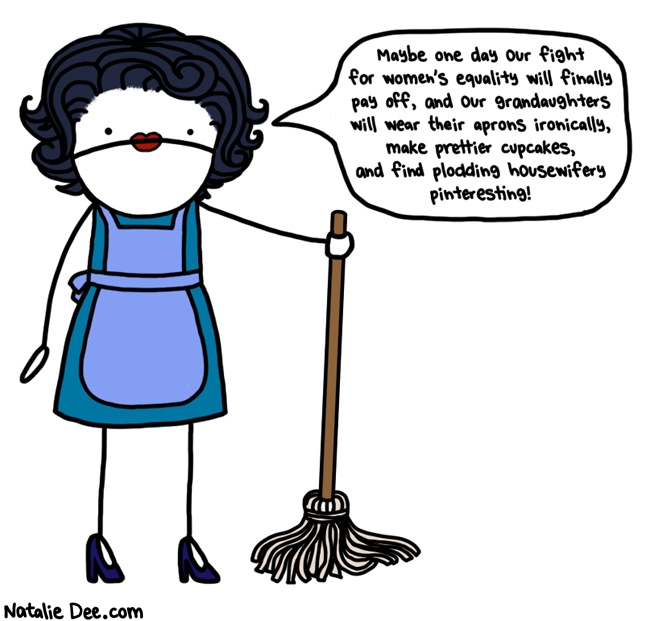
Once upon a time, I came upon this web comic on one of my favourite “let’s waste some time with funny things” website, NatalieDee.com. And I laughed and laughed and laughed. Ha ha, I thought, I’ve seen those ladies whose lives are so pretty and ladylike and are all so perfectly just-so. Do they really think having a choice between cute stripes and cute polka dots on their way-too-pricey for kitchen use, too-precious-even-for-Zooey-Deschanel, vintage-esque oven mitts makes them liberated? How charming! I felt pretty damn smug for a while and snickered and snickered judgementally.

Then my sister (who isn’t the kind of woman being described in the comic at all but is a clever and independent lady who didn’t want me to get too smug) reminded me that a liberated woman should be able to choose to do whatever the hell she wants to, even if it’s spend all day on Pinterest looking at pretty things, regardless of whether I personally think Pinterest is just a shopping list with pictures or not (don’t hate, all you Pinterest fans, I know there are very good ways to use the site, it’s just not my bag). I also had to admit to myself that I love cupcakes, and also, that my adorable apron has chickens on it (but I wear it sincerely, to keep my clothes clean, without a trace of irony).

So it seems that I live in a glass house, but I throw stones anyways. What else is new in this weird world of post-feminism feminism? I know I am feminist, in that I believe in wage equality and reproductive rights and that I do not believe in glass ceilings or the idea that “there are some things men are just better at”, but that’s kind of where it stops. Besides recognizing my full personhood (physically, mentally, morally, legally), I don’t really know how to express my feminism.

And now I wonder, do I have to? Is there something I’m supposed to be doing to stand up and be counted (besides politically–I already vote, sign petitions, all that good stuff). Should I stop wearing makeup because it’s just The Man’s way of telling me I’m not beautiful enough without it? Should I have gone into Math and Science in university instead of theatre and English because females are incredibly underrepresented in those areas of study and overrepresented in mine? Am I supposed to take the fact that I’m a smart lady as an indication that I’m wasting my life if I become anything less than a CEO?

I think the answer to all those questions is No. If I’m truly the master/mistress of my own destiny, my gender (or other people’s perception of it) should have very little do with my choices. And yet, the people who have made me feel, at different points in my life, that the answers to those questions should be Yes are WOMEN. Women in my personal life, women on the media, female bloggers–name any group of intelligent feminist women and you will find those who feel the answers to these questions should be Yes.

And maybe for them, they should be. But deciding how to express yourself and being confident in your choices does not mean you get to decide how another woman should express herself or become self-actualized. Another thing I’ve noticed about these questions is that they relate much less to me than they do to what a man is doing in comparison to me (not wearing makeup, studying Math, being a CEO, etc.).

I’m not sure about much in the way of how feminism is doing these days but I’m sure of one thing: masculinity is not going to be the benchmark of my success as a woman. I am not a man, so why measure myself with their yardstick? Why leave the control of my self-esteem in their hands?

Eff that. That said, this is ME saying “eff that” for myself, not for other women. If you are a lady who wants to not wear make-up, or wants to study Math, or be a CEO, more power to you. In fact:

For any woman who does not wear make-up: That’s great. It probably saves you time and money. I don’t wear much make-up but I do like to feel a little fancy sometimes, and there’s nothing wrong with that. Technically, there’d be nothing wrong with me piling on the stuff and going to work everyday looking like Boy George as long as I was happy.

For any woman who studies Math or Science: Coolio. I hope you build a bridge or cure something. I’m terrible at both of those subjects (mostly Math) so I would not have added anything to your field of study. I also love theatre, writing, and books and that’s what I’m involved in. So, y’know, I think we’ve both been learning things we like.

For all you female CEOs, Supreme Court Justices, and other Captains of Industry and Influencers of High Finance and Society: You rock. You are inspirational to women who share your goals, and I appreciate being represented in certain political and legal spheres. Personally, I just want to live on an island in the sea with the people I love and write things and be happy. I’ll use your motivation to reach your goals as inspiration to meet mine, without having to follow your path.

And that’s what it’s all about. Maybe. Natalie Dee will draw her very funny comics. I’ll keep laughing at them and wearing my apron (when I cook, obviously) and wondering what the heck Pinterest is all about. Somewhere out there, some woman will keep on rockin’ her job as a CEO. Little girls will play with cars, or Barbies, or mud, or whatever they want. And that’s what it’s all about?

Well, no, of COURSE that’s not what it’s all about. When I read the news it’s glaringly obvious that we have a LONG LONG way to go. Watching Rachel Maddow being patronized on Meet the Press made me sick. We’ve got a long goddamned way to go.

But you know what won’t get us there any faster? Judging other women for petty choices that have nothing to do with anything, like how they dress themselves or their hobbies or what they like to do.

So please be a feminist. Be a feminist any way you like. And I will do the same. Because the enemy is not my apron. It’s an attitude.

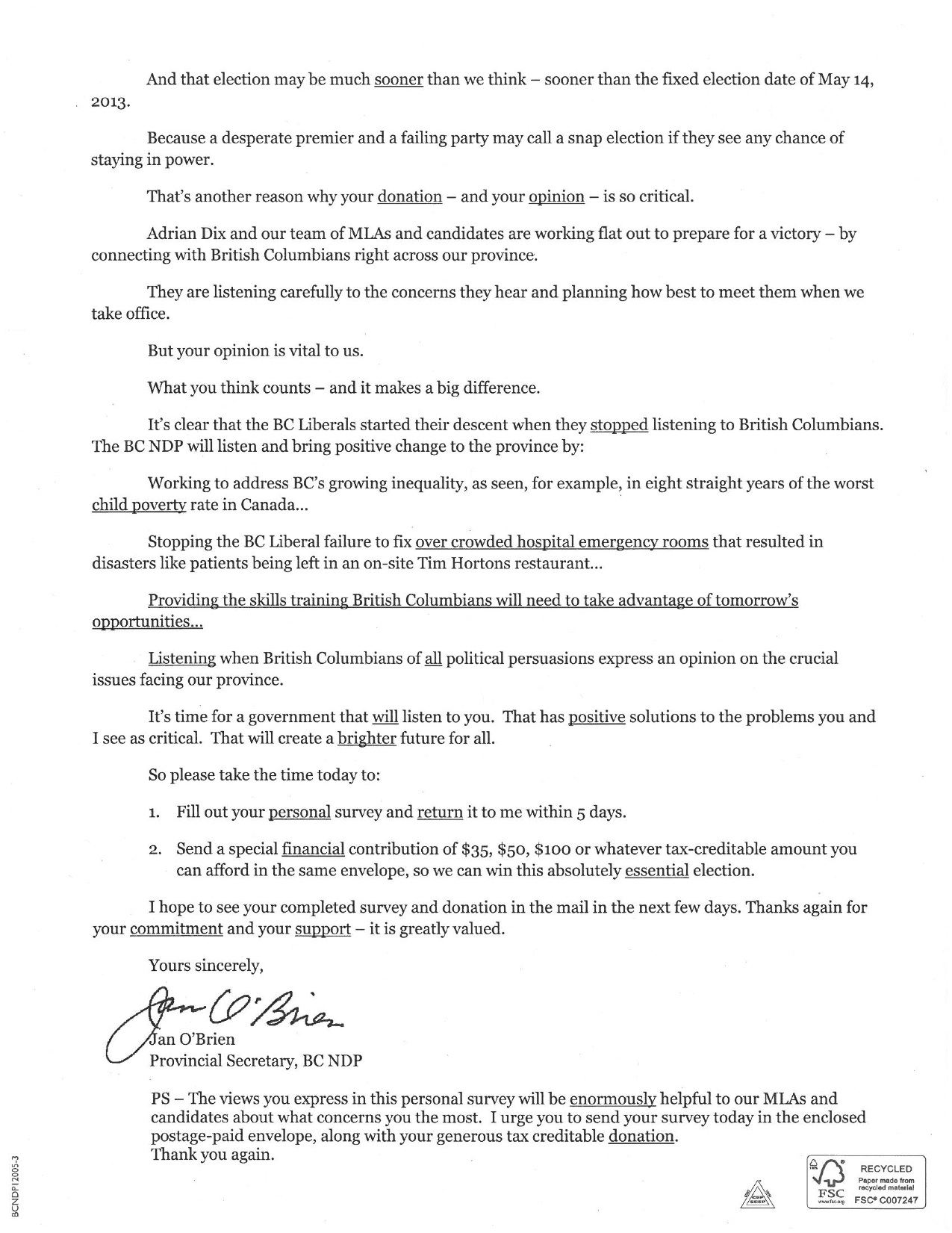
My Reply to the BC NDP’s Sucky Survey

It should come as no surprise to anyone that has read any of my political blog posts that I am a card-carrying member of the federal NDP. I joined before Christmas because I wanted to be able to cast my vote for the new Leader of the Opposition (such fun!).

What was a surprise to me (though not a necessarily unpleasant one), was that membership in the federal NDP automatically made me a member of the BC NDP as well. That is why I was the recent recipient of a disappointing mail-out called the “BC NDP Pre-Election Opinion Survey”.

Now, I love surveys. Love them. I love sharing my opinion (again, no surprise). I have not been very involved in BC politics and I was excited at the prospect of my opinion helping shape the direction the party would be taking in the next provincial election.

Much to my dismay, this “survey” proved to be little more than a request for donations, and a collection of questions so leading and so obvious you’d have to be a Nazi to answer any differently than the party expects you to. Since this survey was sent only to BC NDP members, I suspect Nazis were not given the opportunity to respond.

An example of the in-depth research this survey is doing.

Of course it’s important to ask questions about housing, persons with disabilities, the economy, education, etc., but the way these questions are phrased simply asks questions we all know the answer to. I think I can safely say all British Columbians (no matter which party they support) would agree that people with disabilities should be provided some assistance and security and that well-paying jobs are a priority for the province. What the survey failed to ask was how we felt about how the BC NDP proposes to do this. How is good housing for adults with disabilities to be secured? How will apprenticeship programs be expanded and well-paying jobs created? Who will pay for these initiatives?

A more useful survey would be one in which respondents were asked to rank the issues/iniatives which were most important to them (in the economy, education, health care, etc.), and were then asked what they would be willing to see their provincial government do to make these initiatives happen. Would we be willing to see income tax increases? Corporate tax increases? Would we be able to stomach cuts in certain areas? If so, which?

A criticism of the BC NDP that I have heard repeated several times since moving to BC is that although they are against whatever the BC Liberals do, they themselves do not seem to have a plan and do not seem to have any solid alternatives to offer. You can’t simply decry cuts to this and that without any alternative plans for balancing the budget. Although I will likely give the BC NDP the benefit of the doubt and vote for them in the next provincial election, I can’t blame British Columbians for having little confidence in the party, especially when its own members are receiving stupid surveys like this one.

After ripping open my survey envelope in delightful anticipation of participating in the political process and having my hopes immediately dashed, what I found most galling is that the confidential survey finishes off with a money grab.

Soo confidential! With my name and address on it and everything!

I’m used to being asked for donations so that didn’t bother me much, but I couldn’t believe that my “No” option for donating was enclosing $6.50 to pay for the privilege of answering this absolutely useless survey. If the survey questions had been decided on as the product of intense research and thought I would have likely been happy to support the initiative. I do not feel like I need to pay $6.50 for what is essentially junk mail.

While I’m in the process of bashing the provincial party I will likely vote for, I’d also like the point out that the letter I received with the survey was stupid too. As you can see, the letter uses underlining to great effect. Good god. I’m not in elementary school anymore. I don’t require underlining to tell me which words are important. Remember that this is a letter to the BC NDP’s own members, not someone completely unfamiliar with the party. If I was so stupid that underlining key words would sway me, I wouldn’t be voting NDP (the Liberals and Conservatives have better soundbites and use more repetition). Eugh.

You may ask why, if I am an NDP-supporter, I would write a post criticizing and poking fun at the BC NDP. The answer is because I want to vote for them, and I want to vote for a party that doesn’t underestimate my intelligence. I want the BC NDP to step it up. Ill-conceived donation drives like this one (masquerading as surveys) do not increase my confidence in the party.

C’mon BC NDP. If you can’t give me solutions right now, at least show me that you’re making an honest and genuine effort to come up with some. Until you do, your sucky missives are going straight in the recycling.

Ooh Saskatchewan!

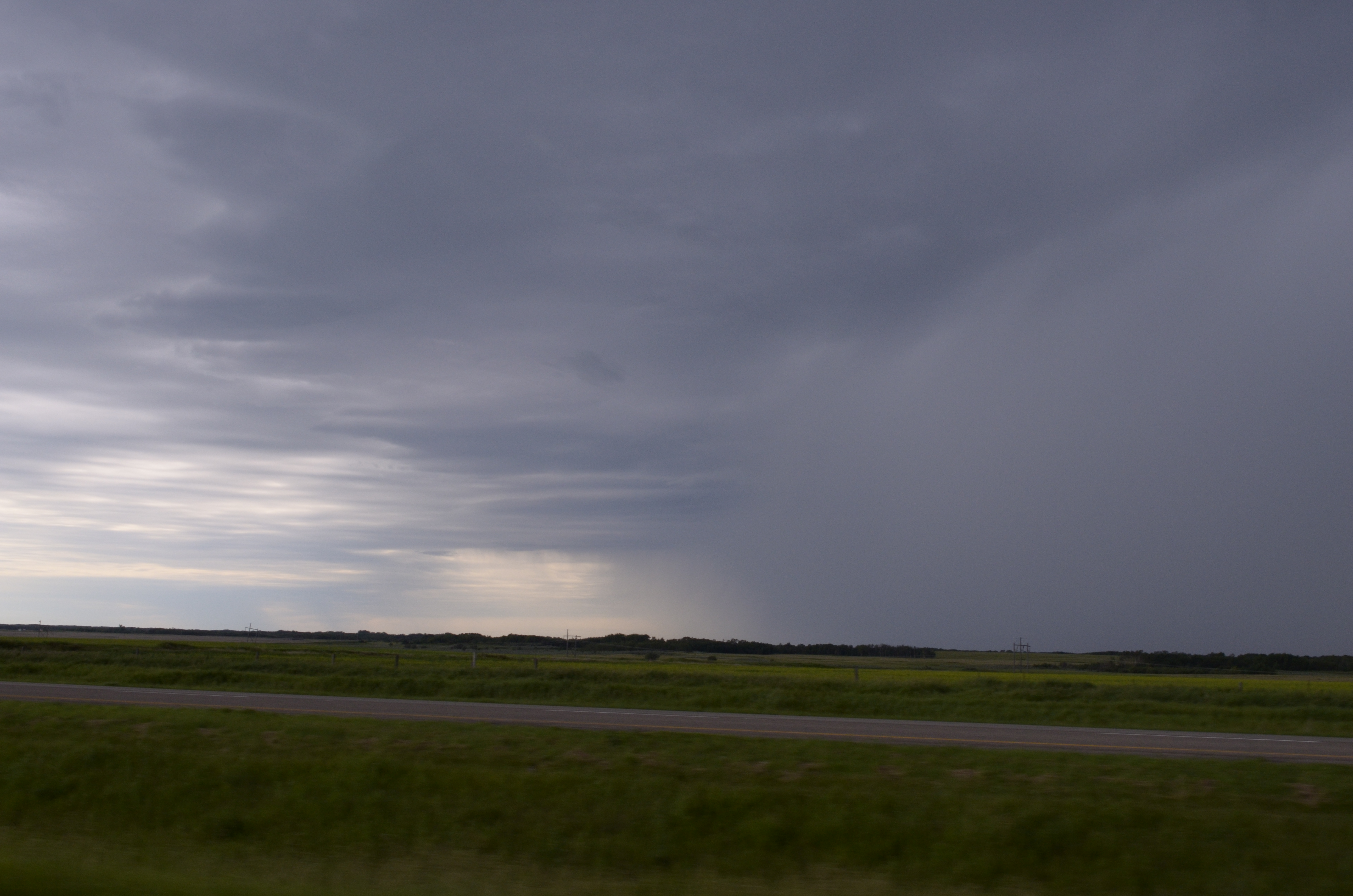
Driving through southern Saskatchewan.

Last Friday, my TC and I packed our bags for a week in Saskatchewan. Our trip took us through Saskatoon (briefly), Weyburn (for a wedding) and Cochin, but most of our time was spent in the house I grew up in, situated on 240 acres of forest and fields (mostly forest) in northwest Saskatchewan. Technically I did not grow up on a farm (I grew up on an acreage), but considering how far we lived from the nearest town (Turtleford–at least a 30 min drive from us, population 500) and the fact that at different times we’ve had rabbits and roosters and laying hens and a duck (in addition to the more usual dogs and cats), I suppose I could forgive your confusion.

This trip was TC’s first time deep in the country, and there are a few things he found a little bit “crazy”:

  • Saskatchewan is flat–you can see power lines for miles. Except only really in the south. It is not that flat where I’m from, comparatively, or nearly as open.
  • Giving directions includes, “Head eight and a half miles out of town on the highway and turn right at the white barn.” In our defense, we were in Weyburn for a wedding, and none of us were familiar with the community. Had we known where we were, the instructions would have certainly included the family surnames of the farms we were passing.
  • Dirt roads. We do not live on a dirt road. The roads out here are gravel thank you very much.
  • There’s no street signs out here. Of course there are no street signs out here. There are no streets. We get to our houses via roads (see above). Gravel roads don’t need names.
  • Wild strawberries. Heck yes wild strawberries.
  • Massive properties with hundreds of old cars and some buildings erected to form a kind of “car village”. To be fair, the property TC is referring to is a neighbour’s farm, and this neighbour is a devoted collector of vintage (and rare) cars.  The bison farm he owns with his wife is a pretty special, very unique place, not the norm for Saskatchewan farms. The fact that his collection and its set-up is not commercialized in any way is also very special.
  • Cows and other “critters” on the side of the road. Yes, this happens sometimes. And yesterday, we saw a badger!
  • There are three cats in the house. This is only crazy because TC is so ferociously allergic to cats. For the rest of us, it’s just triple the cuteness.

Our provincial flower, the Western Red Lily.

It’s hard for me to describe my home because I love it so much. I love the fields, I love the woods, I love the gigantic skies. I love driving the gravel roads that form a near-perfect grid across the province. I love Bright Sand Lake, I love the neighbourliness, I love the quiet (except in its own way, the Prairie is very loud). I love watching thunderstorms roll in. I love that my parents and their friends talk about hilling their potatoes, and the weather (because it impacts more than their mood and their beach plans), and never about salaries or how much people are paying in rent/mortgage/car payments etc. (which is somehow acceptable conversation in a city). I love that we ate good food all week and no one took a photo of it. I love being in the house my dad designed and built (except I hate when things inside it change). It’s the home of my soul, and always will be.

Despite his cat allergies and his newness to the region, TC and I had a lovely time. My only regret is having to head back to the city tomorrow. Sigh.

A thunderstorm rolls in.

My woods from my favourite place, Crocus Hill.

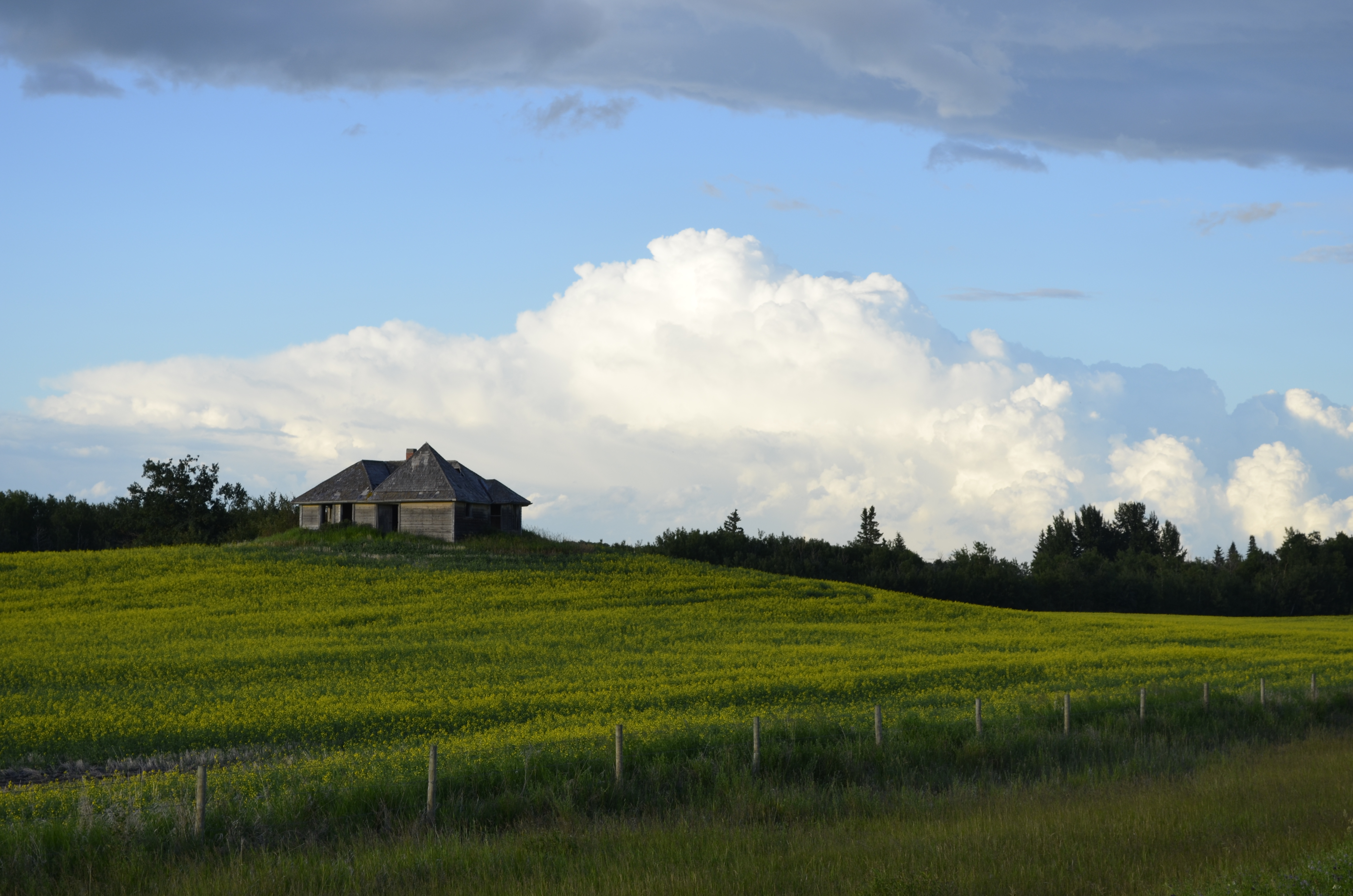
One of many abandoned farm houses–this one between Livelong and Glaslyn.

Beep beep.

[All photos by my TC.]

Covering the 2012 Jessies for Hummingbird604.com. Awesome!

Howdy arts fans!

The official purpose of this post is to direct you to my coverage of the 2012 Jessie Richardson Theatre Awards on Hummingbird604.com. The blog’s creator and chief contributor, Raul Pacheco-Vega wasn’t able to make it so I was only too happy to cover the Jessies for him again this year.

Hold up, you might say, this is not the first time you’ve mentioned Raul or covered something for his blog. Who is he, and how do you know him? Is this “Raul” a real person or some magical blogging elf man?

This really isn’t a good picture of either of us. Firstly, blame the fact that we took the photo ourselves. Secondly, blame a wee little bit of tequila.

The answer is that while Raul is probably, secretly, a magical blogging elf man (in addition to being a professor and consultant), he is also a friend of mine and is definitely real. We were introduced by a mutual acquaintance at a gala in 2010 and took a shine to one another. We stayed friend-ish but it wasn’t until a few months later when I started blogging that we became friends (I think it’s funny how the internet plays such a big role in facilitating new friendships nowadays, but I’m not complaining).

Though Hummingbird604.com is a very different blog from mine (in terms of its influence and reach, the number of times it posts, the fact that there are guest contributors, the “lifestyle” features that I don’t write much about, etc.), Raul has been very encouraging as I do my thing. Mostly, I draw on his experience and moral support, but he has also been tuned in to what I like to write about and has brought appropriate opportunities my way. Raul is the reason I was put in touch with Jessie van Rijn, General Manager of Carousel Theatre for Young People, last December, and reviewing Carousel shows this spring has been nothing but fun.

Friendships nurtured via the Internet are a relatively new phenomenon, but that doesn’t make the beneficial relationships that result any less real, only different. Friends are good to have, no matter where or how you met. And good friends? They’re just plain great.

And that, my dears, is why I always (sometimes profusely) say thank you to people like Raul, or Lois Dawson, or any of the other people who have provided fun opportunities to blog about things I enjoy. My blogger friends have been very good to me, they are good for me, and I’m always grateful for that.

If you read my coverage of the Jessies on Hummingbird604 (and I hope you do since technically I guess that was the point of this post), you will see that gratitude played a huge role in the evening and in the spirit of that gratitude, I just want to say thank you to the people who keep sending good things my way. You’re awesome!