Fair is fair: why straight cis people don’t need a “Pride” event

World Pride 2014, Toronto

World Pride 2014, Toronto

Last weekend I came across this troublesome little gem on social media, relating to fake posters for a “Straight White Guy Festival” which were plastered around an Ohio town (during the lead up to the community’s Gay Pride events). “Everyone welcome,” the fake flyers read, “Come help us celebrate our enjoyment of being straight white and male.” The author of the post, Sean Brown,  seems to think the stunt was not only funny but a legitimate shot at “leftists” whose only interests lie in protecting minority groups:

While it may be true that straight white men don’t face the same struggles as gay people do, the fact that they’re not allowed to celebrate their own sexuality in the same manner out of fear of offending someone is reprehensible. Everyone has the right to be proud of who they are, regardless of the color of their skin or who they choose to have sex with. It’s apparent whoever created this flyer did so to point out the hypocrisy in this debate.

True equality is not achieved by stifling others in order to uplift a minority group. It’s done by treating everybody exactly the same way, even if it means some people may get offended.

I hope Mr. Brown won’t mind being offended if a leftist who is interested in protecting the rights of minority groups calls his bullshit bullshit.

It’s bullshit. And this is why:

Straight, cis-gendered people like me get to celebrate and be proud of their sexuality everyday. We can marry whoever we want to and no one can say boo. We can arrange to adopt or foster a child without the extended birth family (who aren’t interested in caring for the child anyways) pulling out at the last minute because they don’t want the baby to be cared for by a gay couple. Western media constantly celebrates heterosexuality by using overtly heterosexual imagery to promote products and a “desirable” lifestyle (anyone seen a beer commercial in the last 20 years?). At home, at school, at work, our lives have been easier in every way imaginable because we were not born queer, or bi, or trans*. I’m sure if you asked an LGTB person, they’d probably take the lifetime of acceptance straight cis people currently enjoy over a pride party once a year. We don’t need a party celebrating our good fortune. Every single day we aren’t discriminated against is our party.

Funnily enough, I’m not shocked that the post’s author could acknowledge this privilege and still think that “treating everyone exactly the same way” vis-à-vis pride events for privileged people is a legitimate position. I remember once thinking the same way about a variety of issues surrounding equality (granted, I was in high school at the time, but still, it’s all part of the learning process). Why couldn’t someone formally celebrate being white/straight/middle-class, etc., I wondered. Fair is fair after all.

Here’s the thing (which I won’t have to tell you if you are interested and active in issues of racial, sexual, economic, or gender equality): fair is only fair if everyone starts from the same place and has had the same advantages.

Let’s say 10 people are running a 100 m race. 9 of these people are “straight white (cis) males”. The 10th runner is gay, a person of colour, and/or not a cis-male. All of the runners are required to start at the start line at the sound of the gun, and run 100 m to the finish line. Fair is fair, right?

Except perhaps the 10th runner was not able to attend track practice in the months before the race because the locker room atmosphere (which included their 9 competitors) was not a safe space to be. Perhaps the 10th runner did not receive adequate training during their formative years because they were overlooked by coaches throughout their life–overlooked for reasons that had nothing to do with their running ability. Perhaps for weeks prior to the race, the 10th runner was subjected to nightly death threats, and a daily barrage of “news” items and opinion pieces constantly questioning whether Runner 10 should have the right to run the race at all, or whether they even belong in polite society.

The other 9 runners, meanwhile, have been supported throughout their training by each other, by their coaches, and by society at large and are on equal footing with one another. As the competitors take their marks, one of the 9 runners gives the 10th runner a shove, completely breaking their focus as the race is about to begin. The race officials pretend not to notice because, you know, that 10th runner, always being sensitive about something, can’t ever take a joke, right?

The gun goes off. All 10 runners sprint towards the finish. Perhaps the 10th runner has managed to train on their own with the support of a close group of friends and allies and they manage to put in a decent showing. Perhaps the 10th runner has been mostly on their own and the stress of the conditions under which they’ve had to compete have taken their toll. Either way, can we really say the race was fair? Of course not.

And given that the race was not fair, can we really say that it’s tasteful for the 9 “straight white male” runners to celebrate the superiority of their circumstances? Of course not. (And don’t even get me started on the qualifiers “white” and “male” in terms of the privilege being fêted in this prank–they just add further insult to, well, insult. And injury.)

But if the 10th runner wants to party with their friends? Absolutely. They deserve as much, don’t you think?

So Sean Brown finds straight white guys “not being able to celebrate their sexuality…for fear of offending someone” to be “reprehensible”. What I find reprehensible is celebrating privilege achieved at the expense of another human being’s rights and dignity. And I don’t find my position hypocritical in the least.

Besides, are Pride events really that exclusionary? Unless you’re there to be hurtful or spread homophobia, the answer is usually no. If you’ve ever been to a Pride you’ll probably notice that people of all sexualities, genders, races, and economic backgrounds are in on the party. Even straight white guys.
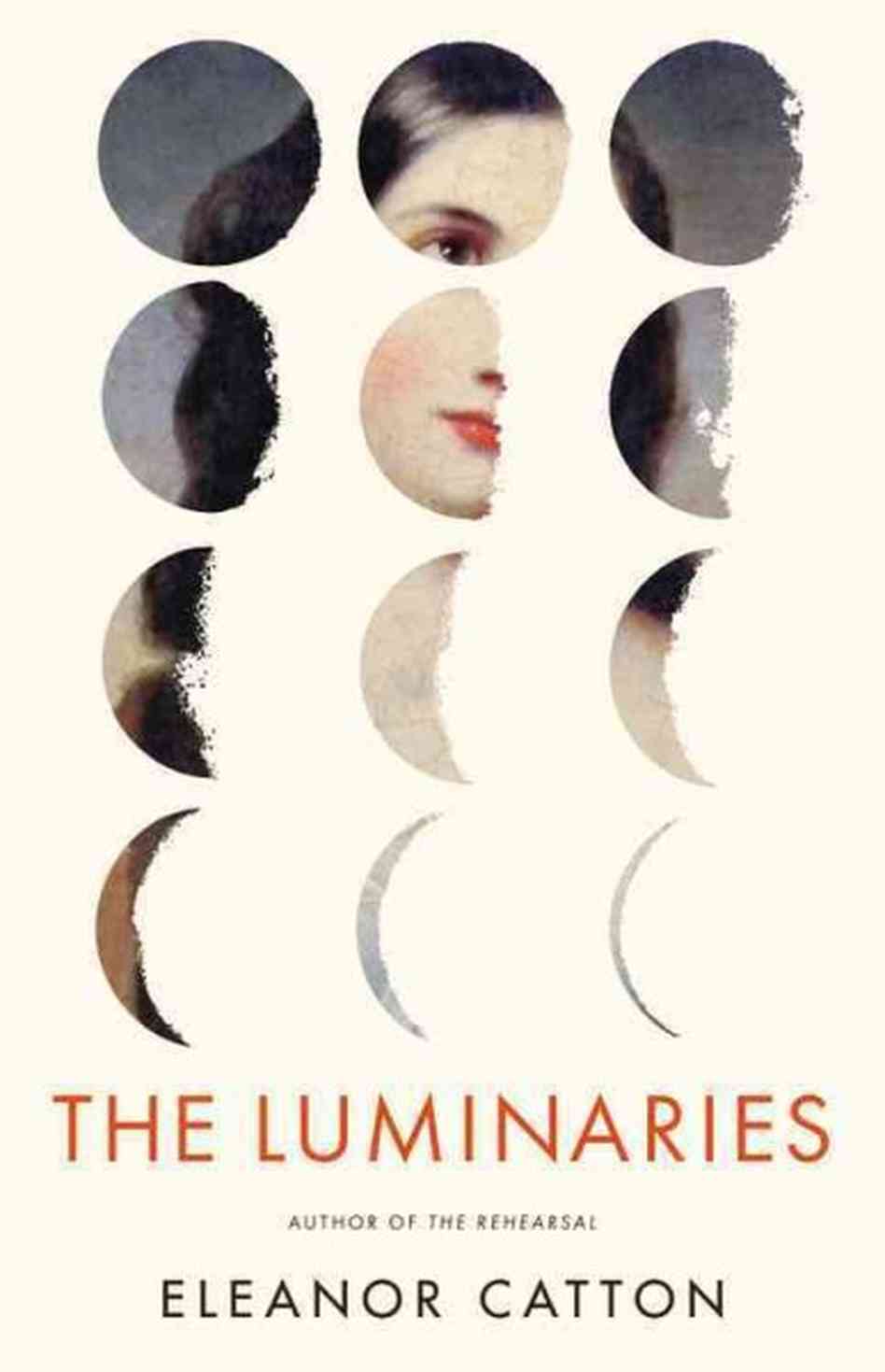
Exquisitely Crafted: Eleanor Catton’s “The Luminaries”

9780316074315_custom-ab2793381053c909c69a0e7d56cac302350a9795-s6-c30To begin Eleanor Catton’s elegant, 832-page novel, recipient of both the 2013 Man Booker Prize and the Governor General’s Award for Fiction, is a daunting task. The Luminaries contains 20 important characters (helpfully charted in the opening pages), follows an astrological structure and is, as mentioned above, an intimidating 832 pages long. To settle into the opening chapter (“In which a stranger arrives in Hokitika; a secret council is disturbed; Walter Moody conceals his most recent memory; and Thomas Balfour begins to tell a story.“) is not a matter of allowing yourself to be swept away (because how can you be with a book this physically heavy?), but of making a conscious decision to begin a long journey in the rain.

This, I think, is Catton’s intention. Her opening scene, set in 1866 Hokitika, New Zealand, finds young Walter Moody rattled from his overseas journey, bogged down by fatigue and rain. Upon entering the smoking room of the Crown Hotel, he comes upon twelve men silently occupying themselves in the kind of “studied isolation” that betrays the secret council in which they were deeply engaged just moments earlier. Both Moody and the reader must decide if the glimmers of intrigue that Catton has left visible are worth the trek into the murky unknown.

The answer for this reader is yes. Though never an easy read, the weight of The Luminaries is one which begins to gain momentum the moment we know something another character does not (which happens repeatedly throughout). Catton is a master of both concealment and revelation, parceling out each in just the right amounts so that our confusion never quite overtakes our dawning understanding, and vice versa. Her style is one which assumes and speaks to the reader, and ultimately rewards them in the incredibly satisfying final chapters.

Despite the mathematical and thematic sophistication of the book’s structure and Catton’s gorgeous, though occasionally high-falutin’, prose (the men in the Crown Hotel “might have been twelve strangers on a railway car, each bound for a separate quarter of a city that possessed fog and tides enough to divide them” their “bodily silence…deadened here not by the slur and clunk of the coaches, but by the fat clatter of the rain”), The Luminaries is, at its heart, a mystery story. Like any good mystery, the beauty of the language and the elegance of the chapter headings and divisions are secondary to the characters’ (and the reader’s) quest to seek out what is hidden and to unravel what seems at first to be hopelessly twisted. The prose and the structure, significant as they are, are the vehicles in which we travel–the mystery is the terrain.

Luckily, The Luminaries‘ mysterious landscape is one the author has mapped well and one she is adept at revealing. Unlike the patronizing explanations of Sherlock Holmes, Catton’s facilitation of our understanding is as emotional as it is rational, as lyrical as it is illuminating, and as wistful as it is fulfilling.

Having quite enjoyed The Luminaries, the only reason I wish the book were not so long is so that I would be more likely to undertake the repeated readings that would allow me to tease out Catton’s carefully crafted design a little more and derive even more pleasure from her skill. Even returning to the book casually (i.e. for leafing through) for the purposes of this review revealed details I hadn’t noticed before: delicious section names like “Tar”, “Tin”, and “The Widow and the Weeds”, and the way that the title of Part I, “A Sphere with a Sphere”, comes full circle (and becomes more poetic) for the book’s final section title, Part XII, “The Old Moon in the Young Moon’s Arms”.

There is so much to notice in this novel and so much to take pleasure in that I hope The Luminaries’ size will not dissuade you. Eleanor Catton clearly laboured long and now has a triumph to show for it.

I miss my journal (blogging is not the same)

The other night I was inspired to write a bit in my journal (currently a lovely, if scratchy-papered, leather-bound affair with an owl on the front). I was shocked, and somewhat ashamed, to find that I hadn’t written for almost two months. Flipping through the pages I realized that for the last few years I’ve been journalling, on average, once a month (or less). And the few entries I have written haven’t really been massive epistles to make up for lost time either–just little blips here and there, a note about Christmas, a paragraph about a recent disappointment or a recent triumph. I feel like I’m growing apart from an old friend. And it makes me sad.

I used to journal at least a few times a week. In grade 6 it was a bit of an obsession–trying to get through journals as fast I could, MAKING myself write at least one page per day, even when I had nothing to say except “Only 26 more days until this journal is done and then I can write in the new one with the tiger on the cover!”, etc. I’m not entirely sure why I was so obsessed with my next journal, as opposed to the one I was currently writing in. I think the sight of those blank pages made me feel that SOMETHING, something better than now, was waiting to be written in that next journal. Usually, it was just more of the same silly poetry and over-abundance of exclamation marks and musings about how close I was getting to the final page. I always finished a journal with a humorously wistful “Last Page” post (humorous because it usually involved me summing up the wisdom I believed my 11-year-old self had gained and finishing, as I often still do, with my signature).

Once I hit junior high and high school and became confused and insecure and angst-ridden, the tone of my writing was decidedly less positive. My childish indignation about popularity politics and boys I thought were icky (or cute, depending) gave way to a deep and abiding conviction that these things mattered–that being popular was a worthwhile goal, that whether or not any boys liked me was a measure of my value as a person. That my clothes mattered and my bra size mattered and that I was helplessly alone (even when I was loved all along). Receiving only 75% on my grade 8 science final necessitated a long walk in which I cried in the forest and wrote of my disappointment in myself. Envying my best friend her boyfriend resulted in pages of self-loathing. Arguments with my sisters or my parents were chronicled in capital letters with multiple exclamation marks immediately followed by regret. Often, I turned to my journal not for silent understanding but to say I was sorry.

It wasn’t all bad of course. I wrote about whether the boy I liked had talked to me that day. I told the story of my first kiss (and several weeks later, my fun fun time with mono). I could detail exactly the intensity of eye contact in a “romantic” situation, or what it felt like to have a boy reach for my hand for the first time while we watched a movie in the dark. I seemed to remember each and every electron that fired when everything I was experiencing was so new. I recorded my dreams, and wrote about vampires (which were a thing for me, I guess when I was 15), and Peter Pan, and my best friends, and all the places I was seeing, and what I wanted to do when I grew up (writing or theatre, depending).

When I revisit my old journals I always expect to find them funny, and instead I find that I am sad. Sad that the girl I was didn’t love herself more, or see how much she was loved. Sad about some of the not-so-good situations she got herself into due, in part, to her low self-esteem. Sad that I wasn’t always respectful to my parents, or understanding with my sisters. And sad about good things too. Sad to read about a school chum that isn’t here anymore. Sad to read about best friends that live so far away now. Sad that my hometown keeps changing without me, and for the beautiful places I have been that I can’t properly remember.

Which is why my journals are so important to me. They aren’t great literature. But they are a record of a life, unexceptional as it may be. I don’t want to forget how it felt to be those other people I have been, but I do forget, and, when I need them to, my journals bring those other Laurens back.

But only if I write in them. I know that I journal more when I am sad than when I am happy. I journal more when things are new than when they are routine, even though I know that life does keep changing in slow and subtle ways. And it’s too bad. In the sad times I’m always dismayed to look back in my journals and find I had little to say about the happy ones–I was having too much fun, I guess, or taking my happiness for granted. I read once that “misery stains backwards through the pages of life”, and it’s so much easier for that to happen if I neglect to write about the good times.

In a weird paradoxical way (familiar to procrastinators everywhere, I’m sure), the guilt I feel about neglecting my journal actually makes me want to write less. Opening my journal makes it obvious how poorly I’ve been keeping it up lately and it makes the guilt worse. So I cart my journals around with me like reproachful bricks until I FINALLY make myself write, at which point there is so much to say that my efforts are merely perfunctory.

I know there are other reasons I’ve been terrible with my diaries. For example, as mentioned above, I write less when I’m happy and in general, I am quite happy nowadays. I also am not as self-centred as a I used to be. I’m not saying I was a selfish teenager, just that the things that bother me the most nowadays aren’t necessarily personal insults or failures (the kinds of things I used to exhaustively record in high school because I was not as good at coping with them), but broader issues like violence, Canadian politics, and misogyny. (I don’t know how to journal about being afraid of the MRA movement, and the recent massacre in Isla Vista, for example. I don’t know how to bring that into my record of my life and I don’t know if I want to.) And, of course, I don’t have the free time I had when I was 13 (it turns out my parents were right–taking care of a household, even a small one like mine, IS a lot of work, and having their children help out without complaint WOULD have been very useful).

And then there’s this blog. It’s like a journal, in a way (and here I do attempt some larger issues), but it’s changed the way I write for, and about, myself. Instead of being honest with myself in private I’ve been presenting my emotional life in a public forum, and using my journal merely as a log of achievements and setbacks. I try to be truthful, but “presenting” is definitely what I do in this blog–it’s not, and can never be, a replacement for my journal. It’s glossy, it’s vague, and it’s CLEAN. Much cleaner than my emotions really are. I admit my confusion to myself less and less nowadays, and instead take a solid position because a solid position is easier to blog about. Sometimes, that kind of writing is necessary and useful and for that reason I continue to enjoy this blog. It’s a great new friend.

But blogging is not the same as my journal. My journal, truly, is singular, an entity that spans multiple handwritten books (a dozen? Two dozen?) written and collected over the past 20 years. My journal has been with me since I was a child. It has never left. It has always waited patiently with blank pages and the promise of better things to write about. I have neglected it and I am sorry.

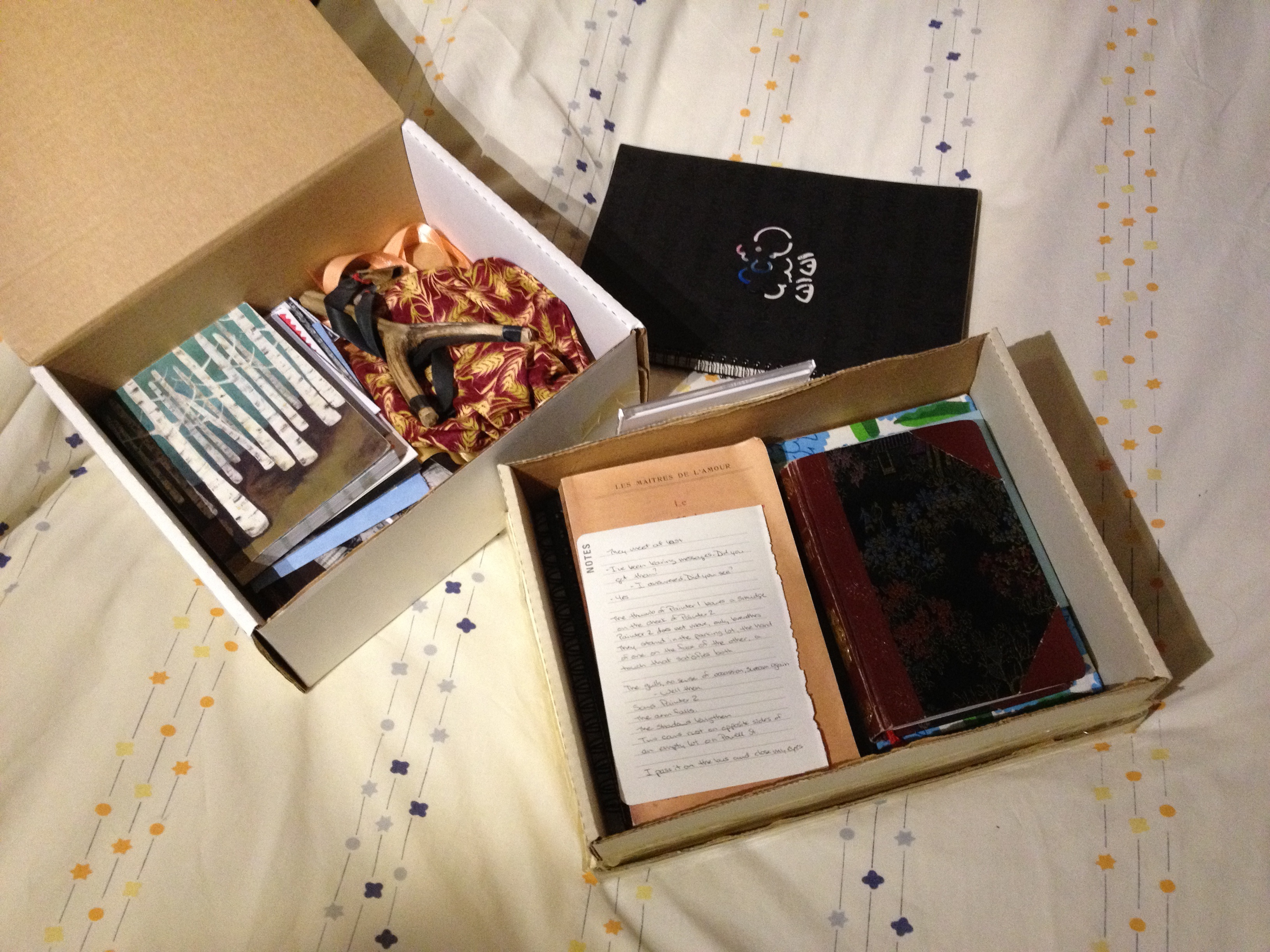
Journals boxes! There are two more of these stored at my parents' house.

Journals boxes! There are two more of these stored at my parents’ house.

Sal Capone: a tragedy with sincerity and depth

Sal Capone PosterWhen I was offered the opportunity to attend Sal Capone: the Lamentable Tragedy of (presented by urban ink productions in cooperation with Black Theatre Workshop) I had no idea what to expect. I know nearly nothing about hip hop, and had no idea how it would play in a theatrical production. I thought, this will either be an incredible experience or a dud. I had never heard of Fredy Villaneuva, the unarmed youth whose fatal shooting by Montreal police inspired this play. Many new plays have called themselves tragedies, but very few have had the balls to honestly examine the complexities that create them.

It was my good fortune to discover that Omari Newton’s Sal Capone is a tragedy in the true Shakespearean sense of the word. As in Macbeth or Hamlet, one act of violence leads to others–violent emotions, violent words, violent actions. We know where this is going but the powerful emotional responses that bring us there are so skillfully wound up that we cannot look away. In this tragedy, the protagonists are not kings or princes but disenfranchised young people full of potential and talent. Their “fatal flaw” is not ambition or indecision but their anger at a system that marks them as dangerous, dehumanizing rather than protecting them.

Kim Villagante as Jewel

Kim Villagante as Jewel. Photo: Andrée Lanthier

I know I am watching a compelling piece of theatre when I cannot see the line between where the script ends and the performance begins. Tristan D. Lalla, Kim Villagante, and Jordan Waunch did exactly what excellent actors should do, inhabiting their characters (members of a hip hop group called “Sal Capone”) so completely that I never saw them working, only being. The hip hop pieces in the show are unforced, unpretentious, and incredibly powerful. I may not know much about hip hop, but I know when a performer is truly connected to what their character is doing, and these actors (who are also hip hop artists) are nothing if not genuine. I believed it. I bought it. I sent my heart out to it.

Counterintuitively, a cross-dressing sex worker narrator (played by Billy Merasty) frequently breaks the fourth wall and a little sister character (Letitia Brooks) also seems to play directly to the audience with her amusing grammatical pedantry. I personally found this contrary to the authenticity Lalla, Villagante, and Waunch create (which is not to say that there were problems with Merasty and Brooks’ performances, only that they operate, it seems, on a different level of theatricality). That said, when Merasty and Brooks enter the action not as a guides or foils but simply as people caught in the crosshairs, the “actor” masks fall away and you see every character for what they are, motivated by fear and anger, prey to a violence they participate in but cannot control. What I’m saying is that there will be times in this play when you are taken out of the honesty of the moment, into a place a little more literary, a little more theatrical, but when shit hits the fan the moment becomes real and every single performer is in it, body and soul. Sal Capone transports you into a place you’ve been busy ignoring, a place where violence isn’t just something that happens to people in gangs (as one of the characters points out, “What does ‘known to police’ even mean?”). A place where we realize that we, as a society, need to do better.

One of Newton’s greatest achievements in his script is his ability to examine violence and culture without resorting to a dichotomy of black and white, hip hop=good, police=bad. The “enemy” of the story (i.e. the police) are never even present onstage but between Newton’s sympathetic characters there is still enough fear and violence to spur the plot towards its tragic conclusion. Marginalized and misunderstood, Sal Cappone‘s characters trade in words of hate, hurting one another with “chink” and “faggot”, understanding that words are weapons, often the only weapons they have, and the only outlet for the violence they feel, fending off the physical violence that threatens to emerge.

The lesson in this tragedy, as in so many great tragedies, is that violence begets violence. People must be given a chance to break the cycle. We need to talk to one another, and do better. Sal Capone: the Lamentable Tragedy of is an incredible achievement and a powerful addition to this necessary conversation.

Sal Capone: the Lamentable Tragedy of plays at the Roundhouse Theatre until May 31. Tickets can be purchased online through urban ink production’s website.

Disclosure: I attended Sal Capone: the Lamentable Tragedy of courtesy of urban ink productions. The content of this review is my own.


Bronies are Alright by Me

[Official Trailer] Bronies: The Extremely Unexpected Adult Fans of My Little Pony

I don’t do much (or anything) to hide the fact that I like cartoons. Obviously, there are some very good cartoons for adults, like Bob’s Burgers, Archer, and Futurama, and it’s perfectly acceptable for adults to like those (and I do). I also like animated fare aimed at less mature audiences but that still give a wink to older viewers (Johnny Bravo, Angela Anaconda). And I do have fond memories of the cartoons I loved as a kid (Thundercats, Jem) including some very entertaining animated series based on toys (like Teddy Ruxpin, which was amazing).

So I wasn’t all that surprised to find that I enjoy watching the occasional episode of My Little Pony: Friendship is Magic (a reboot of an 80s cartoon based on the Hasbro toys) on Netflix. However, the reason I checked out the show in the first place is that I was curious about another group of adult (and teenage) viewers I had heard about, viewers who not only like MLP:FIM, but who LOVE it to the point of full-blown fandom. I was curious because this group of adult super-fans is comprised primarily of men.

They call themselves “Bronies”, and they are the unexpected demographic whose devotion to My Little Pony: Friendship is Magic has created internet forums, merchandise, music, fan fiction/fan art, and major conventions (including BronyCon in the U.S., which draws thousands of Bronies each year). And I think that’s awesome.

Before I continue I should probably admit that when I first heard about Bronies I was confused and suspicious. Why would a group of grown men be obsessed with a show for little girls? I wondered. Is it some weird sex thing? Are they trying to socialize with children? What’s the deal here? I pictured an inappropriate presence of creepy old men crashing Pony events aimed at children. What I didn’t realize at the time is that Bronies have no interest in creeping on your little girl. They like the show for its own sake and have built communities of like-minded fans based around the show’s colourful animation and its core tenets of friendship, inclusion, and kindness. What’s not to like?

If you’re Fox News, you might concede that at least being a Brony is better than being a terrorist, and of course those who subscribe to outdated and restrictively macho gender roles will certainly think Bronies are an affront to “the way things should be”, but for the rest of us, Bronies are a subject usually treated with bewilderment and amusement, maybe even curiosity.

If you’re like me, curiosity eventually won out and I’ve not only watched a few episodes of the show to see what all the fuss was about, I’ve also watched the Kickstarter-funded documentary Bronies: The Extremely Unexpected Adult Fans of My Little Pony, which is available on Netflix. Though the documentary has been criticized by some Bronies for presenting a very narrow picture of the Brony culture, and by members of MLP:FIM‘s female fan subculture (sometimes called Pegasisters), for almost completely ignoring women’s contribution to the MLP:FIM fan community, TC and I still found it completely fascinating. Not being very familiar with other established fan cultures either (like Trekkies or Whovians), I find the level of commitment that would lead fans to shell out hundreds of dollars to attend conferences, etc. intriguing enough. The fact that most of the fans interviewed were male and were so into a show that is so outside of what we consider to be in the range of “normal” interests for men is, to me, incredibly interesting and kind of amazing.

Lauren Faust, creator of My Little Pony: Friendship is Magic, said in an interview that although she certainly did not expect Brony fandom when she conceived the show, she welcomes their support, and sees the interest taken by adults and men in the MLP as an affirmation that shows which are considered to be for “little girls” can be good and do have cultural value. It’s worth taking into account that Hollywood has been banking on and promoting our interest in “boy” cultural products for a long time–just look at the millions of dollars spent (and made) on blockbusters like the Transformers and G.I. Joe franchises. When it comes to Hollywood’s treatment of cultural products aimed at girls, their efforts are usually constrained to flimsy, hyper-sexualized fare like the Twilight saga or the underwhelming film version of Josie and the Pussycats (IMDB gives the film 5.3 stars out of 10 and includes trivia tidbits like, “Melody is never in the actual movie seen in a full shirt, i.e. a full neckline and sleeves. The only time she is seen in a real shirt is during flashbacks in the “Three Small Words” music sequence.”).

Though critics of the Bronies documentary are quick to point out that not all Bronies have faced persecution for their fandom (as opposed to the film’s portrayal, which treats being a Brony almost on par with being homosexual, following the stories of young men who have had to “come out” as Bronies to their confused families), the backlash some Bronies do face gives me pause. Why, when we splash “boy toys” all over the big screen, blowing up vehicles and buildings and killing people/monsters/evil robots, is it considered fun for the whole family (or for date night), while magical animated ponies, whose dearest ambition is to take care of each other and their community, are only meant “for girls”?

While I am certainly not qualified to discuss Brony culture, the contempt, confusion, and derision I have come across even while I discuss Bronies in my personal life makes me question, yet again, the values we hold as normal. Why are violence, cruelty, and misogyny the norm in our cultural products? Why can’t we see values like friendship, hard work, and kindness worthy of our energy?

And even if you don’t like My Little Pony (and it’s certainly not my favourite cartoon), what the hell do you care what gender or age its fans are?

“The Writer at Work” (#fiction)

I have been struggling all week to write a blog post and have been drawing a rather unfortunate blank. As I watched East Vancouver roll past the Skytrain window on my way home from work on Wednesday afternoon, I realized with a great deal of relief that I had already written a cheeky little piece of fiction about this very struggle (to which I’m sure we can all relate…..maybe….ha ha).

And so, for your reading pleasure, I give you, The Writer at Work.

The Writer at Work

Knowing the importance of sleep to an intellectual and productive mind, our friend the writer never rises before the sun. On this day, he opens his eyes at his accustomed hour intending to begin his labours at once, however, he feels the dream that had visited him just prior to his waking is of great artistic significance and therefore, for the sake of his work, he is forced to lie abed nearly three quarters of an hour more in an attempt to recapture it. Alas, the dream has escaped him. No matter. When one is blessed with genius such as his, brilliant visions are forever unfolding in one’s mind, in a never-ending parade of wit, pathos, and profundity. The formidable task of his life is to render these visions in writing so as not to deny the world their splendour.

Speaking of his task, our friend resolves to begin straightaway, though not, of course, before the completion of an elaborate toilet in which hair, face, and hands, especially, are carefully attended to. Our friend the writer has such deep respect for the pages which background his gleaming passages that he cannot abide those bohemian writers, hunching in ateliers, hair uncombed and face unshaved, ink-stained fingers marking the very pages they are trying to seduce! Inexcusable slovenliness, our friend thinks, and now, satisfactorily washed and dressed (albeit still in his red velvet dressing gown, one of those pet comforts which serve to aid his genius), he is ready to begin his work. He rings for Mrs. Pimms (his housekeeper) and requests his usual cup of tea.

Before beginning any actual writing, it is our friend’s wont to wander through the rooms of his elegant home, with his cup of tea in hand and the sash of his dressing gown trailing behind him. The symmetry and comfort of his fine rooms and furnishings pleases our friend immensely, knowing as he does the importance of an appropriate environment to the maintenance of the creative faculties. Indeed, one could not wish for a more suitable birthing place for new literature. So thinks our friend the writer as he opens the French doors of his parlour and steps out onto his veranda. His gardens too are pleasing to the senses, sweet-smelling and well proportioned. Not so much as a leaf or a blade of grass is out of place—the gardener is clearly as meticulous in his work as our friend is in his writing. Perhaps a god may understand how such men feel, lovingly perfecting the fruits of their labours! By now, the sun is shining rapturously overhead; the morning-time has passed.

“Fol de rol,” our friend hums, pattering his fingers on the sides of his dressing gown, “there is no greater inspiration than Mother Nature herself. I shall take my luncheon out of doors, yes, I believe this will be the best course of action, and I will tell Mrs. Pimms so at once. I have an excellent feeling about this day, it will be, I believe, quite productive.”

Our friend is possessed of a firm belief that as he endeavours to work, so must he live. Therefore, he does not rush his repast but savours each separate course, allowing himself ample time for digestion and enjoyment between them. One would not rush ahead to the next chapter before being perfectly satisfied with the first, no indeed! Such a process would be the mark of a sloppy artist and such is our friend’s devotion to his craft that he takes great pains to exercise the same thoroughness and care in all aspects of his daily routine. Consequently, it is nearly three o’clock before our friend’s slippered feet can be heard padding along the carpeted hall towards the door of his study.

And what a study! It is the crown jewel of our friend’s estate, its contents, both furniture and objects, judiciously selected and carefully aligned to allow for the maximum influence of the creative muse and the greatest ease of transference from idea to page. And books! Such a collection of books, both new and antiquarian, both famous and obscure. And such wisdom, such inspiration to be found in their pages! Our friend turns to them now, for who would begin his work without first feeding his mind, allowing it time for proper focus and concentration? He lifts a book from the shelf and begins to read, furrowing his brow as he does so.

“Ah, Aristotle, you old scoundrel!” he cries, throwing down the venerable tome with the knowing smile one reserves for the peculiarities of one’s intimates, “Homer old boy, what have you to say this afternoon?” He flips lovingly through the pages of the masterpiece, but simply cannot bring himself to read more than a few lines at once. “Excellent works to be sure,” as he often remarks to his acquaintances, “but much better in the Greek, ever so much better in the Greek. ‘Tis a pity I have only the translations, mere shadows of the original genius; I can hardly bear to read them.” On one occasion the host of a dinner party did indeed have a very fine old copy of Homer, and in the superior Greek no less, but alas on this particular evening our accomplished friend had forgotten to bring his glasses.

Our friend the writer has a very broad, very beautiful desk of carved mahogany, and he sits at it now, satisfied at last that his mind has achieved its proper alignment of focus. He retrieves a stack of paper from one mahogany drawer and places it carefully on the surface of his desk, smoothing it with his hands and noting its superior creamy texture (our friend does not work on cheap paper). Opening another drawer, our friend retrieves his ink bottles and pens, carefully wiping each with a cloth and then meticulously arranging these tools on his writing surface in the particular way which he finds most agreeable. He picks up a pen and settles deep into his chair, closing his eyes for a moment to invite the visions of his mind to hold sway. At last he is ready to begin.

When he opens his eyes, our friend the writer notices that the sun is beginning to lower into the trees outside his study window in a glory of crimson and blush. It is nearly time for dinner, and our friend never works after he sups, believing that to write by any light but sunlight would cause damage to his eyes. Another day of creation, therefore, is drawing to its inevitable close. “Ah,” he sighs, as one who bears the burden of a monumental talent, “a writer’s work is never done.”

Why a picture of ducks? Why not?

Why a picture of ducks? Why not?

Find Yourself “Through the Gaze of a Navel”, April 23 -27

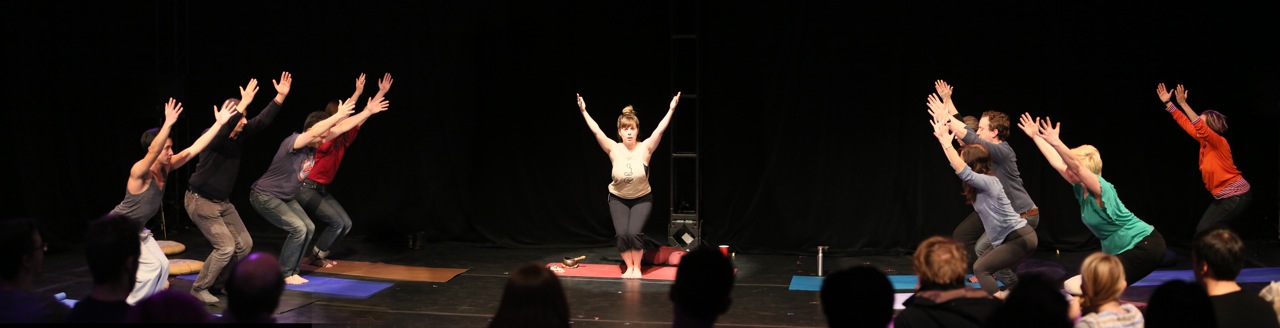
Emilia Symington Fedy, performer Photo: Tim Matheson

Emilia Symington Fedy, performer.  Photo: Tim Matheson

Have you ever gone in search of yourself only to become lost amidst a sea of self-help literature, West Coast mysticism, wheat grass, and yoga pants? Have you ever wished that you could have a guide in this quest for self, someone who’s tried everything, someone who can help you sift through the affirmations and the crystal healings and maybe, just maybe, answer your most burning, pressing question:

Is this all a bunch of navel gazing?

For a limited time this April, storyteller, theatre artist, and self-proclaimed advice expert Emelia Symington Fedy will be sharing her wisdom in The Chop Theatre’s Through the Gaze of a Navel, presented as part of Boca del Lupo’s Micro Performance Series. Part theatre performance, part yoga class, Through the Gaze of a Navel promises to irreverently but unflinchingly explore the fuzzy line between enlightenment and navel gazing, and ask audiences what it is they are really searching for.

Having watched Symington Fedy perform before and having read some of her writing on her website, Trying to Be Good, I was incredibly excited to hear a show like this existed. I was also incredibly excited that Emelia Symington Fedy agreed to answer some of my questions about the show:

You have been described as a “professional seeker”, who “has been obsessed with making [yourself] better since [you] were a kid”. What made you decide that now was the time to share your experiences? 

My co-artistic director Anita Rochon and I were talking one day about how incredible it actually was that I’ve spent so much time and money on “healing” and spiritual pursuits. We realized that I had over the course of 20 years become somewhat of a “professional” at it. Satire is usually a comedic style we like to play with, so considering Vancouver and the overabundance of spiritual practices here, we decided that my personal investment in the material along with living in lotusland made a perfect match and a show began to take shape…

I’m very interested in the shared territory between popular self-help and enlightenment practices and performance. As a theatre student, we did yoga and pilates, we meditated, we had ritualized ways of entering and leaving a performance. What parts of your self-help life have you found performative? What parts of your work as a theatre artist have you found therapeutic?

All of the practices I’ve tried are performative in some way. Searching for an answer is inherently dramatic and the rooms are lit well and the stakes are always high. As well, all of my artistic endeavours have been in some way therapeutic. I make art that I’m personally connected to and means a shit load to me. That’s what makes it good. That doesn’t mean I figure my emotional state out on stage. I’ve figured it out a long time beforehand and now I’m playing around with it; which makes it safe for an audience.

Judging by the almost outrageous amount of self-help literature available on the Internet and on bookstore shelves, and the number of classes, seminars, and gurus advertising paths to wellness, it’s obvious that “self-help” is a lucrative business. Ironically, its success as a business model relies on people not actually finding what they’re looking for. As someone who has explored several different self-help paths, what has been your experience with the “business” side of enlightenment? And why do you think people keep coming back?

I call it “Spiritual Capitalism” and it’s the really disappointing side to a meaningful path. People try to make money of our longing for God and what can I say, it sucks.

There is a part of me that wants to name and shame and blame the folks involved in turning someone’s vulnerable and authentic search into personal gain but then that makes me part of the problem too–so instead we make a play that points satirically at a few of the dark parts in the community. With a light hand we turn the mirror on the audience and laugh together at the struggle of never being satisfied. We are not mean spirited in any way, but I play a character who thinks she knows a lot about yoga and meditation and enlightenment, and really, who can say that they know a lot about that?

In terms of why people keep coming back…we want answers. Why are we here? What is my purpose? Will I get a book deal? And we are willing to pay anything for it.

In grade 8 I studied a pyramid chart called the “Hierarchy of Needs”. At the bottom of the pyramid were needs like food and shelter, and at the very top of the pyramid was a need called “self-actualization”, which could not be sought for until the needs below it were met. With this in mind, do you think the modern journey towards enlightenment is primarily a luxury of wealthier countries, or do you think the quest for inner fulfillment and enlightenment is universal?

You can’t gaze at your navel if you are hungry. Yes, on one hand our ability to focus on “self actualization” is a product of being very lucky and being born in the right country. On the other hand, some people say that humans rising into a higher state of consciousness is our only way to transform and save the earth from extinction. So, like most things, it’s probably not simply good or bad. Folks who have the privilege to study spiritual pursuits are both helping the planet through learning how to raise their awareness and also possibly wasting precious time when they could be digging a well. You know what I mean?

[Yes, I know what you mean, Emelia! Cripes, you’re pithy. And now for a couple of logistical questions…]

I understand Through the Gaze of a Navel will have limited seating. Do you have an additional limit on the number of people who can participate in your yoga class portions of the performance, or are all audience members able to join in?

Everyone is welcome to do yoga. There are seats for folks with mobility issues and anyone who is shy but I have a strong sense that you will be on the mat soon enough when you see that it’s fun and I’m not pointing anyone out. I HATE audience participation when I watch theatre, so I make my shows really friendly and easy to be involved in. The goal is you find yourself saying “I cannot believe I’m doing this, and it’s so. much. fun.” Also, it’s built as a beginner class so everyone can access the poses.

Is there anything the audience members wishing to do the yoga should bring (yoga mats, water bottles, etc.)?

Wear comfy pants.

Having gone swimming with cosmic dolphins and even tried vaginal weightlifting classes, Emelia Symington Fedy is more than qualified to guide you in your search for your centre (whether that centre is spiritual fulfillment or just your own belly button). Remember, spaces are limited so book your ticket early and WEAR COMFY PANTS.

Boca jpg stencilBoca 10 degree


Through the Gaze of a Navel will be performed at various times, April 23 – 27, at The Anderson Street Space (1405 Anderson St., Granville Island). Tickets are $10 and can be purchased online.

Notes: Boca del Lupo contacted me to inquire if I would be interested in writing about this show (and I definitely was). The decision to interview Emelia Symington Fedy, as well as to write this post, was mine. I would like to sincerely thank Emelia Symington Fedy for her time and her thoughtful, eloquent responses.

“AFTER” – Hilarious, Awkward, and Close to Home

AFTER-Poster-FinalThe premise of Martha Herrera-Lasso’s new play, After, is fairly simple: four young people navigate the murky waters of love and lust, all through conversations that take place after sex. While the premise may be simple, the emotional situations explored are anything but, rife with humour, heartbreak, and devastating shades of grey.

If you like sharp, fast-paced dialogue, nuanced performances with rapid-fire timing, and recognizing the awkwardness of your own life onstage, you will not want to miss dream of passion productions and Excavation Theatre‘s co-production of After, running at the Havana Theatre until April 5.

When it comes to intimacy and matters of the heart, once the moment of passion has ended few of us are secure enough with vulnerability to simply be. Instead, we protect ourselves: we make jokes, justify, feign nonchalance, contradict ourselves or lay blame. Many relationships are not what they seem, and the biggest fools are usually the ones with the front-row seats.  Herrera-Lasso’s intelligent, funny, and honest script requires performers who identify with their characters, even as they hurt others, hold tight to things they don’t want, hide from their partners and hide from themselves. Luckily for us, under the direction of Excavation Theatre’s Jessica Anne Nelson, the ensemble of four actors (dream of passion’s Stefania Indelicato, Al Miro, Jane Hancock, and Matthew McLellan) deliver tight performances that never miss a beat. Both perfectly natural and perfectly rehearsed, no gesture, line, or inflection is wasted as the performers feed off one another and carry the audience through an incredibly quick (but incredibly satisfying) 80 minutes.

What strikes me most about  After is the characters’ extreme lack of self-awareness, even as they are acutely self-conscious (whether due to insecurity, like the verbally incontinent Jackie, or narcissism, like the incorrigible James). Unhinged by their moments of vulnerability, these four young people fumble towards and away from one another, wanting both the satisfaction of intimacy and the safety of independence. After the Friday-night show, we overheard another audience member saying he had been all four of the characters at one time or another, and I think this is the play’s real strength. For my part, I certainly recognized myself in two or three of the characters (I won’t give myself away by saying which characters or why) and it is this familiarity and recognition that elevates a simple (rather comedic) premise into something much more impressive and special.

After plays at the Havana Theatre (1212 Commercial Drive) until Saturday, April 5. Tickets are $20 and can be purchased online at Brown Paper Tickets. Shows are at 8:00 p.m.

Disclosure: My TC and I attended Friday night’s performance courtesy of Excavation Theatre and dream of passion productions. My content is my own.

“Ghosts in Baghdad” and the Vulnerabilities of Heritage

Sarah May Redmond (Malika) and Alec Willows (Khalil). Photo: Tim Matheson

Sarah May Redmond (Malika) and Alec Willows (Khalil). Photo: Tim Matheson

What would you do to protect your life’s work? Your country’s heritage? When does an object stop being a “thing” and become a treasure worth risking your life for? How far will you go to protect the treasures you hold dear?

These are the questions posed by Ghosts in Baghdad, a new script by playwright and Working Spark Theatre founder Michelle Deines. Inspired by a New York Times article by Roger Cohen, Deines’ script centres around the complex decisions faced by Khalil and Malika, two fictional museum directors who continue their work in fear and isolation ten years after the 2003 American invasion and the looting, destruction, and subsequent closure to the public of the Iraq Museum. With thousands of ancient historical and cultural objects still missing and the Museum open only to government officials and foreign diplomats, Khalil walks the empty halls alone, dreaming of the day he can throw open the doors and share his country’s history with its people. Malika, meanwhile, hides away in her office, hunching over a piece of stone tablet she has been translating for over a decade, and while she tries to decide if her affection for country and colleague are enough to keep her in a city still so dangerous and full of sorrow. When a desperate young boy appears claiming to have found the missing Mask of Warka, his arrival threatens to unravel the delicate webs of secrecy and betrayal that have sustained what is left of the damaged Museum.

The Little Mountain Gallery, which houses this production, is a spartan venue that certainly has its difficulties (I’ve performed there myself so I know first hand). Working Spark has done an exceptional job of transforming this space, building a new and larger platform for the actors and bringing in more comfortable multi-level seating for the house. That said, the space has its challenges. The performance I attended was the Thursday-night preview and it was clear, both from director John Murphy’s comments before the show and the slightly tentative energy of the performers onstage, that there were still a couple of kinks to be worked out in the space. Without a conventional “backstage” in the Little Mountain, the transitions between scenes seemed to be a particular challenge for this particular performance. However, I trust these transitions are going more smoothly during the actual run of the play, and also recommend simply choosing the seats in front of the shallow thrust stage (rather on the left or right side) where the “offstage” movements of the actors won’t be as visible.

Still, the actors fill their roles with natural ease and without pretension (Gili Roskies’ performance as the youth Dawood is particularly arresting) and Deines and Murphy made important choices in the writing and direction that support this ease. The actors’ voices are without put-on accents and their dialogue is as casual and full of expression as any other English dialogue. These choices (i.e. the choices NOT to have the actors use accents or speak using phrases or expressions that are different from those we would use in everyday English) are tremendously important in that Working Spark has managed to set a play in Baghdad without casting the characters as “the Other”. Of course there are no special accents–Iraqi people are not “foreign” in their own country. Of course there are no unfamiliar expressions–the expressions used by native Arabic speakers would not sound unfamiliar to other Arabic speakers. The point is not to exoticize Baghdad or to pass any kind of judgement on its culture, before or after the American invasion. The point is that culture is important in itself.

What Ghosts in Baghdad shows us is the way in which society’s treatment of historical, natural, and cultural artifacts is a measure for the condition of its people. When looters storm a national museum and force its closure to the public, they steal not from an enemy force but from themselves. Only extreme circumstances would create that kind of selfishness in most people–circumstances whose immediacy renders centuries and millennia of artistry miniscule. You can’t eat a statue, or live in an ancient vase. An artifact in a display case can’t protect you from bullets and heritage can’t buy your ticket to a safer place. But if money could do these things–and you could find the right buyer–could anyone blame you? Sadly, these treasures once lost are usually lost forever, and a people whose history has been stolen and who are unable to take pride in their collective culture will find it that much more difficult to heal–but what can they do?

In Ghosts in Baghdad these questions are turned back on themselves, as those champions who have sworn to preserve their cultural artifacts struggle to protect them from the desperation of poverty and fear–and also from themselves.

Ghosts in Baghdad plays at the Little Mountain Gallery (Main at 26th Ave.) until Sunday, April 6 (no show Monday, March 31). Tickets can be purchased online through Brown Paper Tickets.

Disclosure: TC and I attended the Thursday-night preview courtesy of Working Spark Theatre. My content is my own.

Dancing Monkey Presents: “Someone Who’ll Watch Over Me”

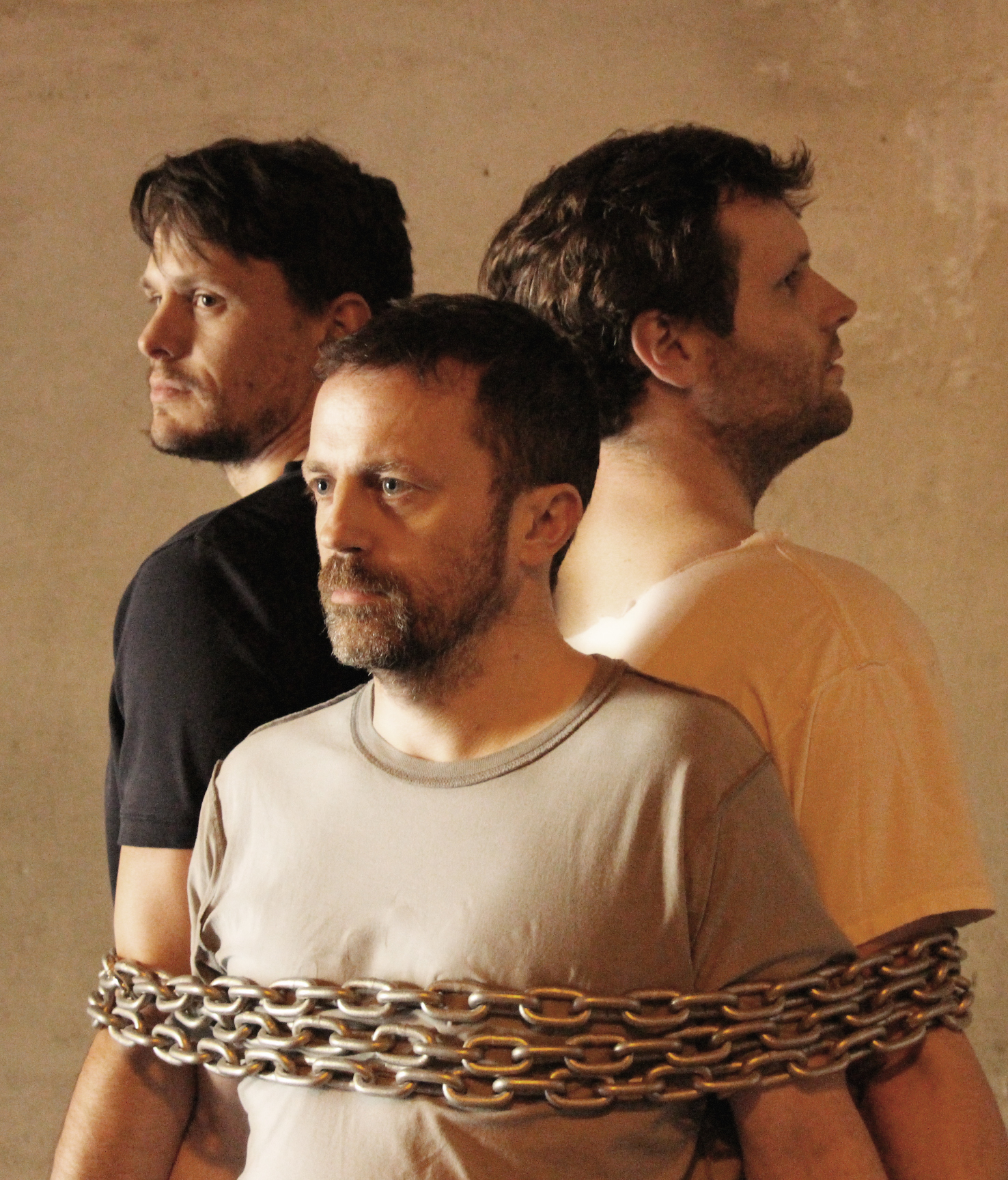
Stop me if you’ve heard this one: an Irishman, an Englishman, and an American are chained to a wall–

swwomlogoNo, this is not the set-up for some lame stereotypical joke, but the premise for Frank McGuinness’ searing play Someone Who’ll Watch Over Me, a story set not against the backdrop of the Lebanon Hostage Crisis, but chained deep within its dark belly. Under the direction of the luminous Julie McIsaac, the players of Dancing Monkey Presents wade neck deep into the waters of fear, despair, madness, and hope that threaten to overwhelm us when we are, quite literally, hostage to forces beyond our control.

Though the play runs over two hours (with a short intermission), McGuinness’ script is witty, biting, and fast-paced, taking its characters careening between the polemic and the playful, the religious and the ridiculous, between anger, insanity, honesty, and love. Though the Lebanon Hostage Crisis and its casualties are, of course, deeply rooted in the political realm, McGuinness’ story does not dwell on this, choosing to focus on the human beings beneath the hostages, in all their fear, self-righteousness, and unexpected kindnesses, rather than on condemning or excusing either the hostage-takers or the governments who may or may not have done all within their power to secure their citizens’ safe release.

McIsaac’s staging of Someone Who’ll Watch Over Me is simple yet effective. Three men are chained in a small bare room, lit by a single dangling bulb. We do not know what time of day it is, or where they are, and neither do they. Against such a sparse backdrop, the performances of Jay Clift (Adam), Ashley O’Connell (Edward), and Kirk Smith (Michael) truly shine as McGuiness’ script races them, and us, through an emotional labyrinth at break-neck speed. Each character is a pressure cooker, roiling with physical energy they cannot expend, anger they cannot unleash, and fear they cannot relieve. The script, which is actually quite funny at times, swings each man from tears to laughter and back again, relentless and unflinching.  The skill that lies beneath the delicately controlled performances delivered by Clift, O’Connell, and Smith is not to be understated.

Though 1980s Lebanon is worlds away for most of us, McGuiness and his characters strip away the layers of distance and time that separate us, the comfortable audience, from them, the men waiting to find out if they will live or die, if will they ever see their families again, or if anyone even knows what has happened to them. In the isolation of a cell, with the possibility of madness an ever-present companion, three men encounter the same fears that gnaw at most of us–that it does not matter where we are from, how educated we are, whether we are good or bad people. Things will happen to us that we do not understand and cannot control. We will not know why. We will not know if there is even a why. What we will know is what our reality is, in the here and now. We will know what the darkness is and we will have to decide how to live with it, no matter how short or long our captivity. In the darkness there is loneliness and helplessness but also humanity.

If I were to have a complaint about the evening it would be that the intimate seating still contained several empty chairs and Someone Who’ll Watch Over Me deserves to play to packed houses. With a ticket price of $16 (affordability being part of Dancing Monkey Presents’ mandate) a script this good, and performances this strong, there is really no excuse not to see it if you can.

Someone Who’ll Watch Over Me plays at Renegade Studios (125 E. 2nd Ave., Vancouver) for one more week, March 18 – 23, at 8:00 p.m. each night. Tickets can be purchased online or at the door (though the house is small so booking early is advised). NB: The vents are turned off during the performance and the space does get a little cold during that time so dress appropriately!

Clockwise from top left: Jay Clift, Kirk Smith, Ashley O'Connell

Clockwise from top left: Jay Clift, Kirk Smith, Ashley O’Connell

Disclosure: My guest and I were provided tickets courtesy of Dancing Monkey Presents. My content is my own.