OMG, I <3 LOTR!!!

The-Lord-of-the-Rings-Trilogy-posterThis post is late in coming, and the reason for this is that I have spent the majority of the past week watching the film series of J.R.R. Tolkien’s The Lord of the Rings (and related material) instead of doing anything else.

It went something like this: TC and I watched The Hobbit: An Unexpected Journey on DVR before I went home to Saskatchewan for the holidays (actually, we watched it once when I was really hungover, and then I wanted to watch it again when I didn’t have a headache, so we did, and then I wanted to watch the dwarves singing again, so we did, and then we just kept it playing on a loop while we cleaned our apartment, so we basically watched The Hobbit: An Unexpected Journey for about a week, on and off). When I got home for the holidays, my little sister mentioned she had just seen The Hobbit: The Desolation of Smaug in theatres. This in turn inspired her to decide to watch the entire Lord of the Rings film trilogy (the regular-length one, that we had bought for my dad years ago) over the rest of our holiday, and I was only too happy to join her.

My sister popped The Fellowship of the Ring into the VCR (yes, that one was on VHS) last Thursday and I watched half of it before I managed to peel myself away to go “ice fishing” with my friends (“ice fishing”, as it applied to us, meant bundling up and sitting in lawn chairs on the ice and just shooting the shit while other people fished; alcohol was also involved). When I got home to my parents’ place that evening my sister and my dad and I watched The Two Towers and then The Return of the King two days later (which I only half-watched because I was also playing a game of Settlers of Catan at the same time).

When I got back to Vancouver on Sunday night TC was jealous of all of my LOTR watching and then he wanted to watch the trilogy but I said no, because I’m busy (and I actually am, I swear). When our New Year’s Eve plans fell through on Tuesday we booked seats at the Scotiabank Theatre to see The Hobbit: The Desolation of Smaug in 3D UltraAVX with Dolby Atmos surround sound and popcorn and Skittles.

And then when we got home that night TC put on his extended version of The Fellowship of the Ring (2 DVDs! No wonder I fell asleep!) and we rang in the New Year somewhere around the time that Bilbo was thanking people for coming to his birthday party.

And we have been watching the extended version’s extensive bonus features ever since. And they’re great.

We’ve also been looking up the lore on Wikipedia because I had a few questions the movies weren’t answering for me, including:

  • What is Sauron? Like, what kind of being? (He’s the same kind of magical being as Gandalf and Saruman, just very powerful and fairly evil and in the three LOTR books, as far as I can gather, he does not have an actual body).
  • What is the Land of the Undying where all the elves go? When Bilbo and Frodo go there at the end of Return of the King, are they actually dying? Is the Blessed Realm the same thing as “heaven”? (No. It is not the “heaven” that humans and hobbits might go to when they die. Gandalf and the elves who sail there will not die and will stay there forever, but the hobbits are only there temporarily for restorative purposes and will someday die).
  • Why is Sauron such a jerk? What’s his deal? Why does he want to control everything and make it all shitty and grey and on fire? (In the beginning, Sauron wasn’t a bad ol’ magical being, but he really liked order and really liked getting things done quickly. This meant he wanted to do things his way. Eventually, having the ability to do whatever he wanted they way he wanted, i.e. the ability to exercise his will, became an end in itself. Which makes people/magic beings pretty damn awful).
  • What the hell are orcs and where do they come from? Do they actually BREED? If so, where are the lady orcs? (I still don’t know the answer to this one so tell me if you know).

The funny thing is, if you asked me to make a list of things I love, or even things I really really like (the kind of things I could imagine myself devoting a week’s worth of free time to), I would never dream of putting The Lord of the Rings on that list. I’ve never even read the books (I tried, in my youth, but Tom Bombadil sang his song for PAGES and that was enough for me). I’ve read The Hobbit and from what I recall I liked it. It was a fairly straightforward tale of adventure (which means it definitely didn’t need three whole films devoted to it, greedy money-grubbing Hollywood execs and rabid Tolkien devotees notwithstanding) but I didn’t like it as much as other childhood stories. I honestly never thought I was that into Tolkien having read more fanciful pieces like Roverandom as well and thinking, “M’h”.

But there’s something different about the world of LOTR that makes it so much more than a work of fantasy. The history of Middle Earth (and surrounding vicinity) is so detailed and so complex, with languages having different dialects as well as changing with time the way real languages do, so much so that even characters like Sauron, who in the entire LOTR is called no other proper name but Sauron, as far as I can gather, has had five or six other names in the history of “creation” in this universe. The epic LOTR, with The Hobbit included, is just a tiny fraction of the history of Tolkien’s world, just as the entire 20th century is just a tiny fraction of the history of our own. It boggles the mind. It makes me feel like Tolkien didn’t invent this lore, he recorded it. As if Middle Earth already existed somewhere and Tolkien’s the scholar and explorer who discovered it and as he explored more of the kingdoms and became more familiar with its legends he recorded them and passed them on to us. In order to create what he did, Tolkien was clearly a genius, and was clearly involved in this world of his own making. Which is probably why it’s so involving.

And then Peter Jackson made some movies, and the elf cities are so beautiful, and Merry and Pippin and the adorable Gollum/Smeagol are my favourite characters (I don’t even like Frodo, what a drag). And the music is so dramatic, and the battles are so exciting, and the rest is history. The History of Lauren, in her Pajamas, Watching Her TV, that is. An epic tale of addiction and occasional self-loathing. Or maybe the power of the One Ring has got me too, and I’m just consumed by it, and in a hundred years I’ll be grey-skinned and big-eyed and singing adorable songs about eating raw fish, “so juicy sweeeet!”

Which would maybe be worth it?
It’s Fun to Believe in Santa Claus

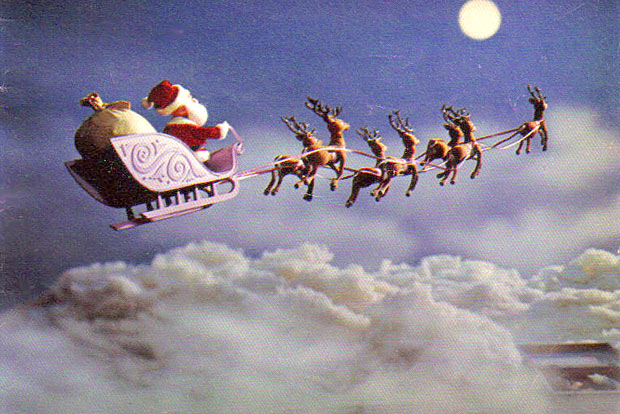
Rudolph the Red Nosed Reindeer sleigh flying through night

As I type this it is Christmas Eve and I am in Saskatchewan with my family. A thick blanket of snow surrounds the house and the temperature outside is -4 degrees Celsius (“So warm!” my mom says). The tree is lit up, that cats are confused, and the rest of my family is playing Settlers of Catan. A peaceful Christmas scene.

Beneath this peaceful façade runs a current of excitement that has been known to me since childhood. As per family tradition, most of the presents were opened on Christmas Eve, but even in a household of adult children, we know that tomorrow morning means full stockings. And full stockings mean Santa Claus.

Perhaps the tone with which we “thank Santa” for our presents is a little more laughing now and a little less earnest, but Christmas Day still involves some surprises that weren’t there the night before and it’s still fun.

I know some parents don’t “do” Santa Claus with their children because they don’t wish to lie to them. Which is their right, I guess, especially when “doing” Santa Claus means trying to explain why Santa gives better presents to rich children than to poor ones. Or trying to explain how Santa is going to get into the house if there’s no fireplace. Or trying to explain why your kid’s new toy says “Made in China” on the bottom even though Santa’s Workshop is in the North Pole. Etc.

In spite of this, I believe in the idea of Santa Claus, of infusing the dead of winter with a bit of magic and whimsy. I believe children have this right to Santa’s gifts by virtue of their being children. Being a kid is tough–their lives are so often bound by adult rules and restraints they neither caused nor understand.  Despite the books and stories and interesting play spaces that surrounded me growing up, being a kid meant that my imagination was curtailed by adults all the time. No, sticking a bunch of feathers to your clothes won’t make you fly; please don’t jump off anything. No, no one else in your grade one class wishes to hear you sing during Math; please sit quietly. No, there’s no treasure buried in our yard; please don’t dig holes in the lawn. Obviously the adults in my life had to keep me safe, but it was still kind of a downer.

Happily, when it came to Santa Claus my imagination was given free rein. When I discussed my different theories regarding how Santa was going to get in the house (we had a chimney but it led straight to a hot furnace in the basement, which was not ideal), or how he was going to find us at my Grandpa Fred’s that year, no adult dared to contradict me. They may not have believed themselves, but they believed there was something worth preserving in my belief. And that was good enough.

Complaints about rampant consumerism aside (especially if kids have an unrealistic expectation of receiving “things”), why shouldn’t a magic old elf want to bring joy to children once a year? If I was a magical elf I would.

Unfortunately, I am not a magical elf, but I do hope someday to be a parent. And when TC and I are parents I hope that Santa Claus will visit our home and bring to our children the same spirit of wonder and excitement that Santa brought me when I was small. Santa Claus still symbolizes generosity, and the right of children to believe in something good, if they want to. I guess the difference between my own childhood and now is that I now understand the extent to which my participation as a parent will be required. I don’t mind. It will only be for a few years, and when those years are over perhaps I will be wishing that I could still believe in the magic, and not just the symbol.

In any case, have a very Merry Christmas, however you celebrate. xoxo

I need to stop looking at things on the internet

Internet wallpaper from fecoo.com

Internet wallpaper from fecoo.com

This is probably a hypocritical statement for a blogger, but it’s true: I need to stop looking at things posted on the internet.

If you, like me, have a smartphone and/or a Twitter account and/or a Facebook account, you have probably become aware that you are spending too much time reading or viewing things on a screen and less time doing…anything else. You have probably also become aware that most of what you read/view is neither productive nor enlightening and may in fact be making you stupider (this is speculation, as I am not a psychologist I really can’t definitively determine whether or not anyone is becoming “stupider”).

I have a lot of reasons for feeling this way (and the more I think about it the more reasons I come up with), but generally speaking it comes down to this:

  1. I believe too many things I read/see on the internet, even though anybody with a computer and a high-speed connection can post an article or video on the internet. I mean, I’m doing it right now, and I’m not an expert in anything.
  2. At the same time, because it’s on the internet, I am cynical and skeptical of everything I read/see (especially if it makes me uncomfortable, would require action on my part, or is something I don’t agree with). It doesn’t help, of course, when there is little to no fact-checking or framing of what friends/Twitter peeps post and share. An eye-catching headline about corruption in the TEDx Talks organization, for example, will reel me in, and then halfway through the article the writer will start claiming that vaccines cause autism (they don’t!) and I will realize that instead of cruising the Information Highway for the last ten minutes I’ve actually been riding the New Age Paranoia Crazy Train the whole time.
  3. I have caught myself experiencing FOMO (Fear Of Missing Out) if I am behind on reading/viewing the latest internet meme. As if there’s going to be a quiz on this crap later. Or as if any of my real-life friends and colleagues would think less of me if I hadn’t listened to the digitally-altered audio recording of the crickets that sound like creepy angels (except I have, of course).
  4. I have increasingly caught myself reading comments sections (!), which just leaves me feeling sad and angry that so many people, even in Canada, are so racist, misogynistic, homophobic, inconsiderate (of their fellow humans and their environment), uninformed, and greedy. And annoyed and mystified that so many people, even after at least 12 years of school, are unable to spell or use anything resembling proper grammar.
  5. The vast majority of the posts I encounter are meaningless and their sole purpose is the wasting of time (I’m looking at you, random Buzzfeed lists). This means that something very significant and very detrimental happens: boredom is no longer inspiring. Internet memes/posts/videos, etc. are so easy to access and so facile that I simply maintain my current level of boredom instead of actually becoming bored enough that I want to do something active or creative.

I think the loss of traditional boredom is what troubles me the most because, unlike my other concerns, it can’t be mitigated with critical thinking. Time-wasting posts and memes aren’t deep, and they generally don’t require any critical thinking at all. Or any thinking. Which means I’m just…breathing…in front of a screen…and moving my fingers to click or scroll sometimes. It’s kind of a disgusting state to be in. If I’m that bored, why can’t I read a book or play an instrument or maybe WRITE something for goodness sakes? Why can’t I use my boredom as an impetus for creation or action or even just exposure to good literature or good art?

I’m lazy, and I know this. I love to procrastinate and I tend to avoid doing the creative things I love for fear I’ll start a project and realize it’s not any good (this is why I blog, to keep myself writing even when I don’t feel very talented). The thing is, in the past, extreme boredom would at least lead to notes and scribbles and BEGINNINGS of something creative. Now I just have a data plan and very little to show for it. How sad.

It is for this reason that I am going to try, for the entirety of my Yuletide holiday, to not read a single article or click on a single meme on the internet (I will still be on Facebook because I’m not some kind of holy wizard, but I won’t click away to anything posted). This means no reading blog posts in the airport, or watching Upworthy videos in bed (they seem to be primarily slam poetry anyways, which is not my thing so I really don’t know why I watch them). This means no getting all huffy and incensed over the latest political outrage in Canada or Australia or the U.S. or the Middle East or England or Russia (there is more than enough to get huffy about in my Maclean’s, which I still read on paper). This means no being worried that the fall-out from Fukushima is going to kill us all, or that every single product I put in or on my body is giving me cancer. This means no reading up on this or that misogynistic pop artist, this or that quack celebrity doctor, or this or that train wreck of a film/music video/appearance on Saturday Night Live. I need a break from all of this self-inflicted noise.

I need some quiet. For my brain. We’ll see how it goes.

[P.S. I am aware that I may be contributing to the noise by blogging, but at least my goal here is the sharing of my opinions, ideas, and experiences, and the improvement of my writing, rather than going viral and making a million dollars or some such nonsense.]

Home Ethi-nomics: Sometimes I Think I Should be Vegan

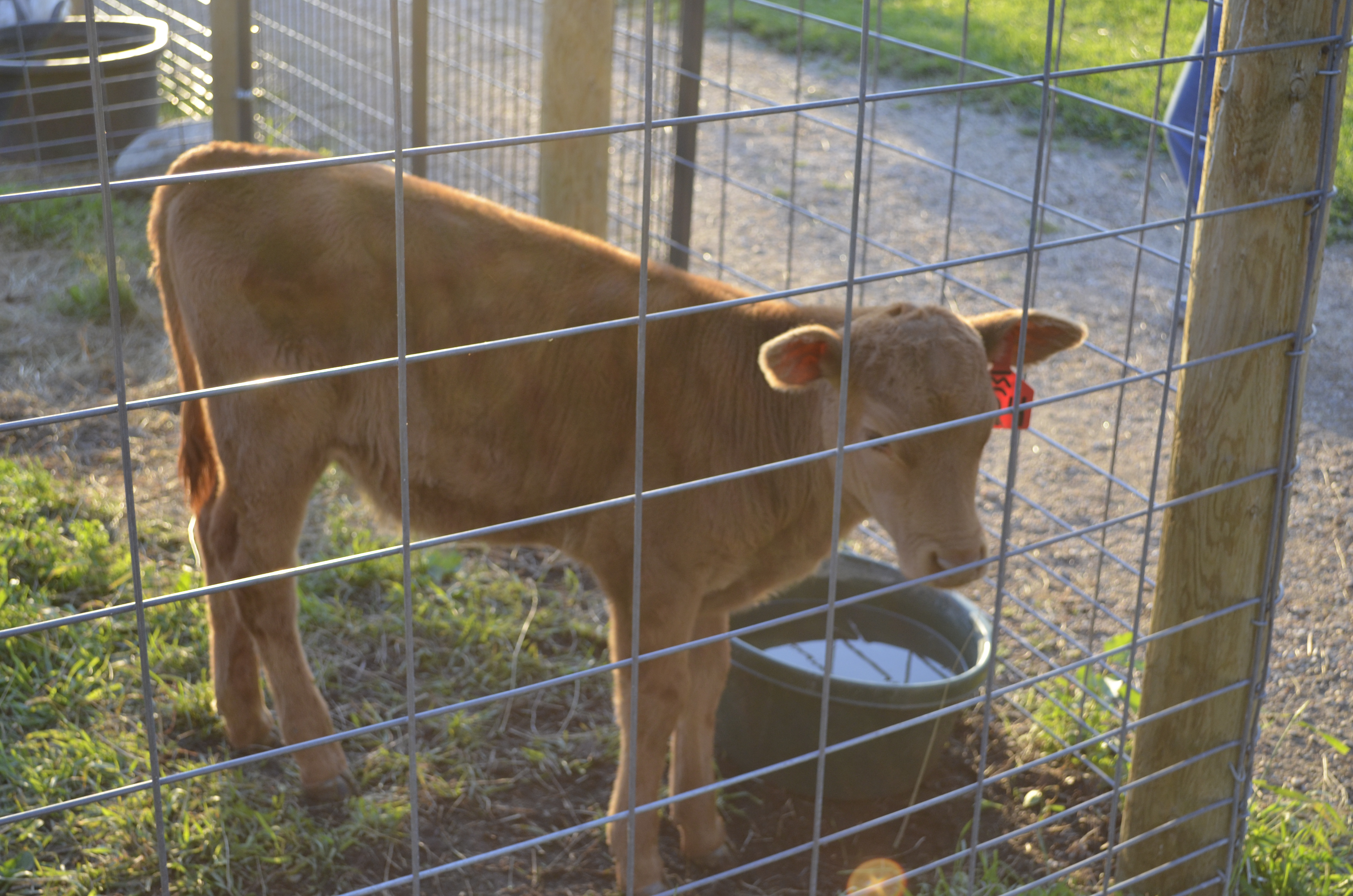
Calf

[Note: I probably won’t be vegan, but hear me out anyways.]

Over the past few months I have been surprised to find myself examining some of the domestic life choices I have assumed will never change, and really asking myself if a change is possible, or desired. I didn’t intend to engage in this self-reflection, it just sort of happened, but now that it has I’m not sure what to make of it.

The other day I said to my TC “I think maybe I’m supposed to be vegan” and he said “Huh” because I love eating meat (though we generally only eat it once or twice a week, definitely more than fulfilling that “Meatless Monday” thing already). To clarify, I am not talking about becoming vegan to be healthy, I am talking about veganism as an ethical choice. The reason I was thinking about this was an article I read on The Vegan Woman blog, misleadingly titled 10 Reasons You Should NOT Go Vegan (which basically just makes fun of the reasons people give not to be vegan–I actually clicked on the link when I saw it on Facebook because I was feeling bombarded by anti-meat and dairy posts from vegan friends lately and I wanted to feel good about myself, which I suspect is why the article is titled the way it is, to catch us meat-apologists off guard).

The premise of the post is that there aren’t really any good reasons not to go vegan. The writer lists ten common excuses meat-eaters use to explain to their vegan friends why they don’t want to be vegan, and debunks them. A lot of these excuses and subsequent debunkings don’t apply to me because I’m not an idiot (I have never told anyone that “plants feel pain too” or that a cow would explode if I didn’t drink milk), so I ignored those parts. Excuse #7, “If God didn’t want us to eat animals, he wouldn’t have made them taste so good,” is a very silly excuse but I do take issue with the blogger countering this excuse by quoting “Thou shalt not kill” and suggesting that this maxim applies to animals too. Ethically, you could argue that it does, but in terms of what the Bible says, sorry honey. If I recall my grade 10 Christian Ethics class correctly, according to the Bible, a heavenly voice came to the apostle Peter in a vision, showed him a variety of animals (including pigs, which Christians were not yet eating) and told him it was a-okay to eat them:

He saw heaven opened and something like a large sheet being let down to earth by its four corners. 12It contained all kinds of four-footed animals, as well as reptiles and birds. 13Then a voice told him, “Get up, Peter. Kill and eat.”

Again, I’m not saying these were necessarily ethical instructions, but if you’re going to quote the Bible at non-vegans you should probably know your stuff. (By the by, I’m not Christian but Christian Ethics was a required course at the English school I attended in grade 10 and I got an A+ so there).

Specifically Christian ethics aside, I have been considering the ethical factors at play in whether or not to eat animals and animal products and the final plea of this pro-vegan blog post was really the clincher for me:

Please, if you have an inkling that animals shouldn’t be killed just for your palate, don’t use habit or your upbringing to brush the thought aside, stand up and be part of the generation that heralds the change.

Oh boy. You got me there, vegan blogger. Though I love eating meat and think it’s great, I’m not always 100% sure that I should be supporting the meat industry. So why do I?

My reasons are generally ones I’m not proud of: laziness, my particular taste, cheapness. If these were my only reasons then continuing to eat meat would not be morally justifiable. But I do it anyways, and I don’t just think it’s because I’m an asshole, is it?

In order to answer this question I have to ask myself what I believe about animals and the rights of animals vs. the rights of humans. Philosophically, this area is incredibly interesting but incredibly uncomfortable. If it is morally wrong to kill or keep animals for the purposes of food production on the grounds that animals feel pain, the line between humans and animals becomes very blurry. And I believe in the line, even though I can’t quite define it. Isn’t there a difference between humans and animals? Isn’t there a difference between their pain and ours? I think most of us would agree it’s morally reprehensible to, for example, treat an animal better than we would a human being, but why? If there is a difference, what is it?

And if there isn’t a difference between the rights of humans and the rights of animals, wouldn’t it logically follow that keeping pets would not be vegan either, ethically speaking? Since a pet owner takes something from an animal (their companionship) and often keeps them in confined spaces without their consent (ever heard of “crate training” a dog?), controlling their ability to perform to basic bodily activities like feeding and going to the bathroom, would pet ownership not be a direct exploitation of an animal? And what about making the decision to “put down” a pet who may or may not be at the end of its natural life, without its consent? I have met one or two vegans who refuse to keep pets for these reasons, but there are many many vegans who do keep pets and who, presumably, do not see this as ethically problematic (and power to them, I think responsible pet ownership is great though I’m not so on board with crating dogs).

Which says to me that people’s relationships to animals must be located on a spectrum, rather than being an either/or issue. On one end of the spectrum we have vegans who refuse even to keep pets. On the other we have people who kill, torture, or otherwise cause unnecessary pain to animals for fun or profit, believing it to be their right as a superior species and/or as the “owner” or “caretaker” of the animal. My challenge, it seems, is to situate myself on this spectrum in a way that I can feel morally comfortable with. What do I accept? Penning animals? Breeding animals? Killing animals?

Though this may be morally repugnant to some, I have to accept that I am obviously okay with animals being killed in certain situations. No matter how blurry the line might be, I do believe there is a difference between human beings and animals (which is why I am annoyed when, say, people give more love to their pets than their children, or spend exorbitant amounts of money adopting stray dogs in third world countries instead of using what is clearly surplus cash on something that would benefit the human children in those countries). Society clearly believes in a difference (which is why dogs that attack human infants are put down, rather than being allowed to eat the baby as a reward for being the stronger predator in this particular food chain). I guess, as a human, I have a bias towards other humans. And I think that’s okay, within reason.

My upbringing probably has a lot to do with it. Not only was I raised eating meat, I was also raised within walking distance of several farms. Until I was in grade school I drank whole milk from the farm down the road, and I have been present for the butchering of chickens on more than one occasion. We ate eggs from our own hens (who got to scratch around and roost and lay however they liked). My parents have, for the most part, purchased their beef and bison meat directly from neighbouring farms all my life. I didn’t come up with some sugary vision of happy cows wandering around in grassy fields because the meat industry told me this was so, this is my concept of meat because I actually saw it for myself. I don’t really have a problem with it. I don’t think it was wrong.

It’s worth noting that many cultures we respect and acknowledge as having a special relationship with animals and the environment (First Nations cultures in Canada, for example) still kill and eat them. I don’t think of these practices as unethical as long as they are not wasteful and do not cause unnecessary suffering. The problem for me is not that animals die so that I can eat meat, the problem for me is actually that I don’t live in rural Saskatchewan anymore. I don’t know who’s raising my meat now and I don’t know how these food animals are treated. Probably not well.

So since I’m not going to be raising and butchering animals with my own two hands anytime soon, and since I do have an inkling that consuming the products of industrialized meat and dairy farming supports a system that isn’t okay, what do I do? Do I give up meat and cheese and eggs (which I’ve already said is unlikely)? Do I just hold on and hope I will one day move back to a rural area where I can have a closer relationship with food animals? Do I drive all over the city looking for ethical meat and spend the big bucks on it? (If anyone has suggestions for good butchers/meat suppliers in East Van/Vancouver that only sell “ethical” meat, please pass them along, leave a comment, etc. because this is an option I do want to look into).

I really don’t know what I’ll choose to do. I might do nothing, which is sometimes the result of my ethical dilemmas. I might do a lot. I might do a little. Either way, it is likely that I won’t blog about it again, because even taking ethics into consideration I believe that eating is personal. I might blog about the struggle, as I have here, but I don’t want to talk about the actual food. I’m the one who will have to be morally accountable for the food choices I make. I just want to try to make choices I can live with.

“Corporations in our Heads”: the human event of the season

Artistic Director David Diamond. Photo credit: Tim Matheson

Artistic Director David Diamond. Photo credit: Tim Matheson

Technically, Theatre for Living (formerly Headlines Theatre) is a “theatre” company and therefore ostensibly makes “art”, but if you are lucky enough to attend one of their four remaining showings of Corporations in our Heads, you will see what I mean when I say it is a primarily “human” event, rather than a traditionally “artistic” one.

What I mean is that the “art” of it (virtuosity, technical wizardry, etc.) is not the point–we are. The event doesn’t happen without the audience because there aren’t any actors, and there isn’t any script. What the show does have is artistic and managing director David Diamond, who facilitates and bookends the various moments in the event as the audience creates it through their reactions and their questions and their stories. (The theatrical techniques used to make this happen are explained very thoroughly on the Corporations in our Heads website and it’s important to know that although participation by the audience is absolutely essential to the event and the evening is the richer for it, absolutely NO ONE will be forced to participate if they don’t want to).

So Corporations in our Head is a human event. And it’s a great one. Because every night will be different, I can really only describe what it’s like by explaining what happened to me, and what I took away from the experience.

The show (which is just finishing a tour through communities in Alberta and BC), is based on the premise that the corporations that produce and control the food we eat, the drugs we take, the clothes we wear, the phones we buy, etc.  have expanded out of the realm occupied by the products they sell and have taken up residence in our heads. As a starting point, the show identifies and explores the ways that, consciously or not, our decisions are affected (often unhealthily) by the corporate messages in our heads. As the show begins to unpack the messages recognized and shared by the audience (they always come from the audience, not the show facilitators) it is startling to see how easy it is to identify certain brands based on the corporate messages being shared, and the ways in which we, as human beings in a western society, relate to these messages and brands as we would relate to a real person who had a real relationship with us (examples uncovered last night include the “Lululemon best friend” who wants you to have the same sexy yoga-tastic booty-short fun she is having, or the “No Name Brand grandma” who can’t understand why you would spend more money on something of higher quality when you can just buy larger quantities of a poor quality product).

I have a feeling that the experience I had is going to continue to unfold and reveal and provide insights and eureka moments in the days and weeks to come, but at this time the idea that really struck a chord with me is the idea that we relate to corporations and corporate messages the way we relate to real people. As an example, many people in attendance last night, David Diamond and myself included, cited their deeply loyal relationship to Apple products, despite knowing what they know about labour conditions in the factories that make the products, and about what their relationship to technology is doing to their own lives (I have similar feelings of loyalty to products like Gmail and Microsoft Word, and WordPress, the platform that hosts my blog).

But relationships with corporations go beyond loyalty to a brand we like. Even those corporations and brands we don’t like have relationships with us, whether we want these relationships or not. At a moment during the show, I decided to “intervene” in a scene between an audience member playing herself in a grocery store, and another audience member playing a “Dove soap therapist”, a slippery character who refused to identify their true message and position and instead kept trying to convince the poor girl to trust that the corporation knew better. After I took the place of the girl in the grocery store, I quickly became frustrated and realized that for me, this slippery corporation was not Dove soap, it was Enbridge and the federal government, refusing to acknowledge the significant damage their pipeline will cause and instead insisting that they know better what I, as a Canadian, need and want. After Diamond told us we couldn’t speak anymore but instead had to move in slow motion, the scene became one in which I (in slow motion) began kicking and punching the corporate message as it continued to move calmly around me, holding and caressing and glomming onto my leg or my fist or my shoulder but not responding to the passion or clarity of my actions in kind.

It was embarrassing and frustrating and all too familiar. Because this is what frustrates me about the way the government and Enbridge are operating: they can’t say that a spill won’t happen, because that isn’t true, but they refuse to say, “Yes, a spill will happen, and we acknowledge the devastation this will cause, and we simply don’t care.” Instead they plan to commit extreme acts of violence against communities and ecosystems while refusing to acknowledge that this violence is occurring.

After I sat back down I suddenly realized that I also have had this kind of relationship with ex-partners, people with whom I was engaged in a toxic relationship of some kind, and who refused to acknowledge that their actions were hurtful or inappropriate and instead left me railing against the air, powerless and hurt and humiliated. This realization was a punch in the gut. Do corporations really treat me the way bad boyfriends did? I never consented to a relationship with the Harper government or Enbridge, what gives them the right? And how can I fight something that refuses to acknowledge that there is a conflict?

Based on facial expressions, gasps of recognition, and comments from people around me, I don’t think I was the only one having these uncomfortable realizations throughout the night. It was very profound to watch a middle-aged man in a sports t-shirt drop his head into his hands because he saw something in this dialogue that resonated with him. Or to watch audience member MLA Spencer Chandra Herbert, a man with extensive experience dealing with uncooperative politicians and situations in conflict, becoming flustered at his inability to turn off the unwanted bubbly messages of the Lululemon best friend (fun fact: Chandra Herbert studied in the same theatre program I did in my undergrad, though he graduated before I enrolled and I did not know him).

Throughout the evening, Diamond shared anecdotes from his experiences touring the show in other communities, anecdotes which informed the conversation we were having. Like the community where Lululemon products are only available at Christmas, increasing their cache as a desirable gift. Or the community where a mining company insists the town has to approve the mine it wants to operate, or the town will never be able to “compete” (with what? with whom? in what league, the Tournament of Towns?).

What I like about Theatre for Living is that their work doesn’t simply point a finger at the problem and leave us to feel shitty about it. That said, their work also doesn’t provide unrealistic, overly simplistic, or “one-size-fits-all” solutions to the problems being examined. Potential solutions are suggested or enacted by audience members, with varying degrees of success, the point being that we can begin to think about our relationships to these problems differently, not that we will necessarily happen upon solutions during the show. This is an attitude I admired during Theatre for Living’s previous show, maladjusted, which examined the mental healthcare system, and an attitude I appreciate even more when watching a show about an issue more intimately and insidiously familiar to me.

Corporate messages affecting our decision-making is a problem that can’t easily be solved by enacting a piece of legislation or by installing ad-blocking software. Diamond makes it clear that, “The impulse for Corporations in our Heads is not one that assumes we can end corporate messaging. [Corporations] are going to communicate with us…We cannot just turn it all off. We can, however, change our relationship to the messaging.”

What does changing this relationship means to you? You’ll have to discover this for yourself, though if you can make it to an evening of Corporations in our Heads I believe you will be in a good place to start figuring it out. This show will not do it for youwe are the ones who are in relationships with the corporations in our heads. Us. And we are the only ones who can change it.

Corporations in our Heads has only four nights remaining in its run:

  • Thursday, December 5 – Gallery Gachet, 88 E. Cordova St.
  • Friday, December 6 – Vancouver Aboriginal Friendship Centre (VAFCS), 1607 E. Hastings St.
  • Saturday, December 7 – SFU Harbour Centre, Terasen Cinema, 515 W. Hastings St.
  • Sunday, December 8 – Café Deux Soleils, 2096 Commercial Drive

All shows begin at 7:00 p.m. Please call 604-871-0508 for information or to reserve a seat.

If you want to read more about Corporations in our Heads, you may want to check out Theatre for Living’s website or this article on rabble.ca.

Artwork design: Daphne Blanco

Barcode butterfly: Daphne Blanco

Disclosure: I was invited to review Corporations in our Heads by Theatre for Living and provided two seats for the show. I was compelled to participate in one of the scenes by my recognition that something in the relationships I was seeing disturbed me (I was not personally asked to participate), and I think this was an enriching part of my overall experience. The content of this review is, as always, my own, and I give it gladly. I really, really, want people to participate in this important conversation.

NiftyNotCool Celebrates Three Years

389-3rd-birthday-cake2Being committed to something for one year is a feat. Continuing to commit for a second year is a doubling of that feat. But when you’ve been keeping on for three years you’re kinda just…keeping on. And once you reach this milestone which isn’t a milestone (given that three-year anniversaries of anything are largely unrecognized), you may wish to take stock of what continuing this commitment has meant to you, and what it may mean going forward.

I am doing this now.

In preparation for writing this “three-year bloggerversary” post, I decided to look back at my very first post, published on this site on November 29, 2010. It is called, rather embarrassingly, NiftyNotCool: A Whine and Cheese Introduction (I assume because it’s whiny and cheesy?), and I read it in the hopes of discovering what had changed for the blog between then and now. I expected to laugh at the silliness of me, the way I do at my diaries from junior high or the letter I wrote at 12 to myself at 16.

Instead, I realized with a shock of disappointment that I had lied. Or rather clumsily skirted around the truth with regards to my reasons for starting a blog:

I have recently had to pull myself out of a pit of gloom and crankypants behaviour.

Ah yes. The “pit of gloom and crankypants behaviour.” In other words, I had a broken heart (I was not willing to admit this on the blog at the time because I wanted, and still want, a blog that is not about my love life). Even prior to the breaking of my heart, I was completely and utterly intellectually bored in a way I have never been bored before, and consequently angry most of the time (this was the crankypants behaviour part; the gloom was the sadness that rode on my shoulders for months and months).

In the inevitable period of self-reflection that has followed, I have realized three things. Thing One, I need something to occupy my mind, and make use of the brains that have been growing lazier and lazier since I finished my undergrad.

This part is true. My world had gotten a lot smaller since completing my BFA, and, as I said, I was bored.

Thing Two, spending the day in my pajamas and refusing to leave my bed because the world makes me sad is not helpful to anyone, and the only way my whining could be construed as slightly beneficial to the world is if it is presented in a structured and (hopefully) well-thought-out manner.

This part is also true. As much as I definitely possess a left-leaning bias, and as much as I don’t have the time to research all of the issues I write about as much as I’d like, I have generally tried to be thoughtful in expressing my opinions. I’m not sure if my “whining” is beneficial to civilization at large but since I am blogging about the things that upset me instead of leaving vitriolic comments all over the internet like other angry bored people I believe it has been, at the very least, less harmful than the alternatives.

To address Thing One and Thing Two, I decided that I might like to take a crack at blogging.

This is a total lie. I’d been thinking about starting a blog long before my heart broke and I fell into a pit of gloom, though funnily enough, I had never imagined blogging under my real name until it happened. I guess at that point I felt I had very little to lose and wanted to put myself out in the world and prove that I could be impressive, at least a little bit. At the time, writing the blog and being active on Twitter went hand in hand so I used tweet-ups and blogger meet-ups as excuses to get off my couch and stop re-watching Pride and Prejudice. Even though I am no longer active in this “scene” (I don’t think I’m the kind of person who should have a “scene” anyhow), I am grateful for the distraction and occasional genuine good times Twitter provided. But I digress:

For a 24-year-old I am ridiculously technologically inept, and if I don’t hop on a computer now and use it to do more then check my e-mail and watch the Rick Mercer Report, I might never know how to use one again.

Again, this is untrue. I am not technologically inept. I like technology and use it all the time at work and am generally good with it. Rather than being technologically inept, what I really am is skeptical, especially when it comes to social media. It’s not that I don’t or can’t understand the technology. It’s that I don’t care to be on the cutting edge of its implications–I don’t need it to change my world. I’m happy to let the first users work out the bugs and join the party when it’s in full swing and there’s no getting around it. For example, though I love my iPhone, I’m still not 100% sure that having one has been good for me.

My decision to try writing a blog…brought me around to realizing Thing Three: I am not cool.

The second half of this sentence is true. I’m not cool. But this wasn’t something I first realized when I decided to write a blog, I’d known this for a long time. I decided to write a blog because I am not cool and I felt this uncoolness in a very deep and personal way. The blog is called “NiftyNotCool” in an attempt to own my lack of cool (and because the websites “When this Blog Rolls Over” and “I Am a Dinosaur” were already taken). My social-media moniker has had the unintended consequence of leading people to believe I am more self-deprecating than I actually am, and even Raffi, bless his heart, has taken the time on Twitter to tell me he thinks I’m cool so I won’t feel sad for myself (thanks Raffi!).

Now that I am no longer broken-hearted, and now that I am no longer bored (working full time and studying English on the side have pretty much made boredom a luxury), my original reasons for starting a blog (i.e. “Thing One” and “Thing Two”) are no longer applicable to me. I also have no plans to monetize the blog or use it in any direct way to further a career. So why do I keep on? Make no mistake: blogging is work, and it must be admitted that in a middle of a busy week the last thing I want to do is blog and even now I just wish I was going to sleep instead of sitting on my bed with my laptop heating up my thighs and my restless toes wiggling in my peripheral vision. There have been many times when I have thought to myself, why am I doing this? Why don’t I just stop?

I wondered if my three-year bloggerversary would be a good time to call it quits. Even now, as the clock nears 1:00 a.m., I am wondering if quitting after this post would be a good idea. But I don’t think I will. I have posted at least once a week EVERY week for THREE YEARS and I’m not sure I want to break this streak just yet. Though I don’t always have much time to write (and occasionally not much to write about), when I do have something I really want to say I want my platform to be there for me, and I want the precedent I have set to motivate me. If I decided I would just post whenever the heck I felt like it, I would never post anything. I would keep putting it off and putting it off until the issue was no longer relevant and then feel bad about myself for not saying something I wanted to say. Though my readership is small, I feel a responsibility to them as well. When I read a thoughtful comment or hear from a friend or acquaintance that something I wrote touched them, I feel great, and humbled, and glad that I have this blog.

I recently read a blog post by author Kim Thompson, the gist of which is that if you don’t have anything to blog about, don’t blog. While I am fairly suspicious of the merits of “content generation” for its own sake (especially as part of a business model), I think there is a difference between simply “generating content” as a product, and writing as a process.

My blog is a process. I might not begin the week knowing what I’m going to write about, but I know I’m going to write. The wheels keep turning and as I write I get better at it. Though I’m not happy with everything I post, the fact that it must go up means that I can’t give in to the paralyzing fear of mediocrity, and as an artist, this is one of the most important tools I can have. If I twiddled my thumbs and waited for my masterpiece to come along, it never would–there would be no foundation for it, no process through which to manifest it.

NiftyNotCool is a process. This virtual person who tweets and blogs and tries to be good and oh-so-clever. Her virtual heart isn’t broken anymore and she no longer needs her self-deprecating virtual armor but I’ve become fond of her. We’ve come this far and there’s still no end goal in sight.

Which is fine, I guess. Life is a process and the blog is part of it. It may change someday; it may get a new look or a new name or a new medium. I may not always be able to post as often as I do now. But it’s not really the blog itself that matters, it’s the process.

Three years from the first step, and I think I finally figured out why I keep going.

People Powered: the No Enbridge Pipeline Rally

On Saturday, TC and I joined thousands of concerned Metro Vancouver citizens at the No Enbridge Pipeline Rally, the Vancouver edition of the Defend Our Climate, Defend Our Communities national day of action.

I was happy to lend my voice to the choir of thousands upon thousands of Canadians coast to coast who rallied for an environmentally and ethically responsible future, and the theme of this particular event (No Enbridge Pipeline) was also personal for me. Some people (i.e. politicians and media) often like to insist that shipping oil by pipeline to the coast would be safer than shipping it by rail, but the problem for me is not the mode of transportation. I don’t want tar sands crude reaching the BC coast at all, because once it does, it will be loaded into tankers which will navigate some of the most pristine and dangerous coastline in the world. It would take just one of these massive bitumen-heavy tankers to have a mishap (and it’s not a question of IF this will happen, it’s WHEN), and an ecological catastrophe would ensue.

I fell in love with the love of my life in this city by the sea, we celebrated our engagement kayaking off the coast of Salt Spring Island (with the sea birds and the seals and the otters and the countless marine species that call the water home), and it is beside this same seal-inhabited sea that my TC and I will be married. It would break my heart if our federal and provincial governments’ short-sighted hunger for dirty oil money were to kill or irreversibly harm a beautiful coastline and ecosystem that has given me so much.

My feelings aside, if we’re talking dollars and cents, the permanent costs to the various BC industries that would be decimated by a spill (fishing, aquaculture, tourism, etc.) far outweigh the temporary and minimal benefits that allowing this pipeline (and with it, the tankers) might bring to the province. Though interested parties insist oil and pipeline companies will make sure “world-class” and “world-leading” spill-recovery technology would be in place, the fact of the matter is that oil companies are already using “world-class” technology to clean up their spills, and they aren’t doing a good job of it (three years later Enbridge is still mopping up their spill in the Kalamazoo). If the technology existed to quickly and effectively clean up oil spills, don’t you think companies would be using it, instead of subjecting themselves to a PR disaster every time a major spill occurred? The fact is, the technology to effectively remove bitumen from the ocean does not exist on this planet. So “world-leading” technology, i.e. the best the world has got, is not nearly good enough.

While I was pleased to see mention of the rally in the media (the Vancouver Sun printed a decent summary of the event), it troubles me somewhat when a gathering of thousands of concerned BC citizens is described, as it was in the Province, as “a broad collection of First Nations, environmental, and political groups” (it also bothers me that the last word was more or less given to Enbridge, who have more than enough money to buy some advertising space themselves and do so on a regular basis). While each of the rally’s speakers did fit into at least one of these ethnic, political, or activist categories, and organized groups were certainly in attendance at the rally, labeling the people assembled on Saturday simply as members of this group or that group separates them from the broader BC citizenry, when in fact, those in attendance at the rally were certainly more representative of BC-ers as a whole than any glad-handing politician or smiling corporate representative could be (I mean, take a look at the photos TC took at the event. They look like regular people to me, regular people who are committed to this issue).

Yes, many of us are members or one group or another (or several), but we are still citizens of this province and this country, not separate entities. As a people, we are against the pipeline, and against oil tanker traffic on BC’s coast. What’s so hard to understand? Thousands of people gathered to voice their dissent. People. Not foreign agents. Not radicals. Not malcontents. Moms. Dads. Kids in strollers. Students. Nature lovers (not necessarily members of an environmental group). People who care about the rights of First Nations people (not necessarily First Nations themselves or a member of a First Nations group). People who care about what is happening to democracy in this country and don’t want a pipeline shoved down their throats without their permission (not necessarily members of a political party or group). Grannies in crocheted hats and pea coats. 20-somethings with dreadlocks. Guys dressed as fish. Girls waving orca signs. Taxpayers. Voters. Kayakers on False Creek holding banners in support of the rally. Gay people. Straight people. People of many different races. Young couples in love, like TC and me. Just people. Lots and lots of people.

When City of Vancouver Councillor Andrea Reimer took to the stage to assure us that the City of Vancouver (that’s the whole city mind you, not just First Nations people or environmentalists or political activists) is against the pipeline, I have never been more proud of my city. Vancouver may have a reputation for being cold, or superficial, but we stand for more than just that-time-when-we-hosted-the-Olympics. We stand for something important.

TC and I stood together for something important that day, and thousands of people stood with us. And I don’t know what will happen and I’m very very worried but I’m very very proud too. If a pipeline gets built, no government will be able to say that only radicals were against it (I mean, I’m a secretary for goodness sakes, if I wanted to be an anarchist I’d throw a brick through a window, not attend a peaceful rally). If that pipeline breaks, no government will be able to say this is what the people asked for. If a tanker spills, no government will be able to say they didn’t know their people said no. We will hold them responsible. Hopefully we won’t have to.

A Feminist’s Case for Men’s Centres on University Campuses

male-sign-bathroom-bw-boarder-hiWomen’s Centres have been a regular fixture on many university campuses for a number of years. These spaces provide a safe environment for self-identified women to hang out on campus, but also to access support, referrals, and resources pertaining to sexual and reproductive health, sexual assault, domestic abuse, and mental health. Women’s Centres are usually pro-feminist, pro-choice, anti-racist, and anti-homophobic. Which is all to say that Women’s Centres on university campuses are something I wholeheartedly support. There are numerous issues that affect women and I understand completely the need and desire for women to have a safe, non-pressured space at university.

What often dismays me is the backlash that follows any institution’s forays into developing Men’s Centres. While I know that the fear of a designated “male space” being co-opted by MRA groups to push an anti-woman agenda is legitimate, I feel that the status quo is not really working either. If disenfranchised young men can’t find support on campus, where do you think they’ll end up? MRA internet forums are ready to welcome angry young men with open arms, and believe me, the discussions there are a lot more scary and stomach-churning than anything that would occur under a university administration’s purview.

The issue of whether or not Men’s Centres belong on campus is very complex and a lot of factors are at play here. I suppose when I voice my support for Men’s Centres on university campuses, I should clarify what I mean and why: I mean a safe space for self-identified men to hang out on campus, but also to access support, referrals, and resources pertaining to sexual and reproductive health, sexual assault, domestic abuse, and mental health. When I say “self-identified men” this of course includes trans men and men of any age, ethnicity, or sexual orientation. As a woman, I have always felt more comfortable discussing my emotional, mental, and sexual health with other women, and I imagine that men would feel similarly about discussing these issues with men.

Of course, it’s not as simple as this, as last year’s debate over Simon Fraser University’s proposed Men’s Centre demonstrates (I should note that while I support Men’s Centres in principle, the way in which funding for this proposed Centre was acquired and the reasoning behind it was problematic and over-simplistic to me). There are very legitimate concerns, including a long-standing history of female oppression, that would need to be addressed before a Men’s Centre should go ahead. Open and cooperative communication between Women’s and Men’s Centres on campus should be a must. The attitudes expressed in either Centre should never be adversarial or competitive towards its counterpart and the objectives of each Centre, including a code of conduct for staff and volunteers, should be clearly stated and adhered to (this would hopefully prevent a Men’s Centre from devolving into a misogynistic clubhouse).

I think debates around the rationale for Men’s Centres are important because the “target” of such a Centre would need to be identified. Is the Men’s Centre being established to blame, fight, or otherwise “push back” at women/feminism? If so, such a Men’s Centre would not be an appropriate use of university space or funds–it would basically be a university-sanctioned hate-space. But if the Men’s Centre is being established to address issues related to men’s mental and physical well-being, and to recognize the harmful ways patriarchy puts pressure on young men (by telling them that “real men” don’t cry, or providing them with only a very rigid and outdated framework for what it means to “be a man”, promoting steroid use or violence as a problem-solver, etc.), then this is absolutely the kind of initiative I would support.

I’ve heard the sound byte that “every space outside the Women’s Centre is already a Men’s Centre”, and I see where this is coming from. Historically, the world we live in was for centuries strictly a man’s world, and in the majority of private and public spaces, it still is. That being said, I also know the following:

  • Men suffer from mental health issues; many suffer from drug and alcohol addiction; many commit suicide
  • Men are victims of sexual assault (their attacker can be male or female)
  • Men are victims of domestic abuse (their abuser can be male or female)
  • Men are victims of childhood abuse (their abuser can be male or female)
  • Men have health concerns specific to their gender (prostate cancer, for example)

It has always seemed strange to me that what would be immediately (and rightfully) recognized as assault (by most people) if it happened to an unconscious woman at a party is often dismissed as “hazing” or “a joke” if it happens to a man (a couple examples involving amateur sports teams come to mind). I’m always surprised to hear from those who believe that a man can’t be raped by a woman because “something has to be cooperating” in order for the rape to occur (news flash: boner or no, if the guy is passed out and hasn’t said yes, it’s not consensual and it’s not okay). Most of these male victims are shamed into invisibility–they’re “pussies” for not being able to prevent their own assault, and “reporting” usually gets no further than hallway whispers on Monday morning or a pained admission to a spouse. I believe that creating a space for men to receive help and support sends three important and very useful messages:

  1. Rape, sexual assault, and domestic abuse do occur.
  2. No one, regardless of their gender, and regardless of the gender of their attacker, deserves to be raped, assaulted, or abused.
  3. If you are a victim of rape, assault, or abuse, you can receive help regardless of your gender. Being attacked does not make you a less worthy woman, or a less worthy man.

While it is true that women are victims of sexual assault more often than men, an official acknowledgement by men (as enshrined in the mandate of a Centre, for example) that these crimes do exist would, in my opinion, be a very good step in the fight against rape culture. And I am simply not interested in comparing wounds. How can I say that a woman’s rape is worse than a man’s (except to say that it was more likely to happen to the woman)? I can’t. And how can I say a male rape victim would be less deserving of a safe space on campus? I can’t–the patriarchy that put him in an historically-advantaged position obviously did not prevent his rape, and is not his fault.

I should note that the resources and referrals offered through Simon Fraser University’s Women’s Centre are also available to men, and that the Women’s Centre welcomes the involvement of “Male Allies”. While I applaud these initiatives, I don’t think they can be as effective as they are well-intentioned. The fact of the matter is, if you are the kind of “manly man” that cares about his masculine image to the point that it would be hard for you to ask for help or support if needed, I highly doubt you would be caught dead approaching the Women’s Centre for assistance (I’m not saying it’s a very sophisticated attitude to have, I’m just saying it’s true). I also believe that a man wishing to learn more about the effects of gender constructs and the legacy of patriarchy in his own life shouldn’t have to do so through the Women’s Centre as an Ally, he should be able to do so simply as a man who is interested in gender (yes, I know he could just go to the library but he might not know where to start). A male gender studies professor might be the perfect person to help curate such resources in a Men’s Centre on campus.

Finally, while I am not a fan of patriarchy, I don’t believe men themselves are the problem. I respect that there are some instances in which men would prefer to turn to other men for advice, resources, or support, the way I expect men to respect my preference for discussing sensitive personal matters with women. The bottom line is, I trust men to investigate and support their gender without being misogynistic, the way I expect my feminism not to be aligned with misandry. The more we push against Men’s Centres, the more MRA groups (the exact opposite of the kind of groups we want to see on campus) will use this as “evidence” of some kind of feminist conspiracy to oppress men. What I want to see is less angry, suffering, and disenfranchised men on campuses with nowhere to turn. I think Men’s Centres could help.

All I’m saying is give the guys a chance. Established correctly and run with sensitivity and a spirit of collaboration, Men’s Centres could become some of our most useful allies as we try to make university campuses a safe and supportive place for everybody, no matter their gender.

Lest We Forget to Remember

It’s a law of Canadian nature: once the Halloween candy has been eaten and the weather has turned the kind of ugly only November can produce, red felt poppies bloom on left-side lapels nationwide. As I check and re-check to make sure mine hasn’t fallen off, I take note of who else is wearing their poppy today, who else is being patriotic and respectful. There are a lot of us. And it’s a beautiful gesture. But it isn’t nearly enough.

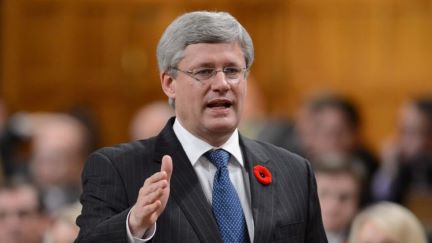
55E845F5BFECA4CC69881FF42DFD6_h243_w430_m2_q80_cEYBSqidjA cursory search on Google Images assures me that Prime Minister Stephen Harper has also been sporting his poppy lately. It’s nice that he has the option to pay tribute to our veterans with this photogenic little accessory, since dropping a quarter in a Canadian Legion box and picking up a poppy on a pin is a heck of a lot cheaper than supporting our surviving veterans through the Veterans Affairs Offices. Which is probably why nine of these offices are closing and elderly veterans in need of assistance are instead being directed to call 1-800 numbers and line up at Service Canada counters. CBC media personality Rick Mercer speaks very eloquently and passionately about this issue in his latest Rick’s Rant and his piece absolutely forms a large part of the context for this post:

I sometimes wonder if it’s all my fault. Like many people my age, I’m impatient with the older generations: Get out of the way, I think, I’m coming through! Give me your jobs and your electoral clout! The future is now, and it’s all for the young! With less and less surviving veterans in our midst every year, Canadian politicians can focus on that big juicy voting demographic they all love to court: middle-class families. Out of our way, grandpa! Yeah, you lost your friends and your youth and maybe your arm on the battlefield, but we want lower cellphone fees and roaming charges! (If you don’t believe lowering cellphone fees are one of our country’s top priorities, just take a look at the 2013 Throne Speech. Yes, “Supporting Our Armed Forces” is also one of the items mentioned, but it seems that our government has equated “support” with “we’ll ask you to do a lot of things for us in the Arctic and in return we’ll give you some new equipment to do things for us with”.)

When I was about 16 or so, I heard that an acquaintance and her high school choir had been permitted to perform Edwin Starr’s “War (What Is It Good For?)” at the school’s Remembrance Day function. I remember thinking at the time that that was so damn cool. I mean, WAR. Huh. What IS it good for?! ABSOLUTELY NOTHIN’!  War is stupid, and dying just because someone told you to is stupid, and killing people just because someone told you to is stupid. My friend and I used to crank the stereo in her parents’ car and just rock out. I love that song, and for the most part, I agree with its message. War means senseless death.

And yet…people fought anyways. My parents’ fathers fought anyways. Our veterans and their families probably don’t need a hit Motown song to tell them that war is a heart breaker, friend only to the undertaker (especially during a Remembrance Day ceremony, good god). They saw it. They know. And they did what they believed they had to do. Nowadays, we may be so privileged that we can’t understand this mindset (unless, of course, we are serving in Canada’s military or have loved ones who are), but that doesn’t mean we should rub this privilege in their faces. And it certainly doesn’t mean we can’t spare the money for the little bit of bureaucratic dignity that is their right.

Before I go any further, I should disclose the following:

  1. I cannot imagine a situation in which I would ever choose to see battle, to put myself in danger of being killed, or be required to kill another person.
  2. I would never want a loved one to join the Canadian Armed Forces because I don’t want them to kill people, and I don’t want them to die.

These two things being said, I still want and expect Canada’s military to protect me and my family, and to participate in conflicts overseas in a peacekeeping capacity. It is because I feel the way I do about my own participation in any kind of armed conflict that I feel anyone who does or did join up deserves so much respect–they did something I would never want to do, something I would never want a person I love to do (it’s also why I cry like a baby every November when I see the Silver Cross Mother on CBC). Was what happened to these men and women glorious? Was it honourable? It’s not for me to say, though in my personal belief system war is neither of those things. But our veterans (and the men and women currently serving) endured it anyways.

And now some of them are old. Very old. Over the years, they have seen friends and comrades pass away, and watched as society has quietly pushed them aside to make way for the things we want right now: tax breaks and lower monthly cellphone bills. We already know Canada’s greying population is going to cost us all a lot of money going forward–magazines like Maclean’s print dire warnings about it all the time. Dying is expensive. Dying with some shreds of your dignity still intact even more so. But a human being does not stop being a human being just because they are old and no longer drive the economic engine. A citizen does not stop being a citizen because they are no longer paying income taxes. And a veteran doesn’t stop being a hero just because there are fewer and fewer people alive who remember their sacrifices.

Remembrance Day is as good a time as any to remember that “remembering” is not passive, and wearing a poppy doesn’t cut it. Truly remembering another person’s sacrifice is an active way of being. It might mean our taxes are a little higher because we have the luxury to whine about roaming fees instead of living in fear that our child, sibling, spouse, or parent might not come home. It might mean our taxes are a little higher because we don’t have to worry that our government will put us in harm’s way to be a cog in some grand scheme happening on the other side of the ocean.

This Remembrance Day, instead of just showing up and receiving salutes, I would like our Prime Minister to encourage Canadians to actively remember the sacrifices of our veterans, and to trust that we want our veterans to spend their last years with the dignity they deserve, whatever the cost. You can’t put a price on human life, and we’ve already asked so many people to give up theirs.

I’m (Getting) Old(er than I used to be)

You get off my lawn.

You get off my lawn.

A few months ago, I found my first wrinkle. It had stealthily cozied up along the left side of my mouth pretending to be a smile line, but I eventually noticed that it is present whether I am smiling or not. Being a wrinkle. Breaking my heart a little bit.

People who know me may be surprised to learn how vain I am, especially since I’m incredibly lazy when it comes to my looks (I own a blow dryer but I use it maybe once a year, and I usually can’t be bothered to do simple things like throw on a pair of earrings for a night out). Despite not being very fashionable, the fact of the matter is that I am vain. Because I like the way I look, I can afford to be lazy, which is nice I guess (yay self-esteem!). And I don’t want the way I feel about myself to change just because I have a wrinkle. Or two.

I knew it would happen eventually, and I always imagined myself aging quite gracefully when the time came. I assumed that when I realized I had grown older I’d be in such a self-actualized place in my life I wouldn’t try to resist–I’d just throw my grey old hair in a bun and go with it. Wide brimmed sun hats! Glasses on a chain! Whooo! But maybe I’m not ready yet.

I am aware that 27 (and a half) is still young, but as 29-year-old “spinster” Valancy Stirling points out in L.M. Montgomery’s The Blue Castle, “Yes, I’m ‘still young’–but that’s so different from young.” And she’s right. To be young is to be unaware and unappreciative of your youth, to be in the process of blossoming with the promise of the best yet to come. To be still young implies that the sand in the hourglass is slipping swiftly through your fingers–to be still young is to be old soon. And it’s just not fair!

I didn’t have great skin in high-school, and I had not yet grown into my long limbs. The Teen and YM magazines I read all promised me that confidence and poise would come from being myself, and that my skin would be blemish-free once I was an adult. I clung to the idea that even if I wasn’t beautiful yet I would be someday. And my skin would be perfect. And I’d be a femme fatale. Or something. Even as I realized that the magazines had lied to me (sleep-deprived semi-impoverished stressed-out university students still get pimples, I’ll have you know), I held on to the dream. Eventually, my skin did clear up (mostly), and I did get better posture and self-awareness, and I did learn to comport myself with a little bit of grace, but even then I still believed, deep down inside, that a greater beauty awaited me. And I’m not talking about some kind of greater inner beauty that comes with wisdom and selflessness and spending one’s life in the service of others and blah blah blah. I’m talking a purely superficial, it’s-all-about-the-wrapping-paper kind of beauty. And now I’m realizing that whatever my greatest moment of superficial beauty was, it’s already happened. I may still be a big bloomy blossom, but my petals are starting to droop. Sigh.

Which I know is okay. Adults who are older than me will think I’m being awfully stupid and I am. But I don’t think I really realized how much “being young” has been part of my identity until I found this little wrinkle, and understood that youth really is fleeting. “Gather your rosebuds while ye may” goes the old refrain, and it looks like I’m just about out of rosebuds. At some point, I won’t be a “young woman” anymore, I’ll be a “woman”. And then a “middle-aged woman” and then an “old woman”.  And then dead, I guess, though at that point wrinkles will no longer be a problem.

My little tempest in a teapot has demonstrated to me that my own ideas of both age and beauty could use some reevaluation. As much as I like to think I am impervious to the dreaded “media” and their “ideals” of beauty (especially since I no longer subscribe to Teen), on some level it has registered that today’s young starlets are younger than me, not older, and on some level I think that bothers me. There goes my chance to be on the Disney channel.

I am also getting the strong feeling that ours is a culture that places extraordinary value on the achievements of the young, and on achieving while you’re young. Of course young people should be encouraged, but I don’t want to feel that my time to make a mark for myself is over just because I can no longer be a child prodigy. I’m tired of seeing internet bucket lists of things I must do and places I must travel before I’m 30 (btw, internet lists are usually written by people like me, who are not necessarily any more qualified or wise than anyone else but who have a  laptop and an internet connection and some time on their hands, so I wouldn’t take them too seriously). I’m tired of being told there are things I must do before I have children (bullshit–my parents did tons of cool stuff while they had us, though not without more effort I presume). The fact of the matter is that people are living longer than ever, which means the percentage of our lives that will be spent being “young” is going to be smaller and smaller. If we believe that we are done learning, done exploring, done being physical (in every sense of the word) and done being beautiful just because we are not “young” anymore, we’re going to spend most of our long lives jealous and miserable and buying shit we don’t need.

Cheers to new adventures!

Cheers to new adventures!

Which is stupid. Alice Munro just won the Nobel Prize for Literature, and she’s in her 80s. Assuming my good luck holds, I have decades of life in which to grow and have adventures and become good at whatever it is I do (which is not to say I can spend my remaining “youth” doing nothing, but just that I don’t need all my life to happen now now now).

As for my wrinkle, I’ll try to remember to wear more sunscreen and otherwise not worry about it. The only person I really feel I need to be attractive to (besides myself) is my fiance, and TC’s not a superficial person. Besides, we’ve spent so much time in the sun that eventually, we’ll both look like a couple of old leather bags anyways. Which is fine by me, as long as we’re together (and as long as we’re sun smart!).

Sometimes, it takes an early wrinkle to remind you that you’re still growing up. All the time. Every day. Which is fantastic. Now where are my glasses on a chain?